How to Calculate and Reduce Multi-Cloud Egress Costs in 2026
Learn how to model, forecast, and structurally reduce data egress fees when operating across multiple cloud providers.

Make email marketing simplified

Make email marketing simplified

Make email marketing simplified

Make email marketing simplified

Make email marketing simplified

Make email marketing simplified

Make email marketing simplified

Make email marketing simplified

Make email marketing simplified

Make email marketing simplified

Make email marketing simplified

Make email marketing simplified

Make email marketing simplified

Make email marketing simplified

Make email marketing simplified

We use cookies for our website to give you the most relevant experience by remembering your preferences. By clicking “accept”, you consent to use of ALL the cookies
This website uses cookies to improve your experience while you navigate through the website. Out of these, the cookies that are categorized as necessary are stored on your browser as they are essential for the working of basic functionalities of the website. We also use third-party cookies that help us analyze and understand how you use this website. These cookies will be stored in your browser only with your consent. You also have the option to opt-out of these cookies. But opting out of some of these cookies may affect your browsing experience.
Necessary cookies are absolutely essential for the website to function properly. These cookies ensure basic functionalities and security features of the website, anonymously.
| Cookie | Duration | Description |
|---|---|---|
| cookielawinfo-checkbox-functional | 11 months | This cookie is set by GDPR Cookie Consent plugin. The cookie is used to store the user consent for the cookies in the category “Analytics”. |
| cookielawinfo-checkbox-functional | 11 months | The cookie is set by GDPR cookie consent to record the user consent for the cookies in the category “Functional”. |
| cookielawinfo-checkbox-necessary | 11 months | This cookie is set by GDPR Cookie Consent plugin. The cookies is used to store the user consent for the cookies in the category “Necessary”. |
| cookielawinfo-checkbox-others | 11 months | This cookie is set by GDPR Cookie Consent plugin. The cookie is used to store the user consent for the cookies in the category “Other. |
| cookielawinfo-checkbox-performance | 11 months | This cookie is set by GDPR Cookie Consent plugin. The cookie is used to store the user consent for the cookies in the category “Performance”. |
| viewed_cookie_policy | 11 months | The cookie is set by the GDPR Cookie Consent plugin and is used to store whether or not user has consented to the use of cookies. It does not store any personal data. |
Functional cookies help to perform certain functionalities like sharing the content of the website on social media platforms, collect feedbacks, and other third-party features.
Performance cookies are used to understand and analyze the key performance indexes of the website which helps in delivering a better user experience for the visitors.
Analytical cookies are used to understand how visitors interact with the website. These cookies help provide information on metrics the number of visitors, bounce rate, traffic source, etc.
Advertisement cookies are used to provide visitors with relevant ads and marketing campaigns. These cookies track visitors across websites and collect information to provide customized ads.
Other uncategorized cookies are those that are being analyzed and have not been classified into a category as yet.
Cyberia Tech, Inc. respects your privacy. This Privacy Policy explains how we collect, use, and share your information. By using our services, you agree to this policy. If any other agreements conflict with this Privacy Policy, the terms of those agreements prevail.
Cyberia Tech complies with the EU-US and Swiss-US Privacy Shield Frameworks for handling personal data from the EEA, UK, and Switzerland. In case of any conflict, the Privacy Shield Principles prevail. Learn more at Privacy Shield. Key Definitions
Information linked to an individual, transferred from the EEA, UK, or Switzerland to the U.S.
Data revealing race, religion, health, sexual orientation, and similar categories.
Effective Date: [ 2026 / 11 / 26 ]
Welcome to The Cyberia Tech ! By accessing or using our website or services, you agree to
comply with and be bound by these Terms of Use and our Privacy Policy. If you do not agree with
these terms, please do not use our Services.
Loading
0 %
Your First Piece of the Puzzle in
Business Growth



Cloud networking architecture is the blueprint of virtual routing, subnet topologies, security boundaries, and interconnect fabrics that govern packet transit across cloud environments and on-premises systems. This engineering guide provides cloud architects, systems engineers, and technology leaders with production-tested models for routing isolation, cross-zone transfer cost reduction, egress billing optimization, and hybrid transport performance.
Enterprise cloud infrastructure has shifted from simple perimeter topologies to complex, distributed networks. Modern distributed systems run across microservice meshes, multi-tenant Kubernetes clusters, hybrid bare-metal footprints, and multi-region data planes. According to Amazon Web Services in 2026, foundational cloud network components carry isolated per-gigabyte charges that compound rapidly when traffic flows across subnets, zones, and boundary firewalls. Building a scalable deployment requires evaluating exact byte costs, packet fragmentation ceilings, and stateful traffic paths. This guide establishes the topological models and structural formulas required to build resilient, cost-governed network backbones.
A hub-and-spoke topology consolidates routing, perimeter inspection, and on-premises connectivity into a centralized transit core, whereas a mesh topology connects individual virtual private clouds directly through point-to-point peering. Hub-and-spoke networks scale predictably because each new VPC requires only a single connection to the central hub. Adding a spoke VPC requires one routing relationship rather than an exponential mesh of distinct connections.
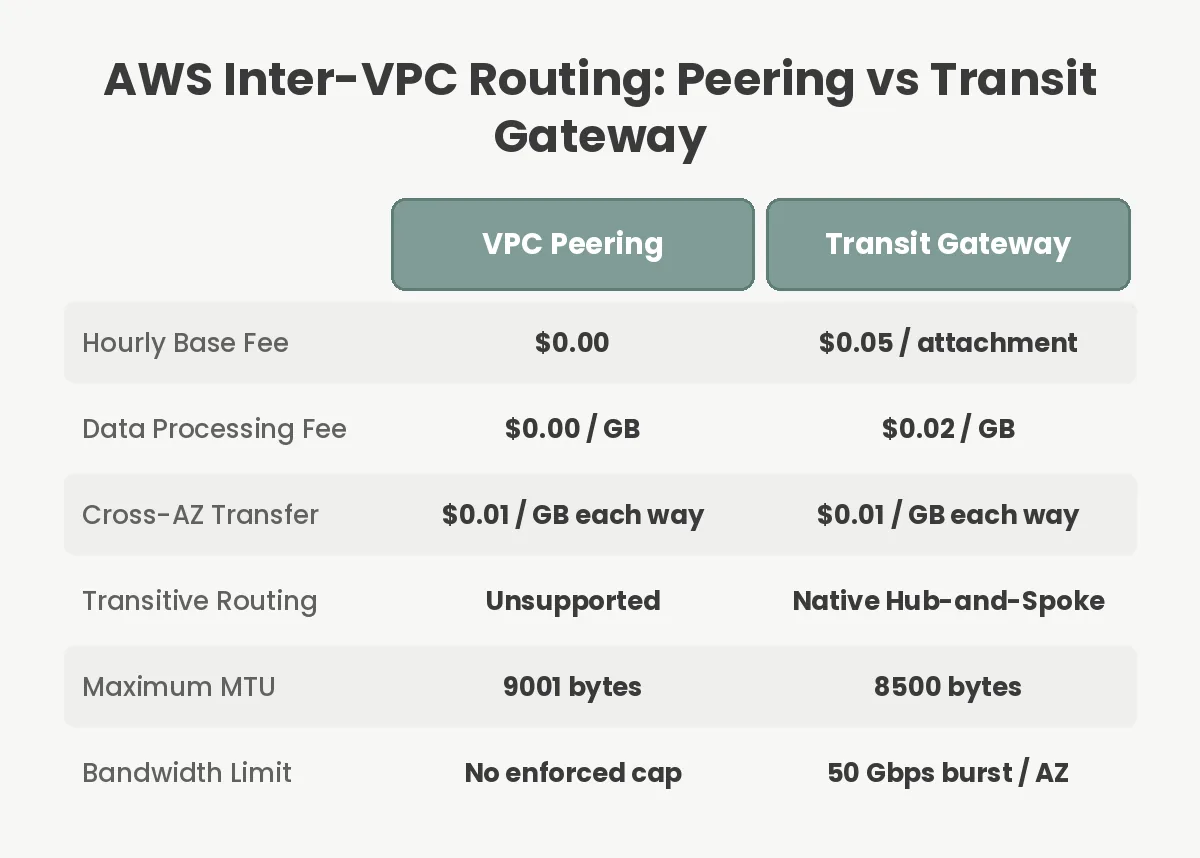
Mesh networks rely on point-to-point connections. VPC Peering is a 1:1 networking connection between two VPCs that allows direct, non-transitive traffic routing over private AWS backbone infrastructure with no intermediate hops. Because peering connections cannot chain traffic transitively, connecting 50 VPCs requires up to 1,225 individual peering links. Transit Gateway is a regional, highly available network transit hub that routes traffic across multiple Amazon VPCs, Direct Connect links, and VPN connections using hub-and-spoke topologies and isolated route tables. This hub model abstracts routing complexity into isolated route tables, allowing security teams to define centralized policies for north-south internet egress and east-west inter-VPC transit.
The architectural trade-off centers on latency, throughput, and operational overhead. VPC peering introduces zero additional latency hops and delivers line-rate throughput bounded only by the underlying EC2 instance types. Transit Gateway introduces an intermediate routing hop that adds between 0.2 and 0.8 milliseconds of latency depending on instance placement. For engineering teams evaluating scaling boundaries and operational overhead, our technical comparison between AWS Transit Gateway vs VPC Peering details routing limits, latency benchmarks, and break-even financial thresholds.
A zero-egress cloud network architecture eliminates unmonitored outbound internet paths by enforcing strict topological containment, localized private routing, and in-zone service placement. Zero-egress designs terminate network flows within private boundary subnets using explicit interface configurations rather than open internet gateways. Data transfer out to the public internet carries a base charge of $0.09 per gigabyte in US regions after a 100 GB global free allowance according to EgressCost.com in 2026, creating substantial operational penalties for unmonitored application traffic.
Designing for zero unexpected egress requires three foundational mechanisms: strict private subnet routing tables without default 0.0.0.0/0 routes pointing to an Internet Gateway, DNS interception via Route 53 Resolver rules, and localized microservice clustering. When microservices communicate across boundaries, keeping traffic within localized compute nodes eliminates external internet routing layers. To build this isolation inside production environments, read our complete implementation guide on how to design a zero-egress cloud network architecture with private subnets and routing boundaries.
A resilient Virtual Private Cloud requires a non-overlapping IP addressing plan that reserves sufficient host capacity for container orchestration systems while preserving contiguous blocks for hybrid routing. Virtual Private Cloud (VPC) subnets cannot be resized dynamically once allocated, making early address planning a critical architectural step.
Subnets must follow functional tiers segregated across Availability Zones (AZs). Production architectures allocate separate tier subnets: public ingress tiers for load balancers, application tiers for compute runtimes, data tiers for persistent storage engines, and dedicated transit subnets for gateway endpoints. Amazon Web Services documentation in 2026 confirms that AWS reserves the first four IP addresses and the last IP address of every subnet CIDR block. A /28 subnet containing 16 theoretical addresses yields only 11 usable IP addresses for Elastic Network Interfaces (ENIs).
Container orchestrators such as Amazon Elastic Kubernetes Service (EKS) deploy network plugins that assign dedicated VPC IP addresses to every running pod. An organization that assigns an overly narrow /24 CIDR block to an application subnet will exhaust all 251 usable IP addresses after scaling a dozen container deployments. Best-practice cloud network architecture allocates a private RFC 1918 supernet—such as 10.0.0.0/16 or 10.128.0.0/16—and carves out /20 subnets (4,091 usable IPs) for core compute workloads, while assigning /24 or /28 blocks to load balancing and transit tiers.
Cross-Availability Zone data transfer charges double on customer invoices because AWS bills inter-zone traffic symmetrically at $0.01 per gigabyte on outbound egress and $0.01 per gigabyte on inbound ingress, resulting in a cumulative $0.02 per gigabyte transfer penalty. Documented in the AWS Inter-AZ Data Transfer Costs guide published in 2026, this fee applies to all traffic crossing physical AZ boundaries, including database replication, distributed cache synchronization, and load-balanced microservice calls.
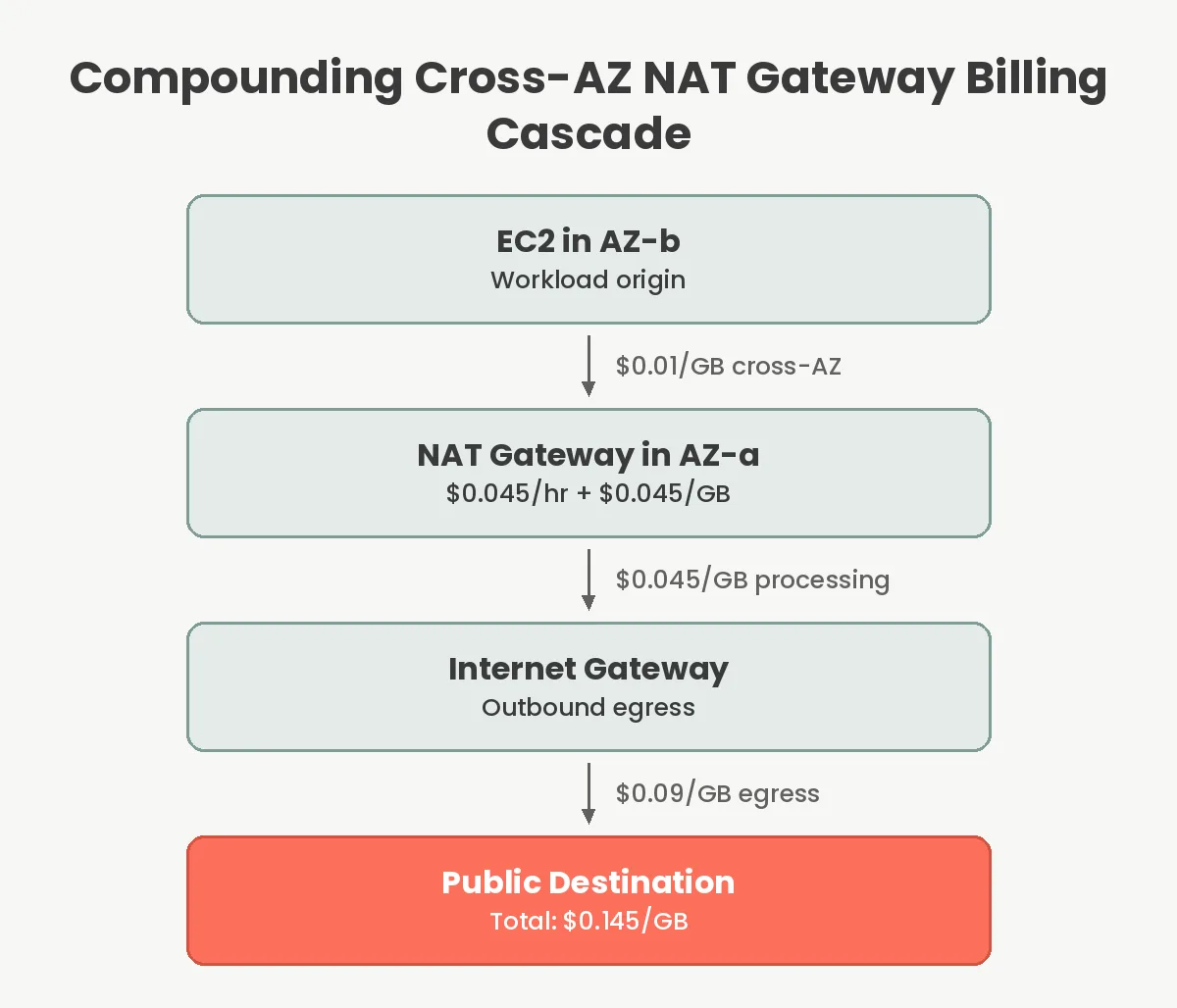
Managed NAT Gateways amplify these expenses. Amazon Web Services bills a fixed base rate of $0.045 per hour per running NAT Gateway (approximately $32.85 per month) alongside a $0.045 per gigabyte data processing fee according to Spendark’s AWS Data Transfer Cost report in 2026. When an EC2 instance in Availability Zone B communicates with the internet through a centralized NAT Gateway deployed in Availability Zone A, the underlying packets incur an extra cross-AZ charge to reach the gateway, the NAT processing charge, and standard internet data transfer egress. A 10 terabyte workload routed through this topology generates $100 in cross-AZ charges, $450 in NAT processing charges, and $900 in outbound egress charges under 2026 Spendark pricing metrics.
You avoid NAT Gateway data processing charges by routing traffic over Gateway VPC Endpoints for S3 and DynamoDB and deploying Interface VPC Endpoints for other AWS dependencies. Gateway VPC Endpoint is a managed VPC routing table entry that directs outbound traffic destined for AWS S3 or DynamoDB directly to the service over private AWS infrastructure with zero data transfer fees. Replacing NAT routes with Gateway Endpoints immediately reduces transfer costs on object storage operations from $0.045 per gigabyte to $0.00 according to Amazon Web Services pricing in 2026.
For services outside S3 and DynamoDB, PrivateLink (Interface Endpoint) provides a private endpoint powered by a dedicated Elastic Network Interface (ENI) using private IPs within a subnet to privately connect workloads to managed AWS services or third-party SaaS without traversing an Internet Gateway. Interface Endpoints carry an hourly baseline fee of $0.01 per Availability Zone and a data processing cost of $0.01 per gigabyte as detailed by Hykell’s VPC endpoint cost study in 2026. Because Interface Endpoints bill at $0.01 per gigabyte compared to the $0.045 per gigabyte NAT Gateway fee, organizations processing high data volumes achieve an immediate 77% processing cost reduction per gigabyte as calculated in Hykell’s 2026 analysis. Teams seeking to optimize this trade-off can follow our teardown on how to reduce AWS NAT Gateway costs with VPC endpoints.
AWS Direct Connect and AWS Site-to-Site VPN can operate as mutual failover paths when dynamic Border Gateway Protocol (BGP) routing is configured to prefer the direct private connection. Choosing the primary interconnect between AWS Direct Connect and AWS Site-to-Site VPN depends on required bandwidth consistency, encryption models, and total data transfer volume.
AWS Site-to-Site VPN establishes IPsec tunnels over standard internet routes at a base charge of $0.05 per hour per connection according to Amazon Web Services pricing in 2026. Amazon Web Services documentation published in November 2025 confirms that while legacy VPN configurations capped single-tunnel throughput at 1.25 Gbps, Large Bandwidth Tunnels support up to 5 Gbps per tunnel using IPsec. However, VPN traffic still incurs standard internet data egress rates starting at $0.09 per gigabyte in 2026. AWS Direct Connect bypasses the public internet completely by provisioning dedicated physical cross-connects at colocation facilities, dropping outbound transfer charges down to $0.02 per gigabyte in US and European locations as reported by EgressCost.com in 2026.
Dedicated Direct Connect ports cost $0.30 per hour for 1 Gbps, $2.25 per hour for 10 Gbps, and $22.50 per hour for 100 Gbps as documented by Amazon Web Services in 2026. On September 15, 2026, the AWS News Blog announced that AWS introduced flat-rate pricing for 10 Gbps and 100 Gbps dedicated Direct Connect connections, offering an all-inclusive hourly rate that eliminates per-gigabyte egress fees and includes a redundant port-pair at no additional cost. To determine throughput limits, failover behaviors, and hardware requirements for your hybrid footprint, read our complete guide comparing AWS Direct Connect vs Site-to-Site VPN.
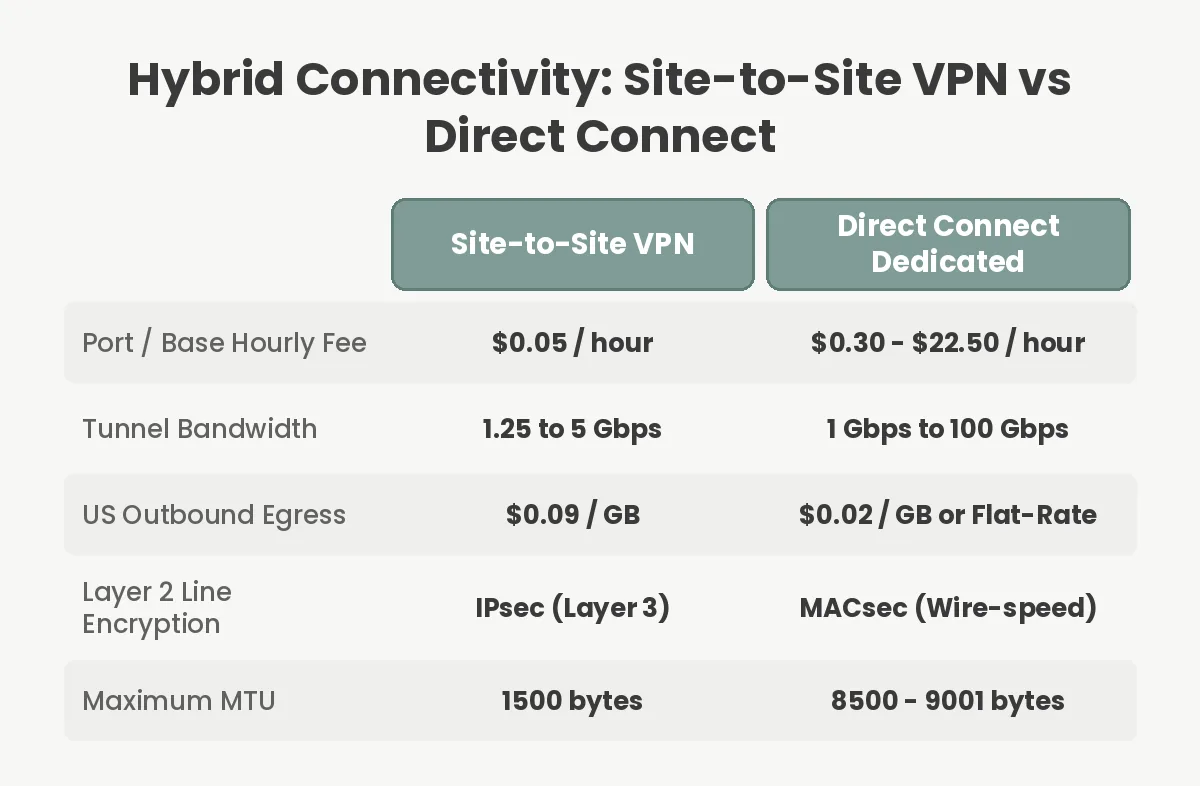
Selecting the optimal network interconnect requires balancing bandwidth capacity, MTU limits, capital commitments, and egress rate discounts. The following comparison matrix analyzes the technical specifications of primary enterprise cloud networking patterns.
| Architecture Pattern | Base Hourly Cost | Per-GB Processing Fee | Throughput Ceiling | Max Supported MTU | Target Use Case |
|---|---|---|---|---|---|
| VPC Peering | $0.00 | $0.00 | Line-rate (No cap) | 9001 bytes | High-throughput intra-region microservices |
| AWS Transit Gateway | $0.05 / attachment | $0.02 / GB | 50 Gbps burst / AZ | 8500 bytes | Hub-and-spoke multi-account topologies |
| Gateway VPC Endpoint | $0.00 | $0.00 | Line-rate (No cap) | 9001 bytes | Zero-cost S3 and DynamoDB data transfer |
| Interface Endpoint (PrivateLink) | $0.01 / AZ | $0.01 / GB | Up to 100 Gbps | 8500 bytes | Private AWS and third-party SaaS integration |
| Site-to-Site VPN (Large Bandwidth) | $0.05 / connection | $0.09 / GB (Internet DTO) | 5.0 Gbps per tunnel | 1500 bytes | Encrypted, lower-volume hybrid transit |
| Direct Connect Dedicated | $0.30 to $22.50 | $0.02 / GB (or Flat-Rate) | 1 Gbps to 100 Gbps | 8500 – 9001 bytes | Enterprise high-volume hybrid interconnects |

Asymmetric routing across multi-AZ topologies causes centralized stateful firewalls to drop return packets when outbound and inbound paths hit different inspection instances. When traffic enters an inspection hub, firewalls track connection state using TCP sequence numbers and flags. If outbound traffic enters through a firewall in Availability Zone A, but the return packet routes back through a firewall in Availability Zone B, the second firewall rejects the packet as an invalid state transition.
AWS resolves this asymmetric behavior using Appliance Mode. Appliance Mode is a configuration on a Transit Gateway VPC attachment that forces bidirectional traffic flows through the exact same Availability Zone network interface to preserve state in stateful inspection firewalls. Enabling Appliance Mode on the transit gateway attachment pointing to the inspection VPC ensures that both forward and reverse flows pass through the same Elastic Network Interface, maintaining stateful table integrity.
Path MTU Discovery (PMTUD) is a network protocol mechanism using ICMP “Fragmentation Needed” feedback to discover and negotiate the largest packet size supported across all hops of an IP network path. If intermediate network appliances or security groups drop ICMP Type 3 Code 4 messages, endpoints cannot discover downsized MTU limits. Because Amazon Web Services documentation in 2025 records that Transit Gateway supports an MTU of 8500 bytes while EC2 instances default to 9001 bytes, dropped ICMP messages cause packets between 8501 and 9001 bytes to be discarded silently, freezing application connections during large payload transfers.
Securing modern enterprise VPC networks requires layering network access control lists (NACLs), security groups, and Layer 7 inspection engines to enforce defense in depth. Stateless NACLs evaluate rules at the subnet boundary without tracking session state, while stateful security groups track TCP and UDP connection states directly at the individual virtual network interface.
Zero-trust architectures extend beyond traditional IP-based firewalls. In modern software environments, perimeter IP filtering cannot prevent lateral movement once a private subnet is breached. Zero Trust Network Access (ZTNA) terminates transport sessions at Layer 7, enforcing cryptographic identity and contextual device posture checks on every single request. Teams replacing legacy perimeter bastions can review our architecture breakdown of ZTNA vs VPN for securing modern web apps to eliminate network-level blast radiuses.
Auditing security boundaries requires systematic evaluation of routing tables, peering trust relationships, and egress filters. To prevent unauthorized data exfiltration and verify your boundary controls against production hardening benchmarks, execute the steps outlined in our enterprise cloud network security checklist.
Modern high-throughput Kubernetes clusters and container networks are transitioning from legacy Linux iptables packet filtering to extended Berkeley Packet Filter (eBPF) data planes. Netfilter and iptables process network packets sequentially through linear rule chains. In large container clusters running tens of thousands of services, evaluating sequential iptables rules consumes excessive CPU cycles and drives packet processing latency higher.
eBPF replaces linear iptables evaluation with constant-time O(1) hash table lookups executed directly within the Linux kernel sandbox. Network plugins like Cilium leverage eBPF to bypass substantial portions of the standard host network stack, streaming packets directly from the network interface to container sockets. To see how kernel-level packet processing eliminates throughput bottlenecks in containerized architectures, explore our comparative analysis on eBPF vs iptables for Kubernetes networking.
Edge ingress architectures are shifting from standard TCP-based HTTP/2 to UDP-based HTTP/3 using the QUIC transport protocol. HTTP/3 resolves head-of-line blocking by multiplexing streams over independent UDP channels, ensuring that packet loss on one stream does not stall concurrent data streams. Furthermore, QUIC combines transport and cryptographic handshakes into a unified sequence to establish zero round-trip time (0-RTT) connection resumption.
Adopting HTTP/3 introduces distinct operational challenges inside cloud VPCs. Many enterprise firewall appliances, middleboxes, and cloud security groups rate-limit or discard high-volume UDP traffic on port 443 by default. Additionally, UDP packet processing historically incurs higher CPU utilization in host operating systems than TCP due to the absence of hardware-based Segmentation Offload on legacy virtual network drivers. Engineers evaluating protocol transitions should review our performance analysis on HTTP/3 and QUIC performance in modern web apps.
At the application gateway layer, selecting the correct reverse proxy determines how incoming client requests map into private microservice VPCs. Infrastructure teams evaluating modern ingress engines can review our benchmark guide comparing Caddy vs NGINX for modern web application performance to assess automated TLS orchestration, memory footings, and event-driven worker architectures.
Production cloud outages and cost overruns frequently trace back to foundational routing misconfigurations. Identifying these failure modes during architecture reviews prevents catastrophic production degradation.
The seven most frequent cloud networking mistakes observed across enterprise environments include:
/24 in container-dense environments causes rapid IP exhaustion when running Amazon VPC CNI.For an expanded breakdown of remediation strategies and step-by-step routing fixes, read our detailed technical review of costly VPC subnet and routing mistakes in production.
AWS Transit Gateway is the wrong architectural choice when an organization operates fewer than five VPCs with simple interconnectivity requirements and high data transit volumes. Amazon Web Services documentation in 2026 outlines that Transit Gateway imposes a flat $0.05 per hour charge per attachment ($36.50 per month per VPC) alongside a $0.02 per gigabyte data processing fee. For high-throughput analytics, machine learning training clusters, or database replication topologies that move 100 terabytes of data monthly between two VPCs, Transit Gateway processing fees add $2,000 to the monthly cloud bill according to 2026 AWS pricing rates.
Under these conditions, direct VPC Peering is technically and financially superior. VPC Peering carries no base hourly attachment fee and zero per-gigabyte processing charges. Traffic crossing a peering link incurs only standard cross-AZ transfer fees ($0.01 per gigabyte each way as confirmed by Amazon Web Services in 2026) if the source and destination reside in different Availability Zones. Furthermore, Amazon Web Services documentation in 2024 notes that Transit Gateway enforces a hard burst bandwidth limit of 50 Gbps per VPC attachment per Availability Zone. Systems requiring higher inter-service throughput—such as distributed vector search engines feeding large language models—scale more effectively across VPC peering links that support line-rate instance hardware speeds without transit processing throttles. When architecting AI data pipelines, teams often weigh these throughput constraints alongside vector database patterns; see our guide on pgvector vs dedicated vector databases for infrastructure sizing context.
When high-volume transfer costs across cloud infrastructure exceed manageable operational margins, some enterprises evaluate physical repatriation. Moving persistent petabyte-scale workloads to leased colocation facilities eliminates variable cloud transit costs in favor of fixed-rate unmetered 100 Gbps cross-connects. Our analytical breakdown on cloud repatriation economics and bare-metal infrastructure details the precise data transfer break-even thresholds for this transition.

Navigating cloud networking decisions requires evaluating topology complexity, compliance inspection requirements, monthly data volumes, and hybrid latency demands. Follow this step-by-step decision sequence to establish your production network architecture.
| Stage | Primary Requirement | Recommended Architecture | Key Configuration Action |
|---|---|---|---|
| 1. IP Supernet Planning | Multi-account non-overlapping CIDR allocation | RFC 1918 Private Supernet (/16 per region) | Carve out /20 subnets for container runtimes and /24 for gateway services. |
| 2. Internal Interconnect | Low volume, <5 VPCs, high bandwidth | Full-Mesh VPC Peering | Configure non-transitive route tables; enforce 9001-byte MTU. |
| 3. Enterprise Interconnect | >5 VPCs, centralized policy, compliance | Hub-and-Spoke Transit Gateway | Isolate security route tables; enforce 8500-byte MTU limit. |
| 4. Storage & AWS Services | High-volume Amazon S3 or DynamoDB access | Gateway VPC Endpoints | Inject route table prefix lists to bypass NAT Gateway fees entirely. |
| 5. External Egress | Private subnets accessing public APIs | Multi-AZ Managed NAT Gateways | Deploy one NAT Gateway per active Availability Zone to prevent cross-AZ hairpins. |
| 6. Firewall Inspection | Stateful inline threat inspection | Dedicated Inspection VPC Hub | Enable Transit Gateway Appliance Mode to prevent asymmetric packet drops. |
| 7. Hybrid On-Premises | Bandwidth >1 Gbps, high monthly transfer | AWS Direct Connect Dedicated | Provision redundant cross-connects; evaluate flat-rate pricing to eliminate egress fees. |
Establishing an enterprise cloud networking architecture requires balancing operational simplicity against data-plane transit costs. Organizations operating microservice architectures across a small fleet of VPCs should prioritize direct VPC peering and Gateway VPC Endpoints to avoid unnecessary transit hub and NAT processing charges. Enterprises managing complex multi-account environments with strict compliance auditing should deploy a Transit Gateway hub-and-spoke model, verifying that Appliance Mode is active and that subnets are zone-aligned to eliminate compounding cross-AZ hairpins.
For engineering teams optimizing their existing AWS cloud footprint, begin by reading our deep dive on reducing NAT Gateway costs with VPC endpoints. Infrastructure architects designing hybrid connections to on-premises data centers should proceed to our analysis of Direct Connect vs Site-to-Site VPN architectures.
Yes, AWS Transit Gateway introduces between 0.2 and 0.8 milliseconds of additional latency compared to VPC peering. Transit Gateway routes traffic through an intermediate software-defined transit hub, whereas VPC peering connects compute instances directly over the private AWS backbone without intermediate routing hops.
You avoid NAT Gateway data processing charges by deploying Gateway VPC Endpoints for Amazon S3 and DynamoDB at zero cost. For other AWS services or internal endpoints, deploying Interface VPC Endpoints reduces the data processing charge from $0.045 per gigabyte to $0.01 per gigabyte.
AWS cross-AZ data transfer is billed symmetrically at $0.01 per gigabyte for outbound egress and $0.01 per gigabyte for inbound ingress. This creates a combined round-trip fee of $0.02 per gigabyte for all network traffic crossing physical Availability Zone boundaries within the same AWS region.
Yes, AWS Site-to-Site VPN can function as an automatic cost-effective backup for AWS Direct Connect links by using BGP routing. Enterprise networks configure Border Gateway Protocol with autonomous system path prepending to prioritize the low-latency Direct Connect circuit over the secondary IPsec VPN tunnel during standard operations.
Asymmetric routing causes stateful firewalls to drop return traffic when outbound and inbound packets traverse different Availability Zone interfaces. Enabling Appliance Mode on the Transit Gateway VPC attachment forces bidirectional traffic through the same Availability Zone Elastic Network Interface, maintaining session state across inspection appliances.
You Can Get More Information!