ZTNA vs VPN: Securing Modern Web App Infrastructure
Zero Trust Network Access (ZTNA) differs from traditional VPNs by...

Make email marketing simplified

Make email marketing simplified

Make email marketing simplified

Make email marketing simplified

Make email marketing simplified

Make email marketing simplified

Make email marketing simplified

Make email marketing simplified

Make email marketing simplified

Make email marketing simplified

Make email marketing simplified

Make email marketing simplified

Make email marketing simplified

Make email marketing simplified

Make email marketing simplified

We use cookies for our website to give you the most relevant experience by remembering your preferences. By clicking “accept”, you consent to use of ALL the cookies
This website uses cookies to improve your experience while you navigate through the website. Out of these, the cookies that are categorized as necessary are stored on your browser as they are essential for the working of basic functionalities of the website. We also use third-party cookies that help us analyze and understand how you use this website. These cookies will be stored in your browser only with your consent. You also have the option to opt-out of these cookies. But opting out of some of these cookies may affect your browsing experience.
Necessary cookies are absolutely essential for the website to function properly. These cookies ensure basic functionalities and security features of the website, anonymously.
| Cookie | Duration | Description |
|---|---|---|
| cookielawinfo-checkbox-functional | 11 months | This cookie is set by GDPR Cookie Consent plugin. The cookie is used to store the user consent for the cookies in the category “Analytics”. |
| cookielawinfo-checkbox-functional | 11 months | The cookie is set by GDPR cookie consent to record the user consent for the cookies in the category “Functional”. |
| cookielawinfo-checkbox-necessary | 11 months | This cookie is set by GDPR Cookie Consent plugin. The cookies is used to store the user consent for the cookies in the category “Necessary”. |
| cookielawinfo-checkbox-others | 11 months | This cookie is set by GDPR Cookie Consent plugin. The cookie is used to store the user consent for the cookies in the category “Other. |
| cookielawinfo-checkbox-performance | 11 months | This cookie is set by GDPR Cookie Consent plugin. The cookie is used to store the user consent for the cookies in the category “Performance”. |
| viewed_cookie_policy | 11 months | The cookie is set by the GDPR Cookie Consent plugin and is used to store whether or not user has consented to the use of cookies. It does not store any personal data. |
Functional cookies help to perform certain functionalities like sharing the content of the website on social media platforms, collect feedbacks, and other third-party features.
Performance cookies are used to understand and analyze the key performance indexes of the website which helps in delivering a better user experience for the visitors.
Analytical cookies are used to understand how visitors interact with the website. These cookies help provide information on metrics the number of visitors, bounce rate, traffic source, etc.
Advertisement cookies are used to provide visitors with relevant ads and marketing campaigns. These cookies track visitors across websites and collect information to provide customized ads.
Other uncategorized cookies are those that are being analyzed and have not been classified into a category as yet.
Cyberia Tech, Inc. respects your privacy. This Privacy Policy explains how we collect, use, and share your information. By using our services, you agree to this policy. If any other agreements conflict with this Privacy Policy, the terms of those agreements prevail.
Cyberia Tech complies with the EU-US and Swiss-US Privacy Shield Frameworks for handling personal data from the EEA, UK, and Switzerland. In case of any conflict, the Privacy Shield Principles prevail. Learn more at Privacy Shield. Key Definitions
Information linked to an individual, transferred from the EEA, UK, or Switzerland to the U.S.
Data revealing race, religion, health, sexual orientation, and similar categories.
Effective Date: [ 2026 / 10 / 11 ]
Welcome to The Cyberia Tech ! By accessing or using our website or services, you agree to
comply with and be bound by these Terms of Use and our Privacy Policy. If you do not agree with
these terms, please do not use our Services.
Loading
0 %
Your First Piece of the Puzzle in
Business Growth



Zero Trust Network Access (ZTNA) differs from traditional VPNs by shifting access control from the network layer (Layer 3) to the application layer (Layer 7). While VPNs grant broad subnet access once authenticated, ZTNA evaluates trust on a per-request basis, continuously verifying identity and device context before granting access to specific web applications.
Relying on perimeter defense for internal web applications introduces systemic risk. When a compromised credential opens an IPsec tunnel into your network, the attacker gains lateral visibility across the entire subnet. According to IBM’s 2024 Cost of a Data Breach Report, organizations deploying mature zero-trust architectures reduced their average breach cost by $1.76 million compared to those relying on legacy perimeter models. The decision to migrate infrastructure access is not about enabling remote work; it is about containing blast radiuses when endpoints inevitably fail.
VPNs operate at Layer 3 of the OSI model. When a client authenticates via IKEv2 or OpenVPN, the VPN gateway assigns an internal IP address and routes traffic into a designated VLAN or subnet. The gateway acts as a router. It does not inspect the HTTP requests passing through the tunnel; it forwards IP packets based on routing tables. If a user has access to the subnet, they have network-level reachability to every server attached to it.
ZTNA shifts this enforcement to Layer 7. Instead of connecting a user to a network, ZTNA connects a user to a specific application via an identity-aware proxy. Before passing a request to backend bespoke enterprise software, the proxy queries a central policy engine. It inspects the HTTP headers, validates the JSON Web Token (JWT) or SAML assertion, and checks endpoint telemetry.
The distinction is absolute. A VPN provides a wire; ZTNA provides a reverse proxy. This fundamental shift eliminates the concept of ‘trusted internal networks’ entirely.
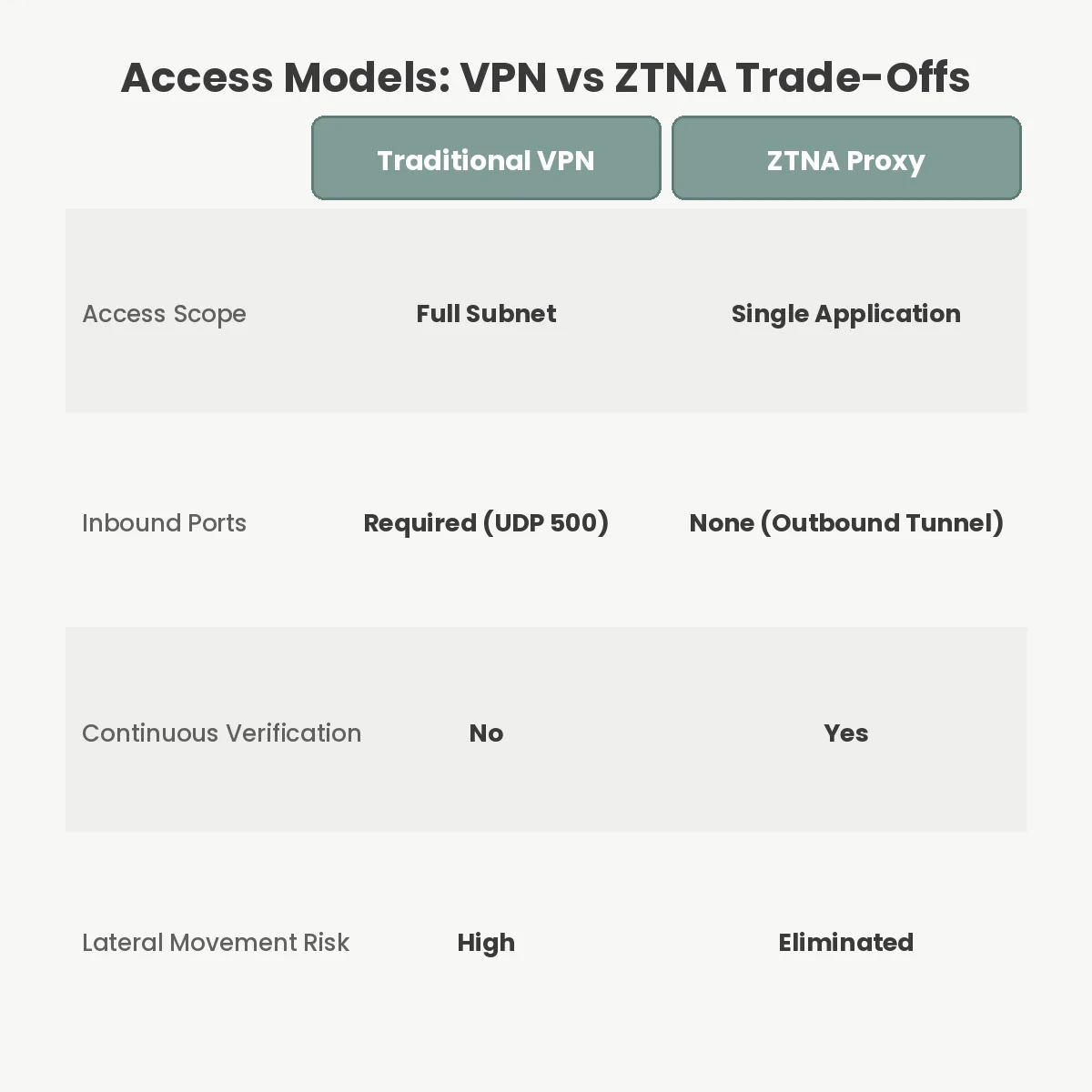
| Architecture Attribute | IPsec VPN (Legacy) | ZTNA (Modern) |
|---|---|---|
| OSI Layer Focus | Layer 3 (Network) | Layer 7 (Application) |
| Access Scope | Subnet / VLAN | Per-Application / Per-URI |
| Validation Frequency | Once (At Connection) | Continuous (Per Request) |
| Inbound Firewall Ports | Required (UDP 500/4500) | None (Outbound Tunnels) |
The most critical failure mode of a traditional VPN is lateral movement. Once an endpoint establishes a tunnel, malware on that device can scan the internal network using basic ICMP sweeps or port scanners. The VPN concentrator blindly routes this reconnaissance traffic because the tunnel is authenticated.
Because ZTNA operates as an explicit proxy, there is no routable path between the client and the underlying server infrastructure. An infected endpoint cannot run a port scan against a ZTNA-protected database server because the database server does not expose an IP address to the client. The only exposed interface is the specific HTTPS endpoint defined in the policy.
If an attacker attempts to access a different application, the DNS request will fail to resolve, or the proxy will drop the connection before the TCP handshake with the backend server even begins. This architectural hard break isolates compromised devices instantly.
VPNs historically suffer from hairpinning. A user in London accessing a cloud-hosted application in Frankfurt might be forced to route traffic through a central VPN concentrator in New York, adding hundreds of milliseconds of latency overhead to every TCP round trip.
ZTNA architectures typically distribute their enforcement nodes globally. Because ZTNA relies on standard TLS 1.3 rather than heavy IPsec encapsulation, traffic terminates at an edge node physically close to the user. The edge node verifies identity and then routes the traffic to the application over an optimized, pre-warmed backbone.
Furthermore, standard web traffic runs over TCP or, increasingly, UDP-based protocols like HTTP/3. Wrapping these modern congestion-control mechanisms inside another Layer 3 reliability protocol (like TCP-over-TCP via an SSL VPN) causes severe packet drop amplification. ZTNA proxies natively handle HTTP/2 and HTTP/3 without double-encapsulation penalties.
Migrating to ZTNA introduces specific limitations. Because it relies on application-layer proxies, ZTNA breaks legacy protocols that do not use HTTP or standard TCP cleanly. Server Message Block (SMB) file shares, legacy RPC applications, and proprietary UDP streams often fail when forced through a Layer 7 proxy.
Additionally, hardcoded IP dependencies fail immediately. Applications that track client IP addresses for logic or logging will see the IP address of the ZTNA proxy, not the actual user. Engineering teams must rewrite application logic to parse the `X-Forwarded-For` header or equivalent identity headers injected by the proxy.
For operations teams managing switches, routers, or hypervisors that require SSH or direct console access, a purely web-focused ZTNA solution is insufficient. These edge cases require specialized infrastructure access platforms (like Teleport or Boundary) that extend zero trust principles to SSH and RDP via short-lived certificates.
Government standards dictate strict compliance requirements for federal contractors and heavily regulated enterprises. NIST Special Publication 800-207 mandates that trust is never granted implicitly based on physical or network location. Legacy VPNs violate this tenet by default.
The Cybersecurity and Infrastructure Security Agency (CISA) Zero Trust Maturity Model Version 2.0 (April 2023) defines five pillars: Identity, Devices, Networks, Applications, and Data. Under the Applications pillar, CISA requires dynamic attribute-based access control (ABAC). This means access policies must evaluate signals like device patch level, geolocation, and time of day in real-time.
A static VPN cannot achieve this. If a user’s antivirus is disabled ten minutes after connecting to the VPN, the tunnel remains active. A ZTNA policy engine, integrated with Endpoint Detection and Response (EDR) telemetry, instantly revokes the authentication token, terminating the active proxy session mid-stream.
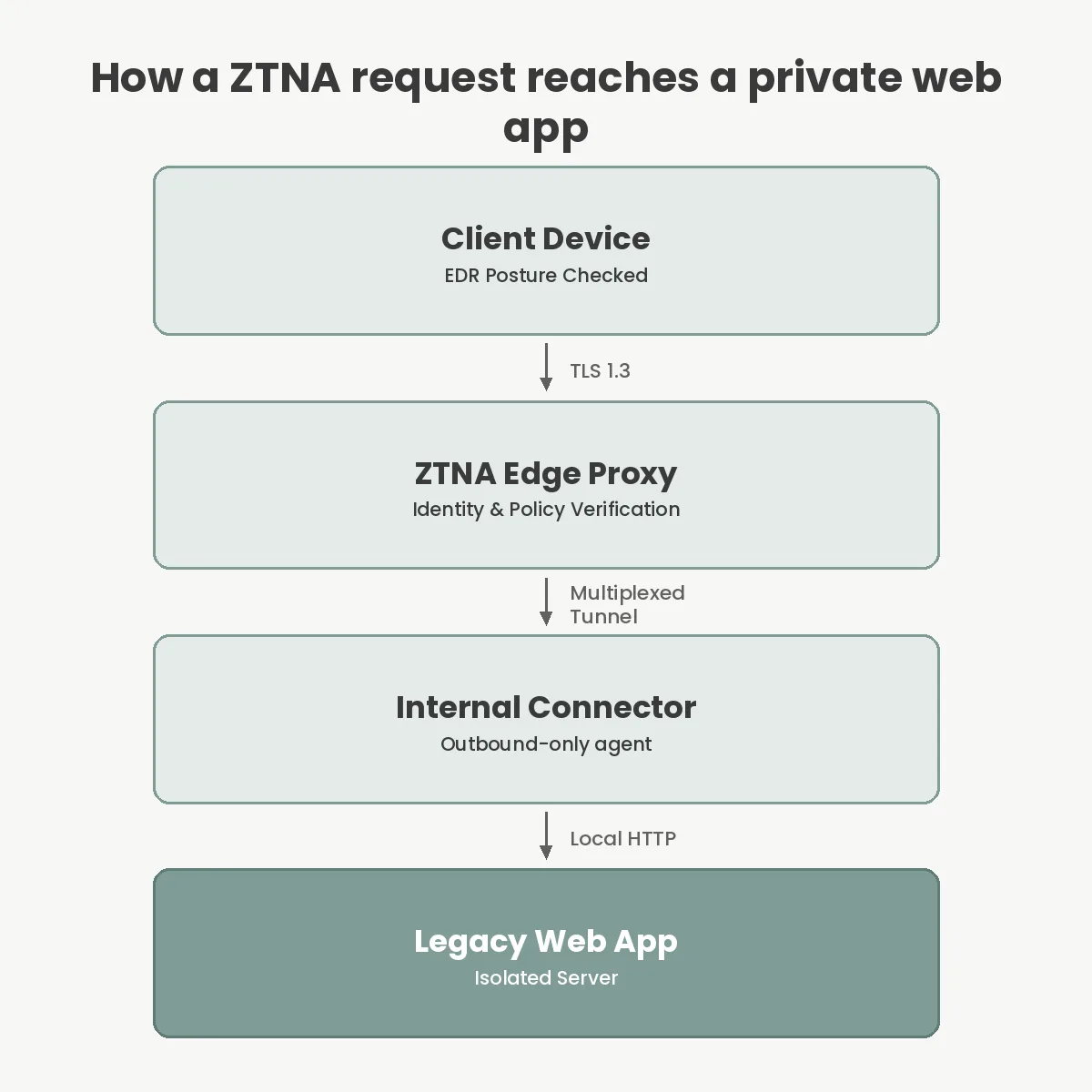
Transitioning existing internal applications to ZTNA does not require rewriting the applications. The standard implementation pattern utilizes an outbound connector—a lightweight agent installed directly in your bare metal environments or virtual private clouds.
This connector initiates a persistent outbound HTTPS connection to the ZTNA provider’s edge. Because the connection originates from inside the network, administrators can completely close all inbound firewall ports. The attack surface drops to zero.
When a user requests access, the ZTNA edge validates the request and multiplexes the traffic down the existing outbound tunnel to the internal connector, which forwards it locally to the web application. This architecture hides the application entirely from the public internet while securely exposing it to authorized identities.
For web applications and HTTP-based APIs, ZTNA replaces the need for a VPN. However, legacy infrastructure requiring direct Layer 2 network access or non-standard protocols may still require a segmented VPN tunnel for administrative access.
Most ZTNA architectures utilize an outbound connector agent installed on the legacy server or adjacent VM. This agent establishes a reverse tunnel to the ZTNA proxy edge, eliminating the need to expose inbound firewall ports.
ZTNA often reduces latency for distributed users. By terminating the TLS connection at an edge proxy physically closer to the client, it avoids the geographic backhauling typically caused by centralized VPN concentrators.
A Web Application Firewall (WAF) inspects payload traffic for malicious queries and attack signatures. ZTNA focuses strictly on cryptographic identity, device posture, and granular access policy enforcement before the user reaches the application.
Network perimeters are obsolete abstractions. If an application relies on a VPN for security, it is implicitly trusting every device sharing that IP space. Engineering and security teams must decouple access from network topology. Replace broad subnet access with identity-aware proxies, close inbound firewall ports, and ensure every HTTP request independently proves its authorization to exist.
You Can Get More Information!