ZTNA vs VPN: Securing Modern Web App Infrastructure
Zero Trust Network Access (ZTNA) differs from traditional VPNs by...

Make email marketing simplified

Make email marketing simplified

Make email marketing simplified

Make email marketing simplified

Make email marketing simplified

Make email marketing simplified

Make email marketing simplified

Make email marketing simplified

Make email marketing simplified

Make email marketing simplified

Make email marketing simplified

Make email marketing simplified

Make email marketing simplified

Make email marketing simplified

Make email marketing simplified

We use cookies for our website to give you the most relevant experience by remembering your preferences. By clicking “accept”, you consent to use of ALL the cookies
This website uses cookies to improve your experience while you navigate through the website. Out of these, the cookies that are categorized as necessary are stored on your browser as they are essential for the working of basic functionalities of the website. We also use third-party cookies that help us analyze and understand how you use this website. These cookies will be stored in your browser only with your consent. You also have the option to opt-out of these cookies. But opting out of some of these cookies may affect your browsing experience.
Necessary cookies are absolutely essential for the website to function properly. These cookies ensure basic functionalities and security features of the website, anonymously.
| Cookie | Duration | Description |
|---|---|---|
| cookielawinfo-checkbox-functional | 11 months | This cookie is set by GDPR Cookie Consent plugin. The cookie is used to store the user consent for the cookies in the category “Analytics”. |
| cookielawinfo-checkbox-functional | 11 months | The cookie is set by GDPR cookie consent to record the user consent for the cookies in the category “Functional”. |
| cookielawinfo-checkbox-necessary | 11 months | This cookie is set by GDPR Cookie Consent plugin. The cookies is used to store the user consent for the cookies in the category “Necessary”. |
| cookielawinfo-checkbox-others | 11 months | This cookie is set by GDPR Cookie Consent plugin. The cookie is used to store the user consent for the cookies in the category “Other. |
| cookielawinfo-checkbox-performance | 11 months | This cookie is set by GDPR Cookie Consent plugin. The cookie is used to store the user consent for the cookies in the category “Performance”. |
| viewed_cookie_policy | 11 months | The cookie is set by the GDPR Cookie Consent plugin and is used to store whether or not user has consented to the use of cookies. It does not store any personal data. |
Functional cookies help to perform certain functionalities like sharing the content of the website on social media platforms, collect feedbacks, and other third-party features.
Performance cookies are used to understand and analyze the key performance indexes of the website which helps in delivering a better user experience for the visitors.
Analytical cookies are used to understand how visitors interact with the website. These cookies help provide information on metrics the number of visitors, bounce rate, traffic source, etc.
Advertisement cookies are used to provide visitors with relevant ads and marketing campaigns. These cookies track visitors across websites and collect information to provide customized ads.
Other uncategorized cookies are those that are being analyzed and have not been classified into a category as yet.
Cyberia Tech, Inc. respects your privacy. This Privacy Policy explains how we collect, use, and share your information. By using our services, you agree to this policy. If any other agreements conflict with this Privacy Policy, the terms of those agreements prevail.
Cyberia Tech complies with the EU-US and Swiss-US Privacy Shield Frameworks for handling personal data from the EEA, UK, and Switzerland. In case of any conflict, the Privacy Shield Principles prevail. Learn more at Privacy Shield. Key Definitions
Information linked to an individual, transferred from the EEA, UK, or Switzerland to the U.S.
Data revealing race, religion, health, sexual orientation, and similar categories.
Effective Date: [ 2026 / 10 / 11 ]
Welcome to The Cyberia Tech ! By accessing or using our website or services, you agree to
comply with and be bound by these Terms of Use and our Privacy Policy. If you do not agree with
these terms, please do not use our Services.
Loading
0 %
Your First Piece of the Puzzle in
Business Growth



Cloud repatriation becomes economically viable when an enterprise’s predictable baseline workloads cost significantly more in public cloud rent than the combined amortized cost of colocation hardware and dedicated site reliability engineers. For most mid-sized tech companies, this threshold typically emerges when annual cloud spend exceeds $1.5 million, marking the point where hardware ownership drastically improves gross margins.
Cloud computing was sold as the ultimate operational hack: infinite scale, zero hardware management, and pay-for-what-you-use pricing. But as startups mature into established enterprises, the financial mathematics invert. According to Andreessen Horowitz’s landmark analysis on the cost of cloud computing, public cloud infrastructure can account for up to 50% of the cost of revenue for software companies operating at scale. The stakes are entirely tied to valuation; every dollar spent on premium cloud services is a dollar permanently subtracted from gross margins. While the flexibility of Amazon Web Services (AWS) or Google Cloud Platform (GCP) is non-negotiable during the search for product-market fit, renting servers indefinitely for stable, high-volume workloads is equivalent to renting a hotel room for a decade.
The decision to migrate away from public infrastructure requires a rigorous audit of workload predictability. The public cloud charges a high premium for elasticity—the ability to spin up ten thousand compute cores in seconds. If a business operates workloads that scale violently based on viral events or extreme seasonality, that premium is justified. However, for organizations running steady-state software applications, paying for theoretical elasticity is a massive capital drain.
Venture capital firm a16z calculates that across 50 top public software companies, cloud expenses stripped away an estimated $100 billion in market value due to depressed gross margins. The tipping point arrives when a company’s infrastructure requirements plateau into a predictable baseline. At this stage, the business is no longer paying for agility; it is simply paying a 200% to 300% markup on commodity compute power and storage.
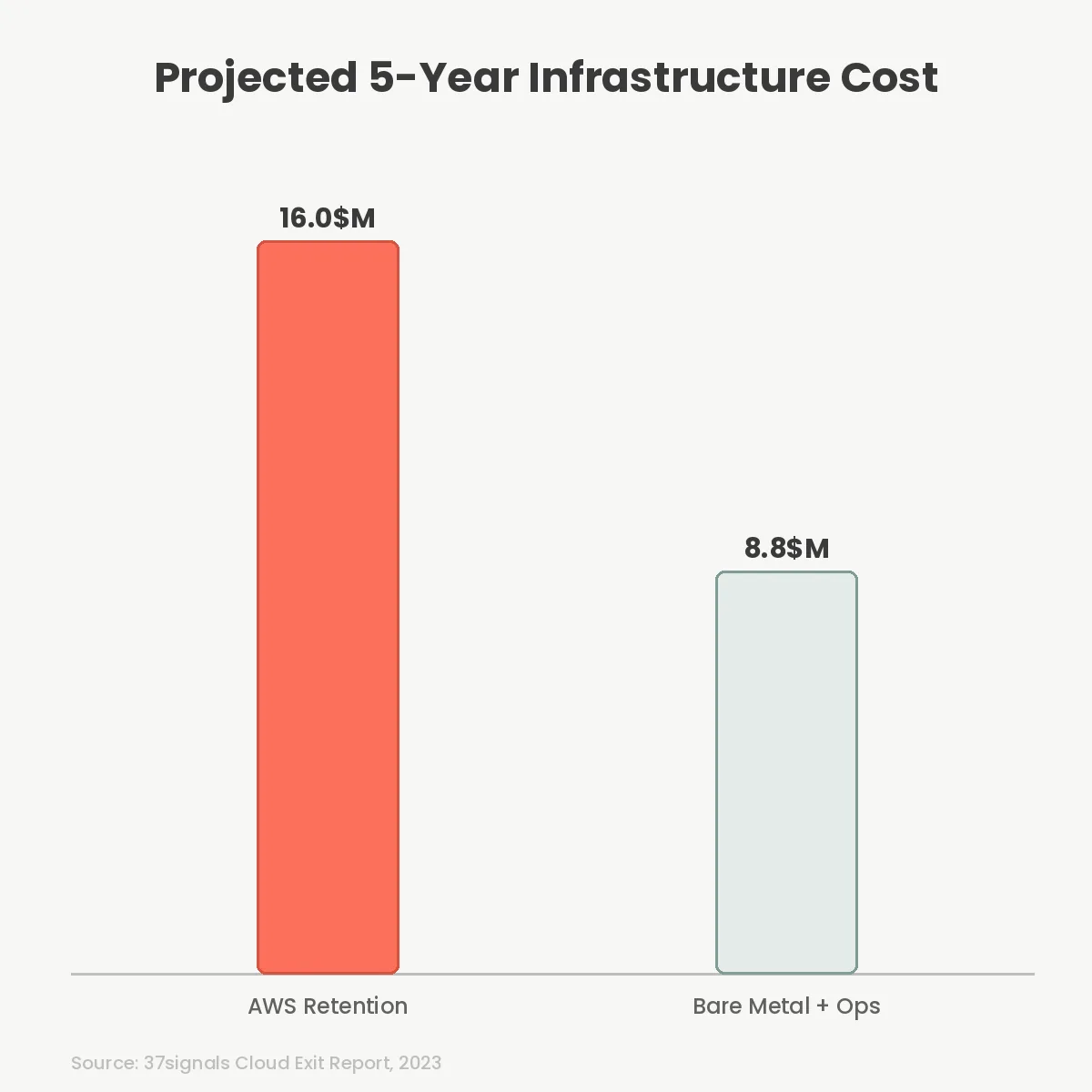
Consider the highly publicized case of 37signals, the makers of Basecamp and HEY. In 2023, they published their cloud exit strategy, projecting a staggering $7 million in savings over a five-year period by moving from AWS to bare-metal servers in a colocation facility. Their analysis revealed that their database and search clusters cost dramatically more to rent annually than the permanent purchase price of the underlying hardware. This realization is pushing boards to ask technical founders difficult questions about long-term unit economics.
To understand the mechanics of cloud repatriation economics, you must compare the equivalent specifications of rented instances against purchased hardware. High-density, enterprise-grade bare-metal servers have become astonishingly powerful. A modern Dell PowerEdge R760 equipped with dual AMD EPYC processors, 1TB of RAM, and fast NVMe storage costs roughly $15,000 as a capital expenditure (CapEx). When depreciated over a standard three- to five-year lifecycle, the monthly cost of the hardware is negligible.
In contrast, renting an equivalent fleet of memory-optimized, compute-heavy instances on AWS (such as the r6a or m6i series) runs into thousands of dollars per month, even when committing to one-year or three-year Reserved Instances. The payback period—the time it takes for the outright purchase of the server to eclipse the cost of renting the cloud equivalent—frequently lands between four and six months. After that half-year mark, the compute cycles are functionally free, minus the costs of power and cooling.
This hardware efficiency directly impacts how organizations approach scaling startups with technology. Instead of constantly optimizing cloud architectures to save fractions of a cent on lambda invocations, engineering teams with bare metal can operate with massive overhead. They can provision excessively powerful database servers without triggering anxiety over the next billing cycle, fundamentally changing the engineering culture from scarcity to abundance.
A frequent counter-argument to leaving the cloud is the cost of human capital. Managing physical infrastructure demands highly specialized personnel. Companies must hire dedicated Site Reliability Engineers (SREs), network administrators, and database administrators to handle the responsibilities previously abstracted away by AWS. Given that the median base salary for a US-based SRE is approximately $140,000, these fixed personnel costs must be factored into the repatriation ROI model.
However, the narrative that cloud computing eliminates the need for operations staff is largely a myth. Large-scale cloud deployments require entire teams dedicated solely to FinOps (financial operations) and cloud architecture just to prevent costs from spiraling out of control. The engineers required to wrangle complex Kubernetes clusters, manage overly intricate IAM roles, and debug proprietary managed services are often just as expensive as the bare-metal operators they replaced.
When a company shifts to colocation, the operational burden shifts from abstract cloud configurations to Linux operating systems, container orchestration, and network routing. While the company takes on the risk of hardware failure, modern high-availability clustering and service meshes ensure that individual server deaths do not result in application downtime. The savings from the cloud bill typically cover the salaries of an entirely new infrastructure team with millions left over.
Migrating massive amounts of stateful data out of a public cloud is technically and financially hostile. Cloud providers operate on a roach-motel model: bringing data in is free, but extracting it triggers severe egress fees. AWS, for example, charges approximately $0.09 per gigabyte for data transferred out to the internet. For an enterprise moving petabytes of historical logs, user data, and backups, these one-time penalties can amount to hundreds of thousands of dollars.
Beyond egress fees, companies must navigate the complexities of replacing proprietary managed services. If an application relies heavily on AWS DynamoDB, Amazon SQS, or GCP Spanner, the engineering team cannot simply lift and shift the codebase. They must refactor the architecture to utilize open-source equivalents like PostgreSQL, RabbitMQ, or Apache Kafka. This engineering overhead is a direct tax on the migration and requires careful scheduling so it does not halt feature development.
Furthermore, hardware procurement is subject to global supply chain realities. Purchasing dozens of specialized enterprise servers involves lead times, vendor negotiations, and shipping logistics. Organizations must also factor in external macroeconomic variables, such as how tariffs on the tech industry might temporarily inflate the capital cost of importing specific semiconductor components or server racks from overseas manufacturing hubs.
Despite the compelling economics at scale, cloud repatriation is catastrophic for the wrong type of business. Early-stage companies still searching for product-market fit should never purchase hardware. The public cloud’s primary value proposition is optionality. If a startup pivots its business model and suddenly needs highly parallelized GPU compute instead of standard web servers, the cloud allows them to switch instantly. Owned hardware locks capital into a specific architectural paradigm.
Additionally, workloads characterized by massive, unpredictable volatility belong in the cloud. An e-commerce platform that processes 80% of its annual transaction volume during a four-day Black Friday event would have to purchase and maintain enough physical servers to handle that peak load, leaving the hardware sitting idle for the remaining 361 days of the year. In these scenarios, the premium paid for cloud elasticity is significantly cheaper than the capital waste of underutilized bare metal.
Finally, companies with a globally distributed user base that require microsecond latency across five continents benefit heavily from cloud edge networks. Replicating a global footprint of colocation facilities requires establishing points of presence in multiple countries, negotiating contracts with disparate data center providers, and managing complex BGP routing. For most mid-market businesses, maintaining a single primary colocation region and using a cloud-based CDN for edge caching is the pragmatic compromise.
The most devastating mistake companies make during cloud repatriation is attempting a pure lift-and-shift of a heavily coupled cloud architecture. Microservices that were designed to communicate over high-bandwidth, zero-latency AWS backplanes often collapse when forced over traditional network topologies. Migrating successfully requires understanding the physical realities of standard switching and routing.
Another frequent failure mode is under-provisioning network capacity. In the cloud, bandwidth limits are softly enforced or quietly auto-scaled (while aggressively billed). In a colocation facility, if you purchase a 10Gbps uplink and your application spikes to 12Gbps, packets are dropped, and users experience immediate outages. Engineering teams must rigorously profile their peak network throughput before signing colocation contracts.
Finally, executives often underestimate the timeline required to execute a secure, zero-downtime migration. Moving critical stateful services, particularly primary databases, requires extensive dry runs. Rushing a software migration without establishing a proper dual-write state or reliable rollback mechanisms frequently results in data corruption and severe reputational damage. Treating a cloud exit as a weekend project rather than a multi-quarter engineering initiative is a guaranteed path to failure.
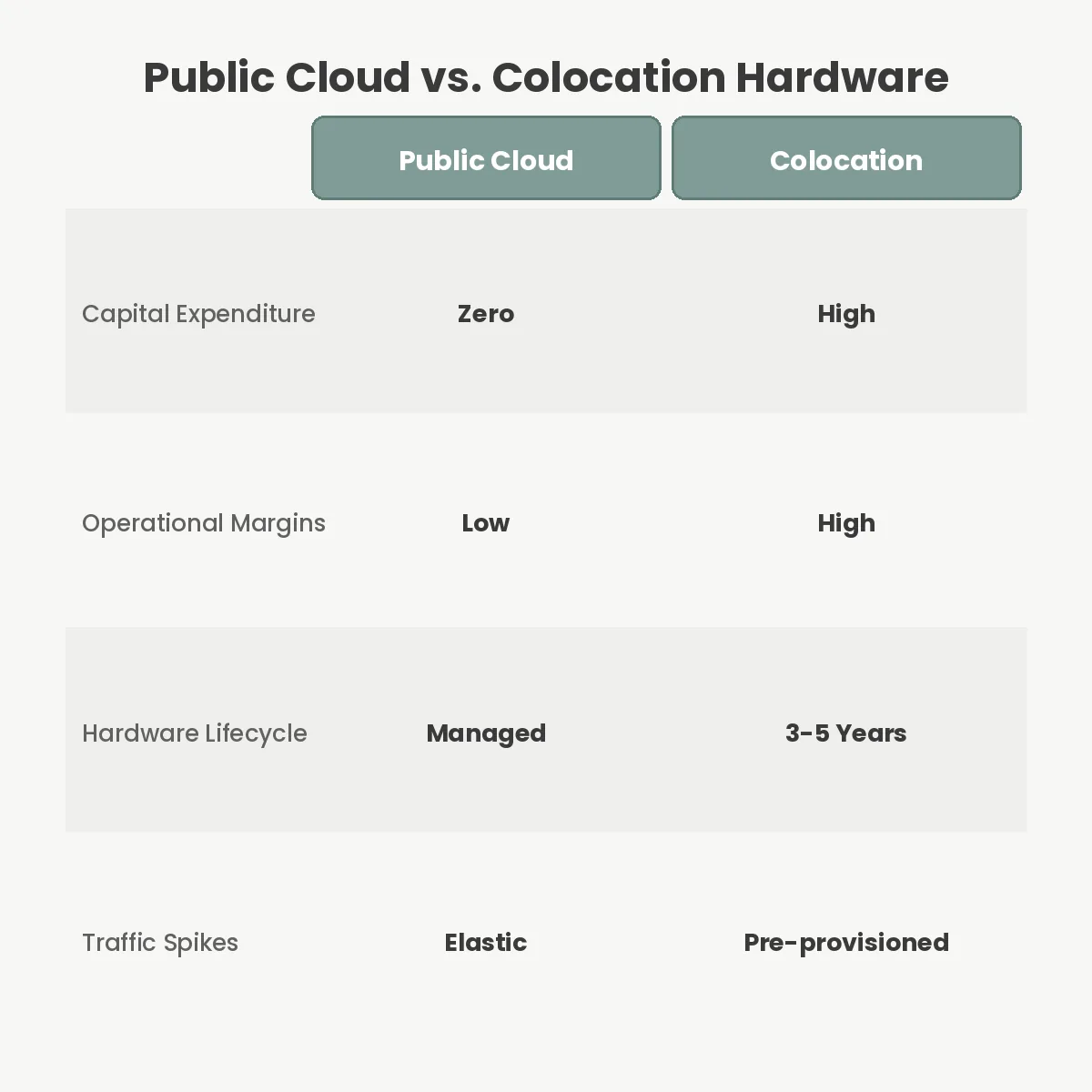
To summarize the fundamental differences, infrastructure decision-makers must weigh the exact parameters of both environments. The table below outlines the core economic and operational trade-offs.
| Operational Metric | Public Cloud (AWS / GCP) | Bare Metal (Colocation) |
|---|---|---|
| Capital Expenditure (CapEx) | Zero upfront cost; pure rental model | High upfront cost; hardware purchasing |
| Operational Expenditure (OpEx) | High variable cost; scales with usage | Low, predictable monthly footprint cost |
| Scaling Speed | Instantaneous elasticity via API | Weeks or months for hardware lead times |
| Data Egress Costs | High (typically ~$0.09 per GB) | Negligible (standard unmetered bandwidth) |
| Vendor Lock-in Risk | High (proprietary managed services) | Low (open-source software foundations) |
Understanding these distinct financial profiles is vital. For enterprises that invest heavily in bespoke software, owning the infrastructure layer often provides the deepest level of optimization and cost control, assuming the business has the maturity to operate it safely.
Cloud repatriation is the architectural process of migrating applications, databases, and workloads from public cloud environments back to on-premises data centers or bare-metal colocation facilities. The primary goal is reducing long-term infrastructure costs by eliminating recurring rental premiums.
A company should evaluate leaving the cloud when its predictable baseline workloads push annual cloud expenditure past $1.5 million. At this scale, the amortized cost of hardware and operational salaries becomes drastically cheaper than public cloud profit margins.
Yes, egress fees are a massive financial barrier during migration. Cloud providers charge heavy penalties for data extraction—often around $0.09 per gigabyte. Organizations must comprehensively audit their transfer volumes to accurately budget for this one-time exit penalty.
No, repatriation almost never involves building physical data centers. Companies rent cabinet space in colocation facilities, which provide enterprise-grade physical security, power, and specialized cooling. The business is only responsible for procuring and maintaining the actual servers.
The choice to repatriate infrastructure is a fundamental shift in how a technology organization views its capital structure. It represents a transition from buying software development speed at any cost to rigorously defending unit economics and gross margins. When executed properly, leaving the cloud enables engineering teams to run wildly inefficient workloads on incredibly powerful hardware, completely free from the constraints of metered billing.
For companies approaching the seven-figure mark in annual cloud spend, the next action is clear. Conduct a comprehensive workload audit to separate elastic services from baseline compute. Calculate the five-year amortization of equivalent bare-metal hardware alongside colocation and staffing costs. If the math reveals that you are merely renting servers you could have bought five times over, it is time to seriously engineer an exit strategy.
You Can Get More Information!