Fathom vs Otter vs Fireflies: The Best AI Meeting Assistants for 2026
The best AI meeting assistant depends on your core workflow:...

Make email marketing simplified

Make email marketing simplified

Make email marketing simplified

Make email marketing simplified

Make email marketing simplified

Make email marketing simplified

Make email marketing simplified

Make email marketing simplified

Make email marketing simplified

Make email marketing simplified

Make email marketing simplified

Make email marketing simplified

Make email marketing simplified

Make email marketing simplified

Make email marketing simplified

We use cookies for our website to give you the most relevant experience by remembering your preferences. By clicking “accept”, you consent to use of ALL the cookies
This website uses cookies to improve your experience while you navigate through the website. Out of these, the cookies that are categorized as necessary are stored on your browser as they are essential for the working of basic functionalities of the website. We also use third-party cookies that help us analyze and understand how you use this website. These cookies will be stored in your browser only with your consent. You also have the option to opt-out of these cookies. But opting out of some of these cookies may affect your browsing experience.
Necessary cookies are absolutely essential for the website to function properly. These cookies ensure basic functionalities and security features of the website, anonymously.
| Cookie | Duration | Description |
|---|---|---|
| cookielawinfo-checkbox-functional | 11 months | This cookie is set by GDPR Cookie Consent plugin. The cookie is used to store the user consent for the cookies in the category “Analytics”. |
| cookielawinfo-checkbox-functional | 11 months | The cookie is set by GDPR cookie consent to record the user consent for the cookies in the category “Functional”. |
| cookielawinfo-checkbox-necessary | 11 months | This cookie is set by GDPR Cookie Consent plugin. The cookies is used to store the user consent for the cookies in the category “Necessary”. |
| cookielawinfo-checkbox-others | 11 months | This cookie is set by GDPR Cookie Consent plugin. The cookie is used to store the user consent for the cookies in the category “Other. |
| cookielawinfo-checkbox-performance | 11 months | This cookie is set by GDPR Cookie Consent plugin. The cookie is used to store the user consent for the cookies in the category “Performance”. |
| viewed_cookie_policy | 11 months | The cookie is set by the GDPR Cookie Consent plugin and is used to store whether or not user has consented to the use of cookies. It does not store any personal data. |
Functional cookies help to perform certain functionalities like sharing the content of the website on social media platforms, collect feedbacks, and other third-party features.
Performance cookies are used to understand and analyze the key performance indexes of the website which helps in delivering a better user experience for the visitors.
Analytical cookies are used to understand how visitors interact with the website. These cookies help provide information on metrics the number of visitors, bounce rate, traffic source, etc.
Advertisement cookies are used to provide visitors with relevant ads and marketing campaigns. These cookies track visitors across websites and collect information to provide customized ads.
Other uncategorized cookies are those that are being analyzed and have not been classified into a category as yet.
Cyberia Tech, Inc. respects your privacy. This Privacy Policy explains how we collect, use, and share your information. By using our services, you agree to this policy. If any other agreements conflict with this Privacy Policy, the terms of those agreements prevail.
Cyberia Tech complies with the EU-US and Swiss-US Privacy Shield Frameworks for handling personal data from the EEA, UK, and Switzerland. In case of any conflict, the Privacy Shield Principles prevail. Learn more at Privacy Shield. Key Definitions
Information linked to an individual, transferred from the EEA, UK, or Switzerland to the U.S.
Data revealing race, religion, health, sexual orientation, and similar categories.
Effective Date: [ 2026 / 10 / 24 ]
Welcome to The Cyberia Tech ! By accessing or using our website or services, you agree to
comply with and be bound by these Terms of Use and our Privacy Policy. If you do not agree with
these terms, please do not use our Services.
Loading
0 %
Your First Piece of the Puzzle in
Business Growth



HTTP/3 improves web app performance by replacing TCP with the QUIC protocol over UDP, eliminating head-of-line blocking and enabling 0-RTT handshakes. However, deploying it requires upgrading reverse proxies like NGINX to 1.25+, managing increased server CPU overhead, and configuring fallback mechanisms for networks that aggressively throttle UDP traffic.
TCP has underpinned the web for four decades, but modern web applications expose its fundamental flaw: head-of-line blocking. When a single packet drops on a TCP connection, every subsequent stream halts until the lost packet is retransmitted. HTTP/3 fixes this structural defect by moving to QUIC, standardized in RFC 9000. But the transition from TCP to UDP is not a simple toggle switch in your load balancer. Migrating your infrastructure requires navigating unfamiliar CPU bottlenecks and unexpected ISP rate limits that can silently degrade the exact metrics you are trying to improve.
To understand why a new transport protocol was necessary, you have to look at how HTTP/2 operates under suboptimal network conditions. HTTP/2 introduced multiplexing, allowing multiple resources—like CSS, JavaScript, and API responses—to share a single TCP connection. This was a massive architectural improvement over the HTTP/1.1 model of opening six separate TCP connections per domain.
However, multiplexing at the application layer exposed the limitations of the transport layer beneath it. TCP is a reliable, ordered delivery protocol. It views all data as a single continuous byte stream. If a web server sends 50 packets containing ten different multiplexed HTTP/2 streams, and packet number 14 drops due to cellular network congestion, TCP stops processing. The operating system kernel holds packets 15 through 50 in a buffer, preventing the application from reading them until packet 14 is retransmitted and acknowledged.
This phenomenon, known as TCP head-of-line (HoL) blocking, means that a dropped packet containing an unimportant telemetry payload can delay the rendering of critical CSS. For mobile web applications on high-latency networks, HTTP/2 can actually perform worse than HTTP/1.1 because a single dropped packet stalls the entire pipeline instead of just one connection.
HTTP/3 abandons TCP entirely. Instead, it runs on QUIC (Quick UDP Internet Connections), a transport layer protocol built on top of the connectionless User Datagram Protocol (UDP). Because UDP does not enforce ordered delivery, QUIC implements its own stream control, packet retransmission, and congestion control mechanisms in user space.
When an HTTP/3 connection multiplexes multiple streams, QUIC assigns each stream a unique identifier. If a packet belonging to Stream A drops in transit, only Stream A pauses to wait for a retransmission. Streams B, C, and D continue processing normally. This independent stream architecture completely eliminates transport-layer head-of-line blocking, making HTTP/3 highly resilient on unstable 4G and 5G mobile networks.
Furthermore, QUIC fundamentally changes connection establishment. TCP requires a 3-way handshake to establish a connection, followed by a separate TLS 1.3 handshake to secure it. QUIC integrates TLS 1.3 directly into the transport layer. A typical QUIC handshake requires only a single round trip (1-RTT) to establish both the connection and encryption. For returning clients holding a session ticket, QUIC enables a 0-RTT handshake, allowing the browser to send HTTP request data in the very first flight of packets.
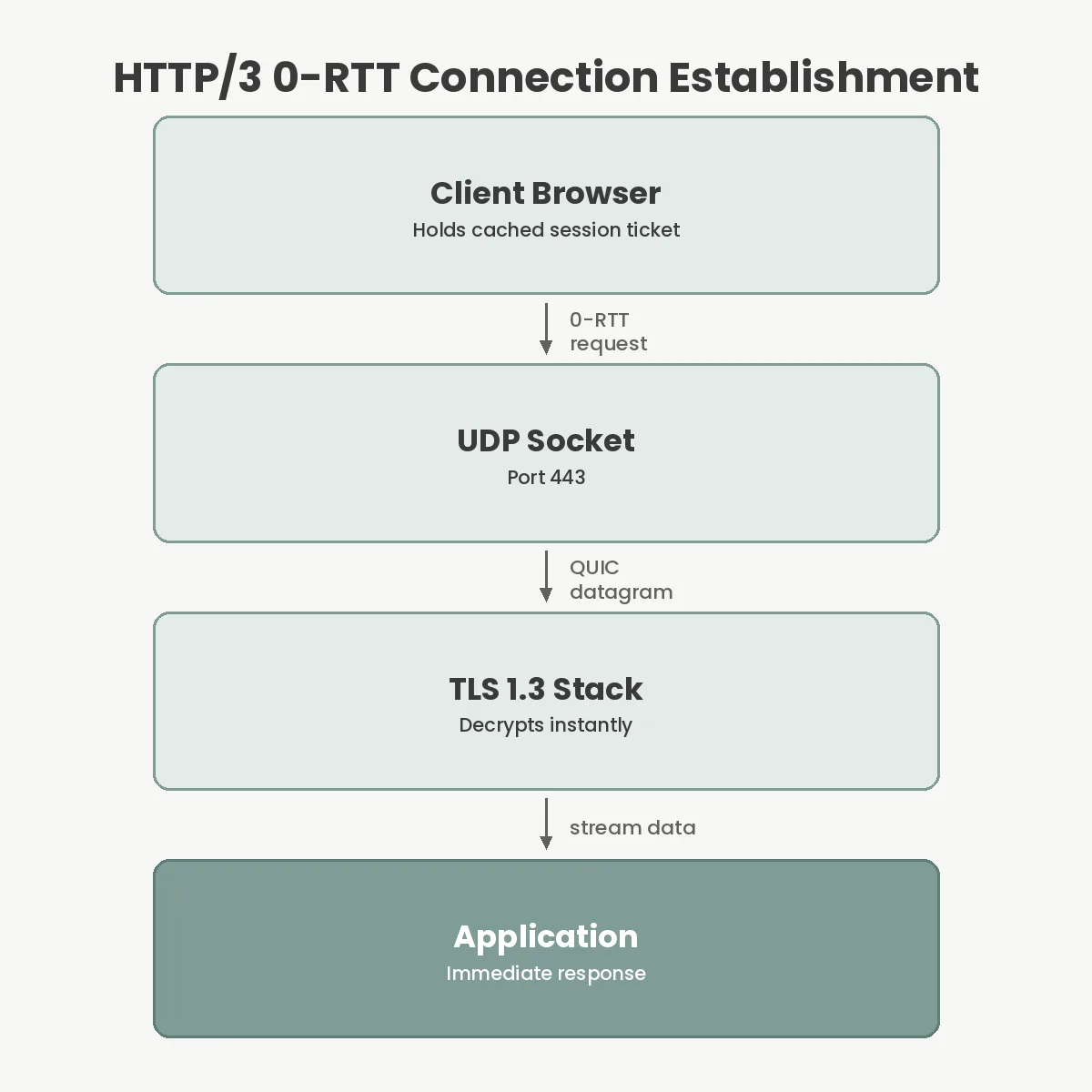
Upgrading your infrastructure to support HTTP/3 requires specific software versions and configuration changes at the edge. The popular NGINX reverse proxy introduced mainline HTTP/3 support in version 1.25.0, released in May 2023. Prior to this, administrators had to compile NGINX from source with third-party QUIC patches.
Because HTTP/3 operates over UDP, you must explicitly configure your firewall and server blocks to listen on UDP port 443. The configuration differs fundamentally from standard TCP sockets. You must enable `SO_REUSEPORT` on the listening socket to allow multiple worker processes to bind to the same port, distributing incoming UDP packets evenly across CPU cores.
Clients do not default to HTTP/3. When a browser navigates to a URL, it initially connects over TCP using HTTP/2. The server must advertise its HTTP/3 capability using the `Alt-Svc` (Alternative Services) HTTP response header. A standard implementation looks like `Alt-Svc: h3=”:443″; ma=86400`. This instructs the browser that HTTP/3 is available on port 443, and the client should cache this routing information for 86,400 seconds (24 hours).
The transition to UDP introduces a severe performance penalty on the server side if left unoptimized. Linux network stacks have spent three decades optimizing TCP processing. Features like TCP Segmentation Offload (TSO) allow the network interface card (NIC) hardware to handle splitting large data streams into packets, saving massive amounts of CPU time.
Historically, UDP has not received the same level of hardware offload support. Because QUIC handles encryption and packet pacing in user space, processing HTTP/3 traffic demands significantly more CPU cycles per megabit than HTTP/2. Cloudflare reported during their early rollouts that QUIC processing required up to twice the CPU overhead of traditional TCP+TLS connections.
To mitigate this, high-performance web applications must rely on kernel bypass technologies. Advanced deployments utilize UDP Generic Segmentation Offload (GSO) to batch packet processing. At scale, organizations handling millions of connections leverage eBPF (Extended Berkeley Packet Filter) and XDP (eXpress Data Path) to route QUIC packets efficiently before they traverse the standard, slower Linux networking stack. If your scalable web application infrastructure relies on small, low-CPU cloud instances, turning on HTTP/3 without monitoring CPU load will induce latency spikes that outweigh the protocol’s benefits.
Even if your server efficiently processes QUIC, the network between you and the user remains a variable you cannot control. Approximately 28.5% of all websites support HTTP/3 as of mid-2024, but widespread adoption faces resistance from middleboxes, corporate firewalls, and Internet Service Providers (ISPs).
Historically, high volumes of UDP traffic were associated with DDoS amplification attacks, such as DNS or NTP reflection. Consequently, many enterprise firewalls default to dropping all UDP traffic on port 443, or strictly rate-limiting it to a trickle. When an enterprise network throttles UDP, the client browser experiences timeouts and high latency trying to establish the QUIC connection.
This failure mode is the primary reason HTTP/3 cannot function as a standalone protocol. Your infrastructure must always maintain a robust HTTP/2 fallback. Browsers are designed to race connections: they will attempt a QUIC connection based on the cached `Alt-Svc` header, but if the UDP packets drop silently in a firewall, the browser falls back to TCP. If the fallback mechanism is poorly tuned, users on restrictive networks will suffer worse slow website performance than if you had never enabled HTTP/3 at all.
Implementing HTTP/3 safely requires a phased rollout and strict monitoring. Begin by adjusting your Linux kernel UDP buffer limits. The default `net.core.rmem_max` and `net.core.wmem_max` values on most distributions are far too small for high-throughput QUIC traffic, leading to packet drops at the socket level. Increase these values to at least 2.5MB before enabling your proxy.
Second, verify your TLS implementation. HTTP/3 mandates TLS 1.3 and strictly forbids fallback to older, vulnerable cipher suites. Your load balancer or reverse proxy must have a modern cryptographic library linked (such as OpenSSL 3.0 or BoringSSL) to process the integrated handshake correctly.
Finally, utilize client-side telemetry to track the percentage of sessions successfully negotiating HTTP/3 versus those falling back to HTTP/2. Do not rely solely on server logs, as silent UDP drops by ISPs will not register on your infrastructure. If building a micro-frontends architecture, ensure all subdomains correctly emit the `Alt-Svc` headers, as cross-origin requests require explicit instruction to upgrade their transport layer.
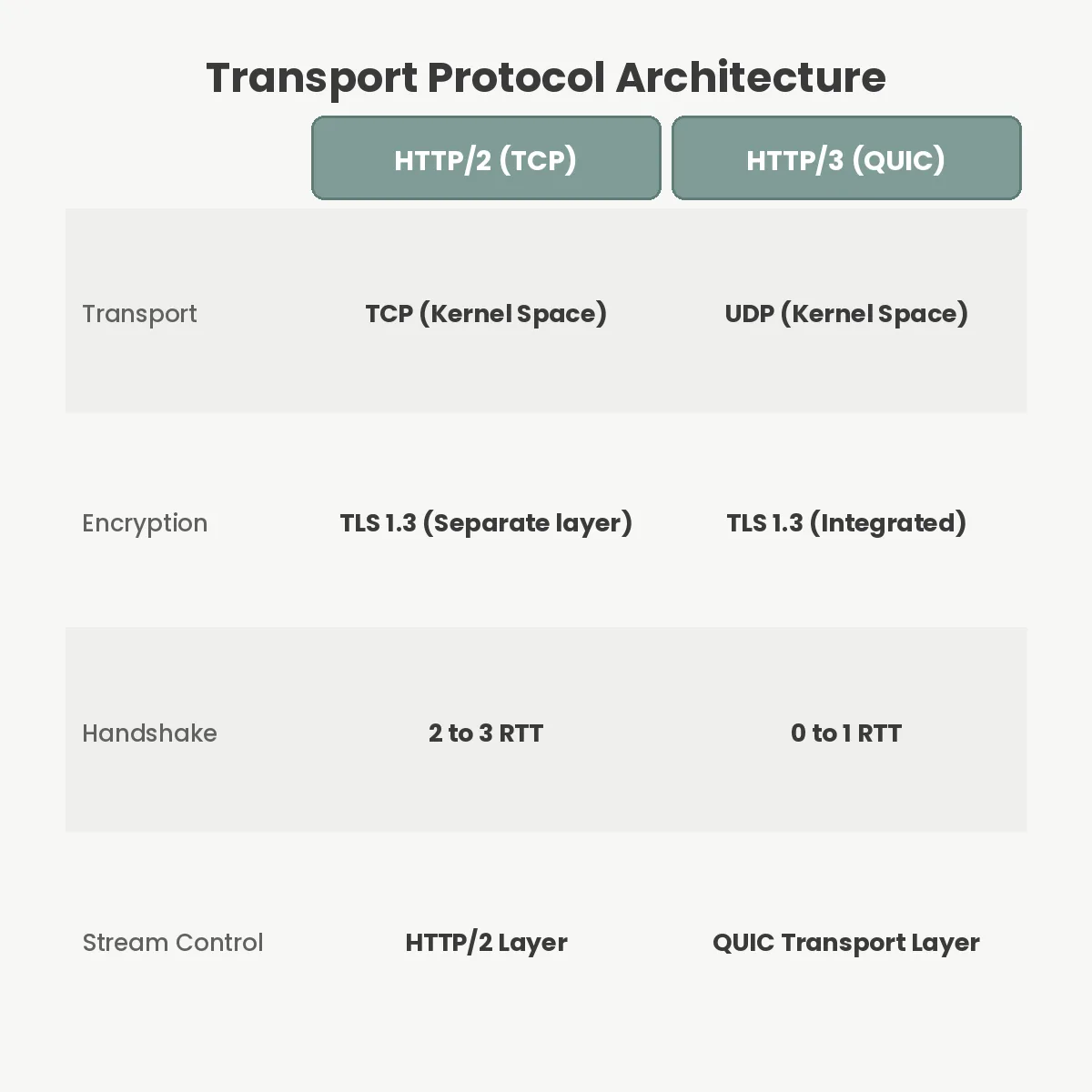
Below is a summary of the protocol differences you must account for during migration:
| Feature | HTTP/2 | HTTP/3 (QUIC) |
|---|---|---|
| Transport Layer | TCP | UDP |
| Handshake Latency | 2 to 3 RTT | 0 to 1 RTT |
| Encryption | TLS 1.2 or 1.3 (Separate) | TLS 1.3 (Integrated) |
| Head-of-Line Blocking | Vulnerable at Transport Layer | Eliminated |
| Hardware Offload | Excellent (TSO, LRO) | Maturing (GSO, eBPF) |
HTTP/3 operates over QUIC and UDP, completely abandoning TCP. This architectural shift eliminates head-of-line blocking during packet loss and allows for faster connection establishment, but it requires different server configurations and firewall rules compared to older protocols.
Yes, TLS 1.3 is strictly mandatory for HTTP/3. Unlike older protocols where encryption is an independent layer added over TCP, QUIC integrates TLS 1.3 cryptographic handshakes directly into its transport layer to minimize round-trip times.
Servers inform browsers using the Alt-Svc response header sent over an initial HTTP/2 connection. This header specifies the protocol and port, instructing the browser to attempt a QUIC connection on subsequent requests to that specific domain.
Linux network stacks are highly optimized for TCP, often offloading work to hardware. Because QUIC runs on UDP and handles its own flow control and encryption in user space, the CPU must manually process tasks that hardware previously handled.
Ultimately, HTTP/3 provides significant latency improvements for end users on mobile or unstable networks, but it shifts the processing burden onto your infrastructure. If you manage your own bare-metal servers or cloud instances, the decision to migrate depends on your capacity to absorb the CPU overhead and tune UDP kernel buffers. For most organizations, the optimal deployment strategy is to offload QUIC termination to an edge network or CDN, allowing dedicated infrastructure to handle the complex UDP mechanics while forwarding standard TCP traffic back to your internal origin servers.
You Can Get More Information!