How to Calculate and Reduce Multi-Cloud Egress Costs in 2026
Learn how to model, forecast, and structurally reduce data egress fees when operating across multiple cloud providers.

Make email marketing simplified

Make email marketing simplified

Make email marketing simplified

Make email marketing simplified

Make email marketing simplified

Make email marketing simplified

Make email marketing simplified

Make email marketing simplified

Make email marketing simplified

Make email marketing simplified

Make email marketing simplified

Make email marketing simplified

Make email marketing simplified

Make email marketing simplified

Make email marketing simplified

We use cookies for our website to give you the most relevant experience by remembering your preferences. By clicking “accept”, you consent to use of ALL the cookies
This website uses cookies to improve your experience while you navigate through the website. Out of these, the cookies that are categorized as necessary are stored on your browser as they are essential for the working of basic functionalities of the website. We also use third-party cookies that help us analyze and understand how you use this website. These cookies will be stored in your browser only with your consent. You also have the option to opt-out of these cookies. But opting out of some of these cookies may affect your browsing experience.
Necessary cookies are absolutely essential for the website to function properly. These cookies ensure basic functionalities and security features of the website, anonymously.
| Cookie | Duration | Description |
|---|---|---|
| cookielawinfo-checkbox-functional | 11 months | This cookie is set by GDPR Cookie Consent plugin. The cookie is used to store the user consent for the cookies in the category “Analytics”. |
| cookielawinfo-checkbox-functional | 11 months | The cookie is set by GDPR cookie consent to record the user consent for the cookies in the category “Functional”. |
| cookielawinfo-checkbox-necessary | 11 months | This cookie is set by GDPR Cookie Consent plugin. The cookies is used to store the user consent for the cookies in the category “Necessary”. |
| cookielawinfo-checkbox-others | 11 months | This cookie is set by GDPR Cookie Consent plugin. The cookie is used to store the user consent for the cookies in the category “Other. |
| cookielawinfo-checkbox-performance | 11 months | This cookie is set by GDPR Cookie Consent plugin. The cookie is used to store the user consent for the cookies in the category “Performance”. |
| viewed_cookie_policy | 11 months | The cookie is set by the GDPR Cookie Consent plugin and is used to store whether or not user has consented to the use of cookies. It does not store any personal data. |
Functional cookies help to perform certain functionalities like sharing the content of the website on social media platforms, collect feedbacks, and other third-party features.
Performance cookies are used to understand and analyze the key performance indexes of the website which helps in delivering a better user experience for the visitors.
Analytical cookies are used to understand how visitors interact with the website. These cookies help provide information on metrics the number of visitors, bounce rate, traffic source, etc.
Advertisement cookies are used to provide visitors with relevant ads and marketing campaigns. These cookies track visitors across websites and collect information to provide customized ads.
Other uncategorized cookies are those that are being analyzed and have not been classified into a category as yet.
Cyberia Tech, Inc. respects your privacy. This Privacy Policy explains how we collect, use, and share your information. By using our services, you agree to this policy. If any other agreements conflict with this Privacy Policy, the terms of those agreements prevail.
Cyberia Tech complies with the EU-US and Swiss-US Privacy Shield Frameworks for handling personal data from the EEA, UK, and Switzerland. In case of any conflict, the Privacy Shield Principles prevail. Learn more at Privacy Shield. Key Definitions
Information linked to an individual, transferred from the EEA, UK, or Switzerland to the U.S.
Data revealing race, religion, health, sexual orientation, and similar categories.
Effective Date: [ 2026 / 11 / 26 ]
Welcome to The Cyberia Tech ! By accessing or using our website or services, you agree to
comply with and be bound by these Terms of Use and our Privacy Policy. If you do not agree with
these terms, please do not use our Services.
Loading
0 %
Your First Piece of the Puzzle in
Business Growth



When evaluating AWS Direct Connect vs VPN, AWS Direct Connect delivers dedicated physical bandwidth up to 400 Gbps with 900-millisecond BFD failover and deterministic underlay latency, while AWS Site-to-Site VPN provides instant software provisioning capped at 1.25 Gbps to 5 Gbps per tunnel with a 30-second failover window.
Hybrid network architecture decisions frequently collapse when operational throughput assumptions collide with packet processing realities. Network engineering teams often plan cloud migrations around theoretical bandwidth, only to watch database replication stalls and voice-over-IP drops manifest under moderate load. Establishing deterministic throughput between data centers and private cloud infrastructure requires balancing physical transport reliability against deployment velocity. Choosing incorrectly traps organizations inside long carrier procurement cycles or leaves transactional microservices bottlenecked by encapsulation overhead. A sound hybrid layout begins with a comprehensive cloud networking architecture guide that accounts for layer-to-layer protocol mechanics.
AWS Direct Connect is substantially faster and more consistent than AWS Site-to-Site VPN, delivering physical port speeds from 1 Gbps to 400 Gbps with predictable latency, whereas standard VPN tunnels cap at 1.25 Gbps over variable public internet routes. The fundamental performance difference stems from the underlying transport medium. Direct Connect routes frames through dedicated single-mode optical fiber directly into an AWS Point of Presence, bypassing public transit providers.
AWS Direct Connect is a dedicated physical network service that bypasses the public internet to deliver private fiber-optic connectivity between on-premises data centers and AWS VPCs or Transit Gateways. Because the circuit does not traverse commercial internet exchange points, it avoids transient routing changes and ISP peering congestion. Bandwidth allocation remains dedicated to the provisioned virtual interfaces, eliminating the noisy-neighbor variability inherent to public internet backbones.
AWS Site-to-Site VPN is a managed networking service that establishes encrypted IPsec tunnels across the public internet between an on-premises customer gateway and an AWS Virtual Private Gateway or Transit Gateway. Tunnel packets traverse public internet service providers where path latency fluctuates based on intermediate carrier BGP policies. As outlined in the AWS architectural whitepaper on hybrid cloud connectivity, Direct Connect eliminates variable intermediate autonomous systems, providing deterministic transport performance that internet-based IPsec tunnels cannot match.
AWS Site-to-Site VPN standard IPsec tunnels enforce a maximum bandwidth limit of 1.25 Gbps and a packet processing ceiling of 140,000 packets per second (PPS) per tunnel. These thresholds represent hard operational boundaries enforced by the AWS managed VPN endpoint architecture. Organizations terminating tunnels on an AWS Virtual Private Gateway cannot exceed these limits regardless of customer gateway compute resources.
Packets Per Second is the metric measuring network interface processing capacity independently of raw bandwidth, defining the absolute number of discrete data frames a gateway or tunnel can process each second. The primary constraint on standard VPN tunnels is often not line bandwidth, but the cryptographic compute budget required for IPsec processing. According to official AWS Site-to-Site VPN quotas published in AWS documentation, AWS Transit Gateway and AWS Cloud WAN support Large Bandwidth VPN Tunnels that scale up to 5 Gbps and 400,000 PPS per tunnel. AWS documentation also specifies that VPN Concentrator tunnels share an aggregate 5 Gbps capacity across up to 100 remote sites, enforcing an individual ceiling of 100 Mbps and 10,000 PPS per tunnel.
Throughput bottlenecks regularly occur at the packet processing layer rather than the interface link speed. When applications emit small transactional payloads—such as microservice HTTP REST calls, DNS queries, or telemetry logs—the average frame size may hover near 256 bytes. At 256 bytes per packet, a standard tunnel hits its 140,000 PPS limit at roughly 286 Mbps of traffic. When that occurs, the gateway silently drops outbound packets despite 75% of nominal link bandwidth remaining completely unused. Engineering teams debugging these issues often uncover wider routing issues, as detailed in our guide on 7 costly VPC subnet and routing mistakes.
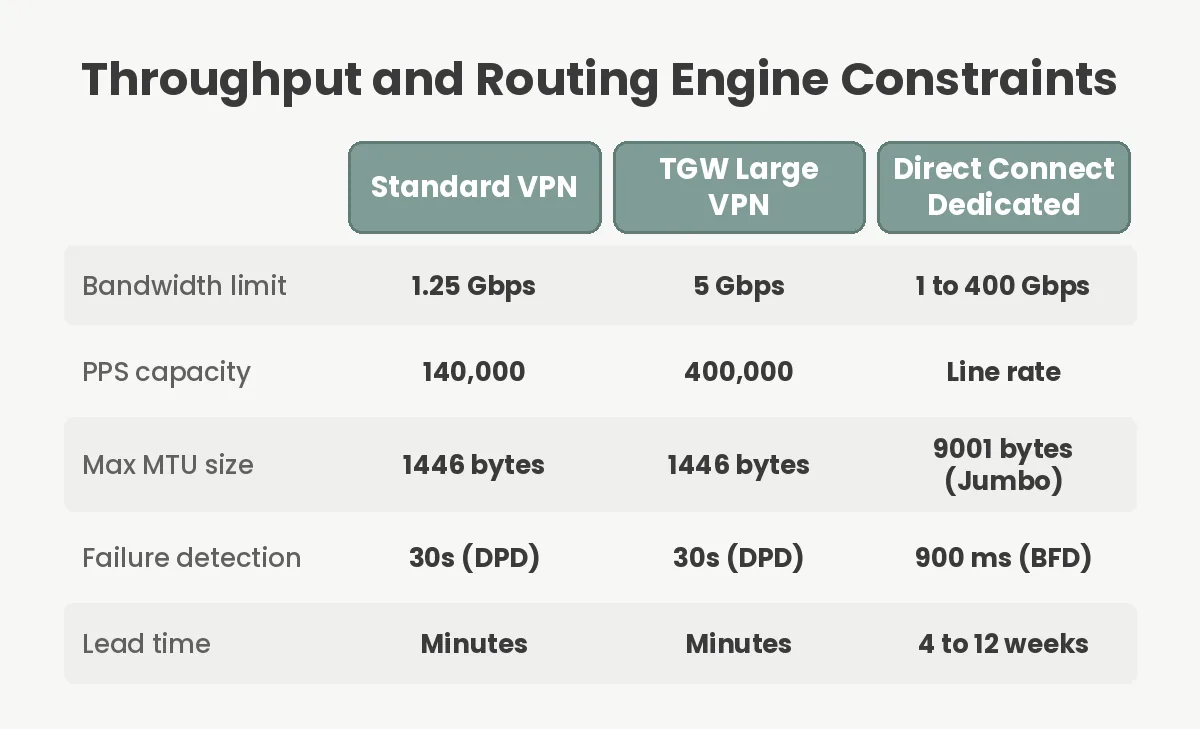
AWS Site-to-Site VPN cannot transport jumbo frames, restricting packet size to a maximum transmission unit of 1446 bytes, while AWS Direct Connect supports jumbo frames up to 9001 bytes. This sizing divergence dictates payload efficiency and CPU utilization across edge network gear. Direct Connect permits larger continuous byte streams without packet segmentation.
Maximum Transmission Unit is the maximum size, measured in bytes, of a single packet that an interface or transmission link can transfer without fragmentation. As specified in AWS documentation for creating a Direct Connect private virtual interface, private VIFs support 9001-byte MTU, and transit VIFs bound to AWS Transit Gateway support up to 8500-byte MTU. Moving bulk storage payloads, database replication streams, or large analytical exports over jumbo frames reduces packet count significantly. Edge network processors handle far fewer interrupts, directly lowering CPU load.
AWS Site-to-Site VPN strictly enforces a 1446-byte MTU and a maximum segment size (MSS) of 1406 bytes. The reduction from the standard 1500-byte Ethernet frame is necessary to encapsulate the original IP packet inside IPsec ESP headers, initialization vectors, and authentication trailers. If an on-premises host dispatches 1500-byte frames with the Don’t Fragment (DF) bit set, the VPN tunnel drops the traffic unless Path MTU Discovery (PMTUD) or TCP MSS clamping is explicitly active on intermediate routers.
Sub-second failover on AWS Direct Connect requires enabling Asynchronous Bidirectional Forwarding Detection (BFD) on customer gateway routers, which cuts fault detection time to approximately 900 milliseconds. Without BFD, routing path failover relies on standard BGP timers that take up to three minutes to reconverge. Fast rerouting protects real-time applications from persistent traffic black-holing.
Bidirectional Forwarding Detection is a low-overhead, millisecond-level network protocol designed to rapidly detect forwarding path failures between directly connected BGP routing peers. AWS implements BFD underlay health checking natively on Direct Connect interfaces. As documented in the AWS technical instructions to enable BFD for Direct Connect, the managed peer defaults to a minimum transmit and receive interval of 300 milliseconds paired with a detection multiplier of 3. If three consecutive 300 ms control packets fail to arrive, the forwarding plane declares the path down in 900 ms, instantly triggering BGP withdrawal.
Relying on standard Border Gateway Protocol (BGP) timers without BFD introduces severe recovery delays. Standard Direct Connect BGP-specific settings employ a 30-second keepalive timer and a 90-second hold-down timer. If a physical transceiver link flap occurs upstream of the immediate AWS edge, or an intermediate transport circuit drops without dropping Layer 1 carrier signaling, AWS will route outbound traffic into the failed link for 90 to 180 seconds. To secure transport between hybrid sites and AWS endpoints, engineers should cross-reference our enterprise cloud network security checklist.
Dead Peer Detection is an IKE/IPsec keepalive mechanism that monitors tunnel liveliness by sending periodic probe queries to verify the remote VPN peer is reachable. AWS Site-to-Site VPN utilizes DPD to monitor Phase 1 security associations. According to AWS troubleshooting guidance on VPN tunnel connection stability, the AWS VPN gateway transmits an R_U_THERE query every 10 seconds by default. The peer must fail to acknowledge 3 consecutive probes before the tunnel declares an outage, establishing a static detection baseline of 30 seconds.
Configuring VPN as a dynamic backup to Direct Connect requires planning for this detection differential. When Direct Connect drops, a properly tuned BFD configuration detects the link loss in under one second. However, shifting traffic back to the primary circuit once service restores depends on BGP hold-down windows and route suppression timers to prevent route flapping.
AWS Site-to-Site VPN can be provisioned within minutes using the AWS Management Console or Infrastructure as Code, whereas a Dedicated AWS Direct Connect circuit requires 4 to 12 weeks for physical deployment. Software-defined network overlays deploy rapidly because they utilize pre-existing public internet routing. Dedicated physical circuits require coordination across multiple telecommunications providers and colocation facility operators.
Letter of Authorization and Connecting Facility Assignment is an official authorization document generated by AWS that designates exact rack, cage, and port coordinates allowing a colocation provider or telecom carrier to cable a physical cross-connect. When ordering a 1 Gbps, 10 Gbps, 100 Gbps, or 400 Gbps dedicated connection, AWS issues the LOA-CFA electronically within 24 to 72 hours. The long lead time occurs during data center provisioning. The telecom carrier must run intra-facility fiber patch cords between the customer’s cage and the AWS cage, verify optical power levels, and complete bit-error rate testing.
Hosted Direct Connect connections provide a viable middle ground for deployment velocity. Provisioned through authorized AWS Direct Connect Partners such as Equinix or Megaport, hosted connections operate on pre-cabled physical carrier fabrics. Partners carve out logical VLANs scaling from 50 Mbps up to 25 Gbps over pre-existing interconnects, compressing circuit delivery down to several hours or days. Teams building automated hybrid landing zones often coordinate this through AWS Transit Gateway vs VPC Peering topologies.

The most destructive failure mode in hybrid network failover configurations is the simultaneous activation of BGP Graceful Restart alongside sub-second BFD. Enabling BGP Graceful Restart (GR) on the customer router negates the fast detection provided by BFD. As documented in the AWS networking guide on optimizing failover times for Direct Connect overlay tunnels, Direct Connect respects the GR helper timer—defaulting to 120 seconds—leaving stale routes active in AWS route tables while BFD has already flagged the underlying interface as failed.
A second common mistake is attempting to configure hyper-aggressive BGP keepalive and hold timers as a substitute for BFD. Network administrators sometimes configure 1-second keepalive and 3-second hold timers directly on the BGP neighbor session. AWS documentation specifically discourages this approach. Under brief CPU spikes or transient congestion bursts on edge routers, control-plane BGP keepalive packets are dropped, triggering false-positive route withdrawals and destructive route flaps between Direct Connect and backup VPN tunnels. Sub-second liveness verification must operate within the forwarding plane via Asynchronous BFD, while BGP timers remain stable.
Asymmetric routing constitutes a third frequent failure scenario when running hybrid IPsec VPNs alongside Direct Connect circuits. AWS uses BGP local preference to prioritize traffic: Direct Connect private VIF routes take precedence over AWS Site-to-Site VPN routes by default. However, if on-premises firewalls do not mirror this preference by setting appropriate AS Path prepending or BGP Local Preference on outbound routes, ingress traffic enters via Direct Connect while egress traffic returns across the VPN. Stateful network inspection engines drop these non-synced return packets immediately.
| Architecture Metric | Standard AWS Site-to-Site VPN | Large Bandwidth VPN Tunnel | AWS Direct Connect Dedicated |
|---|---|---|---|
| Bandwidth Capacity | Up to 1.25 Gbps per tunnel | Up to 5 Gbps per tunnel | 1 Gbps, 10 Gbps, 100 Gbps, 400 Gbps |
| Packet Processing Limit | 140,000 PPS | 400,000 PPS | Line-rate interface capacity |
| Supported Max MTU | 1446 bytes (1406 MSS) | 1446 bytes (1406 MSS) | 9001 bytes (Private VIF) |
| Failover Detection Time | 30 seconds (DPD: 3 x 10s) | 30 seconds (DPD: 3 x 10s) | ~900 ms (BFD: 3 x 300ms) |
| Provisioning Lead Time | Instant (Minutes via API) | Instant (Minutes via API) | 4 to 12 weeks (LOA-CFA cabling) |
AWS Direct Connect is the wrong architectural choice for early-stage infrastructure deployments, temporary workloads, or setups that lack colocation infrastructure. The ongoing financial commitment of fixed port fees and telco cross-connect billing yields poor return on investment when data transfer requirements fall below 10 Terabytes per month. If application traffic does not require sub-millisecond jitter predictability or jumbo frame support, the administrative overhead of physical circuit maintenance is unjustified.
Site-to-Site VPN is also vastly superior when rapid cloud onboarding is required. Building a new hybrid environment to support immediate disaster recovery staging or rapid prototyping cannot wait for an 8-week telco carrier delivery cycle. Furthermore, organizations maintaining dynamic branch offices or micro-sites across dispersed geographies will find Direct Connect cost-prohibitive. For these edge topologies, establishing IPsec VPN tunnels directly into AWS Transit Gateway provides flexible, on-demand interconnectivity.
Finally, Direct Connect provides private Layer 2 and Layer 3 transport, but does not provide end-to-end cryptographic encryption across the link by default. Regulated compliance frameworks demanding encryption-in-transit across all physical spans require layering MACsec on compatible 10 Gbps, 100 Gbps, or 400 Gbps ports, or building an IPsec overlay over the Direct Connect VIF. If native IPsec encryption meets compliance needs and raw throughput demands remain under 1.25 Gbps, a standard VPN tunnel achieves the objective without hardware cross-connect investments.
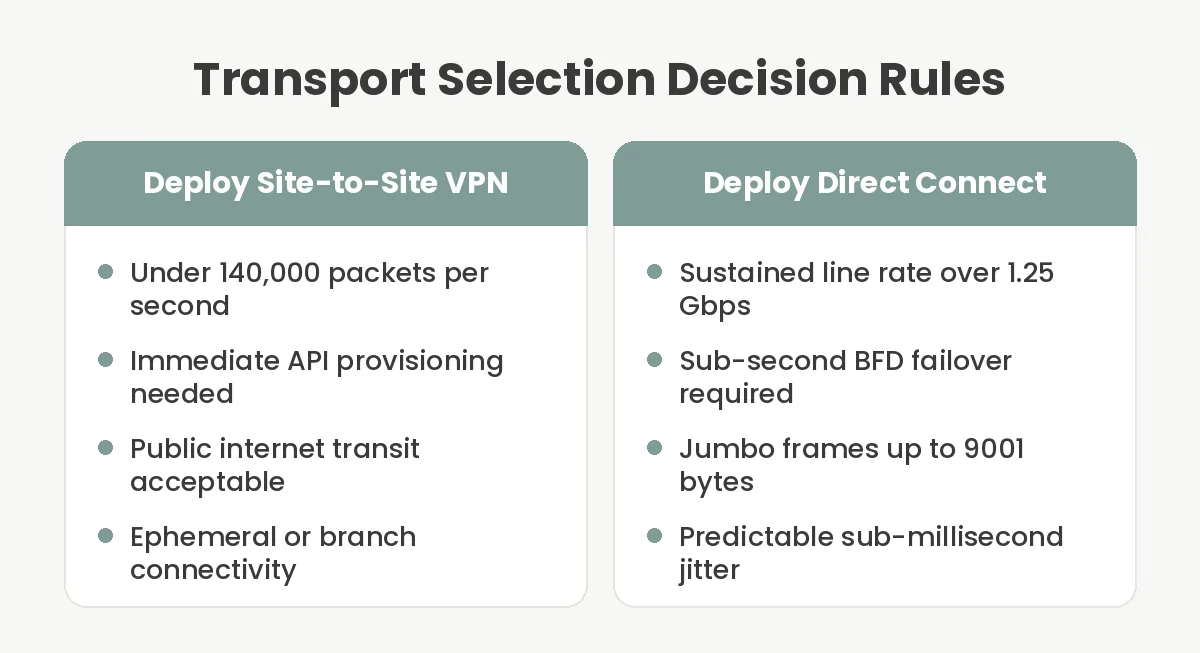
To choose between AWS Direct Connect and AWS Site-to-Site VPN, calculate your daily packet generation profile alongside your downtime recovery tolerance. Deploy AWS Site-to-Site VPN as an immediate baseline if network traffic remains under 140,000 packets per second and your recovery time objective tolerates 30-second path convergence. Migrate to AWS Direct Connect using hosted partner connections when application workloads require deterministic latency, jumbo frame transfer, or sustained line throughput above 1.25 Gbps.
For mission-critical production environments, implement dual Direct Connect circuits terminated across separate provider Points of Presence, backed by a dynamic Site-to-Site VPN tunnel. Configure Asynchronous BFD with 300 ms timers across Direct Connect virtual interfaces while disabling BGP Graceful Restart to enforce clean sub-second failover. Standardize customer gateway routing policies using explicit BGP Local Preference to eliminate asymmetric path drops between encrypted tunnels and physical fiber.
AWS Site-to-Site VPN does not support jumbo frames under any operational mode. Maximum transmission unit size is strictly capped at 1446 bytes to provide sufficient room for IPsec encapsulation headers. Direct Connect supports jumbo frames up to 9001 bytes on private interfaces.
Failover delays occur when BGP relies on default keepalive and hold timers without BFD enabled on the customer gateway. Furthermore, enabling BGP Graceful Restart forces AWS to wait for a 120-second timer to expire before purging failed Direct Connect routes from the network path.
Provisioning a dedicated physical AWS Direct Connect circuit takes between 4 to 12 weeks due to carrier procurement and cross-connect cabling inside colocation facilities. Hosted connections ordered through AWS Direct Connect Partners eliminate physical cabling lead times, provisioning in hours or days.
Configure dynamic BGP routing across both links and advertise matching CIDRs from your on-premises edge router. AWS automatically prioritizes Direct Connect over VPN routes internally, but you must apply BGP AS Path prepending or lower local preference on VPN routes outbound to ensure symmetric routing.
You Can Get More Information!