How to Calculate and Reduce Multi-Cloud Egress Costs in 2026
Learn how to model, forecast, and structurally reduce data egress fees when operating across multiple cloud providers.

Make email marketing simplified

Make email marketing simplified

Make email marketing simplified

Make email marketing simplified

Make email marketing simplified

Make email marketing simplified

Make email marketing simplified

Make email marketing simplified

Make email marketing simplified

Make email marketing simplified

Make email marketing simplified

Make email marketing simplified

Make email marketing simplified

Make email marketing simplified

Make email marketing simplified

We use cookies for our website to give you the most relevant experience by remembering your preferences. By clicking “accept”, you consent to use of ALL the cookies
This website uses cookies to improve your experience while you navigate through the website. Out of these, the cookies that are categorized as necessary are stored on your browser as they are essential for the working of basic functionalities of the website. We also use third-party cookies that help us analyze and understand how you use this website. These cookies will be stored in your browser only with your consent. You also have the option to opt-out of these cookies. But opting out of some of these cookies may affect your browsing experience.
Necessary cookies are absolutely essential for the website to function properly. These cookies ensure basic functionalities and security features of the website, anonymously.
| Cookie | Duration | Description |
|---|---|---|
| cookielawinfo-checkbox-functional | 11 months | This cookie is set by GDPR Cookie Consent plugin. The cookie is used to store the user consent for the cookies in the category “Analytics”. |
| cookielawinfo-checkbox-functional | 11 months | The cookie is set by GDPR cookie consent to record the user consent for the cookies in the category “Functional”. |
| cookielawinfo-checkbox-necessary | 11 months | This cookie is set by GDPR Cookie Consent plugin. The cookies is used to store the user consent for the cookies in the category “Necessary”. |
| cookielawinfo-checkbox-others | 11 months | This cookie is set by GDPR Cookie Consent plugin. The cookie is used to store the user consent for the cookies in the category “Other. |
| cookielawinfo-checkbox-performance | 11 months | This cookie is set by GDPR Cookie Consent plugin. The cookie is used to store the user consent for the cookies in the category “Performance”. |
| viewed_cookie_policy | 11 months | The cookie is set by the GDPR Cookie Consent plugin and is used to store whether or not user has consented to the use of cookies. It does not store any personal data. |
Functional cookies help to perform certain functionalities like sharing the content of the website on social media platforms, collect feedbacks, and other third-party features.
Performance cookies are used to understand and analyze the key performance indexes of the website which helps in delivering a better user experience for the visitors.
Analytical cookies are used to understand how visitors interact with the website. These cookies help provide information on metrics the number of visitors, bounce rate, traffic source, etc.
Advertisement cookies are used to provide visitors with relevant ads and marketing campaigns. These cookies track visitors across websites and collect information to provide customized ads.
Other uncategorized cookies are those that are being analyzed and have not been classified into a category as yet.
Cyberia Tech, Inc. respects your privacy. This Privacy Policy explains how we collect, use, and share your information. By using our services, you agree to this policy. If any other agreements conflict with this Privacy Policy, the terms of those agreements prevail.
Cyberia Tech complies with the EU-US and Swiss-US Privacy Shield Frameworks for handling personal data from the EEA, UK, and Switzerland. In case of any conflict, the Privacy Shield Principles prevail. Learn more at Privacy Shield. Key Definitions
Information linked to an individual, transferred from the EEA, UK, or Switzerland to the U.S.
Data revealing race, religion, health, sexual orientation, and similar categories.
Effective Date: [ 2026 / 11 / 26 ]
Welcome to The Cyberia Tech ! By accessing or using our website or services, you agree to
comply with and be bound by these Terms of Use and our Privacy Policy. If you do not agree with
these terms, please do not use our Services.
Loading
0 %
Your First Piece of the Puzzle in
Business Growth



When comparing Transit Gateway vs VPC Peering, VPC Peering is always cheaper and provides lower latency, whereas AWS Transit Gateway delivers centralized management for complex, multi-account topologies. Because Transit Gateway adds a $0.02 per gigabyte processing fee on top of a $0.05 hourly attachment charge, high data volumes make full-mesh peering financially superior at any scale.
Every engineering team scaling multi-VPC infrastructure faces a direct conflict between network operational simplicity and raw cloud infrastructure spend. Misunderstanding data transfer mechanics can inadvertently double your monthly AWS networking bill through redundant packet processing fees. Evaluating this layout requires inspecting our comprehensive Cloud Networking Architecture baseline. Choosing the wrong boundary creates unmanageable routing table sprawl or thousands of dollars in unnecessary processing overhead.
AWS VPC Peering has zero base cost and zero connection fees, while AWS Transit Gateway costs $0.05 per attachment-hour and $0.02 per gigabyte processed. In standard US regions like US East (N. Virginia), an active Transit Gateway VPC attachment running continuously across a 730-hour billing month incurs a fixed charge of $36.50 before processing a single byte.
The variable pricing structure creates stark operational divergence. According to the official AWS Transit Gateway pricing specification, every gigabyte sent into a Transit Gateway from an attached VPC, VPN, or Direct Connect incurs a flat $0.02 data processing fee. If two VPCs exchange 50 terabytes of data in a month through Transit Gateway, the data processing alone costs $1,024.00, alongside $73.00 in cumulative attachment fees for the two participating VPCs.
AWS VPC Peering does not charge hourly connection fees or packet processing overhead. As detailed in the AWS Networking & Content Delivery Blog, VPC Peering charges are entirely governed by raw underlying data transfer mechanics. Traffic that stays within the same Availability Zone (same AZ) and region is billed at $0.00 per gigabyte, meaning 50 terabytes transferred between co-located subnets incurs exactly $0.00.
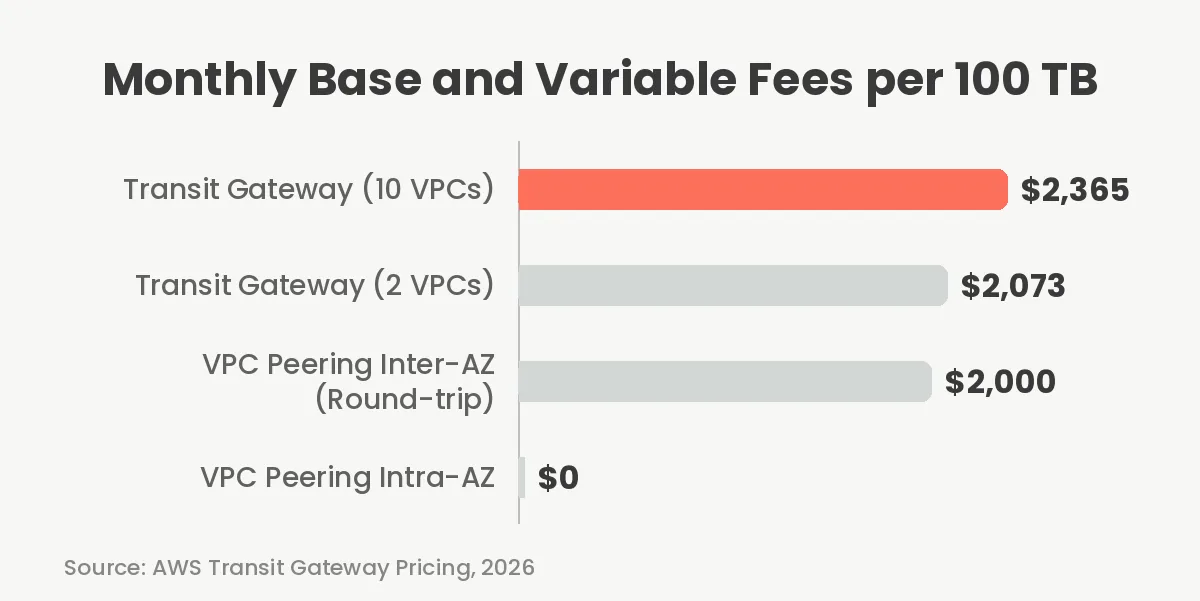
VPC Peering is mathematically cheaper than AWS Transit Gateway across every volume threshold because Transit Gateway charges an extra $0.02 per gigabyte processing fee on top of standard AWS data transfer rates. There is no positive data volume inflection point where Transit Gateway becomes more economical than point-to-point peering.
When resources reside in different Availability Zones within the same region, cross-AZ traffic over VPC Peering incurs standard inter-AZ data transfer fees of $0.01 per gigabyte for egress and $0.01 per gigabyte for ingress, totaling $0.02 per gigabyte round-trip. However, as documented by Spendark’s AWS Data Transfer Cost Map, routing this same inter-AZ traffic through Transit Gateway does not bypass cross-AZ costs; it incurs the cross-AZ transfer rate plus the $0.02 per gigabyte Transit Gateway processing fee. Teams looking to eliminate these base egress fees should consult our guide on how to design a zero-egress cloud network.
The table below outlines the structural cost differences across typical multi-VPC data profiles operating in US East over a 730-hour month:
| Architecture Configuration | Monthly Fixed Fee | Processing Fee (per GB) | Inter-AZ Fee (Round-Trip) | Total Cost (10 TB Inter-AZ) |
|---|---|---|---|---|
| 2 VPCs via VPC Peering | $0.00 | $0.00 | $0.02/GB | $204.80 |
| 2 VPCs via Transit Gateway | $73.00 | $0.02 | $0.02/GB | $482.60 |
| 10 VPCs via Peering (Full Mesh) | $0.00 | $0.00 | $0.02/GB | $204.80 |
| 10 VPCs via Transit Gateway | $365.00 | $0.02 | $0.02/GB | $774.60 |
The economic justification for Transit Gateway is never data transfer savings. Organizations adopt Transit Gateway solely to trade cloud infrastructure expenditure for reduced engineering labor, centralized firewall insertion, and streamlined routing management.
AWS VPC Peering has no bandwidth limits beyond the physical network throughput of the underlying EC2 instance types, while AWS Transit Gateway caps single VPC attachment throughput at 100 Gbps burst per Availability Zone. VPC Peering traffic flows directly across the software-defined AWS Nitro fabric without traversing intermediate gateways or aggregation bottlenecks.
Because VPC Peering relies on native Nitro hypervisor encapsulation, individual flows can achieve line-rate network speeds supported by the instance configuration, such as 100 Gbps or 200 Gbps network cards. As technical benchmarks by Hykell’s VPC Performance Optimization Guide demonstrate, distributed data clusters such as Apache Kafka, Cassandra, or distributed machine learning nodes experience zero aggregate interface throttling over direct VPC peering connections.
Conversely, AWS Transit Gateway manages traffic via virtual elastic network interfaces mapped into designated subnets. The official AWS Transit Gateway Quotas documentation confirms that each VPC attachment supports up to 100 Gbps burst bandwidth per Availability Zone. If aggregate cross-VPC traffic within a single AZ exceeds 100 Gbps during petabyte-scale analytics jobs, packets experience buffer queuing or drops unless traffic is partitioned across multiple attachment points.
AWS Transit Gateway introduces roughly 1.0 ms to 2.0 ms of additional network latency per round trip compared to direct VPC Peering. VPC Peering does not add extra networking hops, preserving native AWS software-defined physical network latency of 0.5 ms to 1.0 ms within the same Availability Zone.
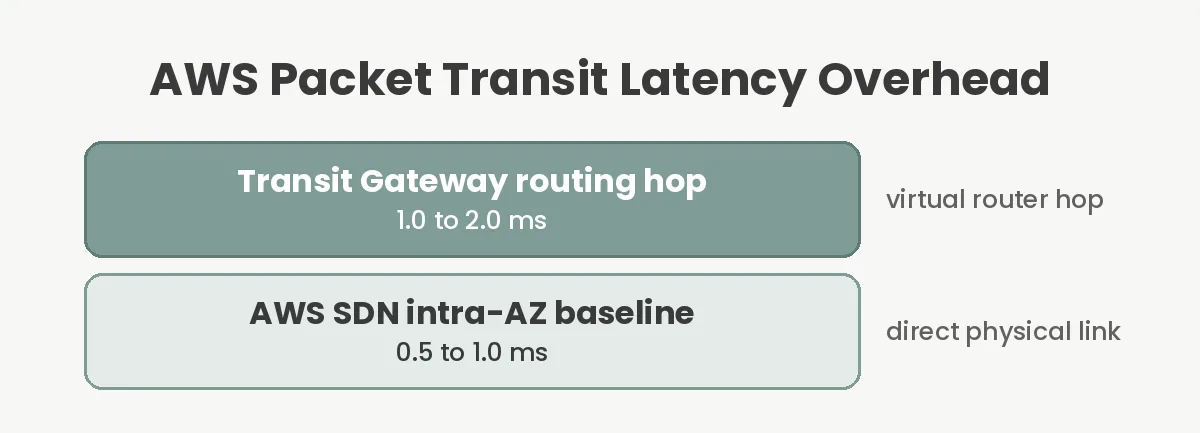
Transit Gateway acts as a managed distributed Layer 3 virtual router. When a packet departs an EC2 instance destined for an IP address behind a Transit Gateway, the local VPC route table directs the packet to the Transit Gateway elastic network interface. The packet must be processed by the Transit Gateway routing engine, evaluated against Transit Gateway route tables, and forwarded to the target attachment interface before reaching the destination subnet.
Empirical cloud latency benchmarks published by Hokstad Consulting confirm that direct intra-AZ network flows maintain sub-millisecond round-trip times. For microsecond-sensitive transactional systems, distributed financial ledgers, or ultra-low-latency caching rings, the 1 ms to 2 ms overhead imposed by Transit Gateway packet traversal represents an unacceptable performance penalty.
AWS VPC Peering does not support transitive routing under any operational configuration. Transitive routing is a network routing mechanism where traffic passes through an intermediate network hop (such as VPC-B) to reach a destination network (such as VPC-C) from an origin (VPC-A).
In a VPC Peering environment, if VPC-A is peered with VPC-B, and VPC-B is peered with VPC-C, instances in VPC-A cannot send packets to VPC-C through VPC-B. According to the AWS Multi-VPC Architecture Whitepaper, you must provision an explicit, direct VPC peering connection between VPC-A and VPC-C. This design limitation forces organizations with extensive inter-service connectivity requirements into a complex full-mesh architecture.
A full-mesh VPC peering topology scales quadratically according to the mathematical formula:
Connections = N(N - 1) / 2
Connecting 10 VPCs in a full mesh requires 45 peering connections. Scaling to 20 VPCs requires 190 peering connections, and 50 VPCs requires 1,225 peering connections. Each peering link demands individual route table entries across subnets in both directions, making manual administration impossible without extensive Infrastructure as Code tooling.

Full-mesh VPC Peering breaks down when a single VPC requires connections to more than 125 other VPCs, or when route table maintenance exhausts engineering resources. The default AWS service quota allows 50 active peering connections per VPC, which can be extended to an absolute maximum hard ceiling of 125 connections.
The AWS VPC Peering Quotas documentation establishes that the 125-connection quota cannot be increased under any support plan. If an organization operates a centralized shared-services VPC hosting common Active Directory, telemetry, or authentication clusters, that central hub cannot communicate directly with more than 125 spoke VPCs via peering. Teams hitting these routing bottlenecks frequently run into costly VPC subnet and routing mistakes that degrade availability.
AWS Transit Gateway resolves this geometric scaling failure. Transit Gateway is a regional managed virtual router and network transit hub that connects Amazon VPCs, on-premises networks, and services through a central hub-and-spoke topology. A single Transit Gateway supports up to 5,000 attachments per gateway and up to 10,000 routes across its route tables. Instead of configuring hundreds of peering routes, spoke VPCs simply point a default 10.0.0.0/8 or 0.0.0.0/0 route directly to the Transit Gateway attachment.
VPC Peering natively supports cross-VPC Security Group referencing within the same AWS Region, whereas AWS Transit Gateway does not support referencing remote Security Group IDs. In a peered configuration, an engineer can create an ingress rule on an Amazon RDS database allowing incoming traffic exclusively from `sg-0123456789abcdef0` residing in an entirely different VPC.
This capability provides fine-grained, dynamic access control that decouples security rules from static IP address layouts. When auto-scaling groups in application VPCs spin up new instances, their dynamic private IP addresses are automatically authorized by the receiving database security group through identity-based referencing.
Migrating from VPC Peering to Transit Gateway breaks this workflow. Because Transit Gateway drops security group metadata during transit encapsulation, security groups on destination instances must define ingress policies using static CIDR IP ranges. This forces security teams to open rules to entire subnet blocks or construct automated IP management pipelines to track dynamic host allocations.
AWS Transit Gateway allows organizations to centralize internet egress and east-west firewall inspection into a single inspection VPC, eliminating the need to deploy dedicated NAT Gateways or firewall appliances in every spoke. This architectural consolidation often recovers more capital than the Transit Gateway processing fees consume.
A standard AWS NAT Gateway costs $0.045 per hour ($32.85 per month) plus $0.045 per gigabyte processed. In an enterprise maintaining 30 spoke VPCs across 3 Availability Zones, running local NAT Gateways requires deploying 90 active NAT Gateways, generating $2,956.50 in monthly base infrastructure charges alone. Consolidating internet-bound traffic through Transit Gateway into an egress hub allows the entire organization to share 3 central NAT Gateways, slashing baseline fees by over $2,800 monthly as highlighted in our analysis on reducing AWS NAT Gateway costs.
Similarly, teams deploying centralized Layer 7 firewall appliances, such as AWS Network Firewall or third-party next-generation firewalls, can utilize Transit Gateway appliance mode to enforce stateful traffic symmetry. Appliance mode pins bidirectional packet streams between spoke VPCs to the same Availability Zone and firewall worker node, preventing dropped sessions caused by asymmetric routing.
The most catastrophic failure mode in AWS Transit Gateway architectures is asymmetric routing caused by mismatched subnet attachments across multiple Availability Zones. When creating a Transit Gateway attachment, engineers must select exactly one subnet per Availability Zone to house the attachment interface.
If an engineer attaches a VPC using a subnet in Availability Zone A, but instances in that VPC reside in Availability Zone B without a corresponding attachment subnet, AWS must route packets across internal availability zones. If the return packet chooses an alternative path, stateful middleboxes such as firewalls drop the connection because they only observe one side of the TCP handshake.
Another prevalent failure mode involves route table blackholing during transitive migrations. When migrating live production services from point-to-point peering to Transit Gateway, failing to remove the more-specific VPC peering routes from the subnet route table causes traffic to continue utilizing the peering connection. Under standard AWS longest-prefix-match rules, existing /24 peering routes override broader /16 or /8 Transit Gateway routes, leading to silent routing failures during connection teardowns.
Choose direct VPC Peering when connecting fewer than 15 VPCs with high inter-service data volumes exceeding 50 terabytes monthly, or when applications require strict sub-millisecond network latency. Point-to-point peering provides unmatched price-performance, zero processing penalties, line-rate Nitro hypervisor throughput, and native cross-VPC security group referencing.
Choose AWS Transit Gateway when managing large-scale multi-account environments exceeding 20 VPCs, integrating on-premises networks via AWS Direct Connect and IPsec VPNs, or centralizing internet egress through shared NAT Gateways and firewall inspection pools. While Transit Gateway introduces a $0.02 per gigabyte processing tax and 1 ms of latency, it eliminates quadratic route table sprawl and provides deterministic, hub-and-spoke network isolation.
VPC Peering is consistently cheaper than Transit Gateway at all data volumes. VPC Peering charges zero hourly connection fees and zero data processing fees, whereas Transit Gateway charges $0.05 per attachment-hour plus an additional $0.02 per gigabyte processed for all transiting data.
Transit Gateway introduces roughly 1.0 ms to 2.0 ms of network latency overhead per request. VPC Peering operates directly across the physical AWS network backbone without intermediate routing hops, preserving baseline sub-millisecond latency (typically 0.5 ms to 1.0 ms) inside the same Availability Zone.
A single VPC cannot maintain more than 125 active peering connections. The default AWS quota is 50 active peering connections, which can be raised to an absolute hard limit of 125. Connecting estates larger than 125 VPCs requires deploying AWS Transit Gateway.
VPC Peering data transfer is completely free ($0.00 per gigabyte) when traffic stays within the exact same Availability Zone and AWS Region. However, if traffic crosses Availability Zone boundaries within the same region, standard inter-AZ transfer charges of $0.02 per gigabyte round-trip apply.
You Can Get More Information!