How to Calculate and Reduce Multi-Cloud Egress Costs in 2026
Learn how to model, forecast, and structurally reduce data egress fees when operating across multiple cloud providers.

Make email marketing simplified

Make email marketing simplified

Make email marketing simplified

Make email marketing simplified

Make email marketing simplified

Make email marketing simplified

Make email marketing simplified

Make email marketing simplified

Make email marketing simplified

Make email marketing simplified

Make email marketing simplified

Make email marketing simplified

Make email marketing simplified

Make email marketing simplified

Make email marketing simplified

We use cookies for our website to give you the most relevant experience by remembering your preferences. By clicking “accept”, you consent to use of ALL the cookies
This website uses cookies to improve your experience while you navigate through the website. Out of these, the cookies that are categorized as necessary are stored on your browser as they are essential for the working of basic functionalities of the website. We also use third-party cookies that help us analyze and understand how you use this website. These cookies will be stored in your browser only with your consent. You also have the option to opt-out of these cookies. But opting out of some of these cookies may affect your browsing experience.
Necessary cookies are absolutely essential for the website to function properly. These cookies ensure basic functionalities and security features of the website, anonymously.
| Cookie | Duration | Description |
|---|---|---|
| cookielawinfo-checkbox-functional | 11 months | This cookie is set by GDPR Cookie Consent plugin. The cookie is used to store the user consent for the cookies in the category “Analytics”. |
| cookielawinfo-checkbox-functional | 11 months | The cookie is set by GDPR cookie consent to record the user consent for the cookies in the category “Functional”. |
| cookielawinfo-checkbox-necessary | 11 months | This cookie is set by GDPR Cookie Consent plugin. The cookies is used to store the user consent for the cookies in the category “Necessary”. |
| cookielawinfo-checkbox-others | 11 months | This cookie is set by GDPR Cookie Consent plugin. The cookie is used to store the user consent for the cookies in the category “Other. |
| cookielawinfo-checkbox-performance | 11 months | This cookie is set by GDPR Cookie Consent plugin. The cookie is used to store the user consent for the cookies in the category “Performance”. |
| viewed_cookie_policy | 11 months | The cookie is set by the GDPR Cookie Consent plugin and is used to store whether or not user has consented to the use of cookies. It does not store any personal data. |
Functional cookies help to perform certain functionalities like sharing the content of the website on social media platforms, collect feedbacks, and other third-party features.
Performance cookies are used to understand and analyze the key performance indexes of the website which helps in delivering a better user experience for the visitors.
Analytical cookies are used to understand how visitors interact with the website. These cookies help provide information on metrics the number of visitors, bounce rate, traffic source, etc.
Advertisement cookies are used to provide visitors with relevant ads and marketing campaigns. These cookies track visitors across websites and collect information to provide customized ads.
Other uncategorized cookies are those that are being analyzed and have not been classified into a category as yet.
Cyberia Tech, Inc. respects your privacy. This Privacy Policy explains how we collect, use, and share your information. By using our services, you agree to this policy. If any other agreements conflict with this Privacy Policy, the terms of those agreements prevail.
Cyberia Tech complies with the EU-US and Swiss-US Privacy Shield Frameworks for handling personal data from the EEA, UK, and Switzerland. In case of any conflict, the Privacy Shield Principles prevail. Learn more at Privacy Shield. Key Definitions
Information linked to an individual, transferred from the EEA, UK, or Switzerland to the U.S.
Data revealing race, religion, health, sexual orientation, and similar categories.
Effective Date: [ 2026 / 11 / 26 ]
Welcome to The Cyberia Tech ! By accessing or using our website or services, you agree to
comply with and be bound by these Terms of Use and our Privacy Policy. If you do not agree with
these terms, please do not use our Services.
Loading
0 %
Your First Piece of the Puzzle in
Business Growth



Multi-cloud egress costs dictate the financial viability of spanning workloads across AWS, Azure, and Google Cloud in 2026. You calculate these fees by multiplying outbound internet transfer volume by provider-specific rates, which range from Azure’s $0.087 per GB to Google Cloud’s Premium Tier at $0.12 per GB.
Engineering teams routinely miscalculate the financial penalty of spanning services across multiple cloud providers. A simple database read spanning from an AWS application tier to a Google Cloud analytical cluster triggers full outbound internet rates on every query. The resulting cloud egress fees quickly eclipse the compute costs of the instances processing the data. Building resilient, multi-region setups requires integrating egress optimization directly into your modern web application infrastructure from day one, rather than treating network bills as an uncontrollable utility expense.
Calculating multi-cloud egress costs requires establishing the baseline internet transfer rates for each provider. Cloud providers structure their data transfer pricing using tiered billing models that decrease in per-unit cost as your outbound volume grows. Before any data leaves the data center, it passes through regional metering systems that log the destination IP address and aggregate the byte count.
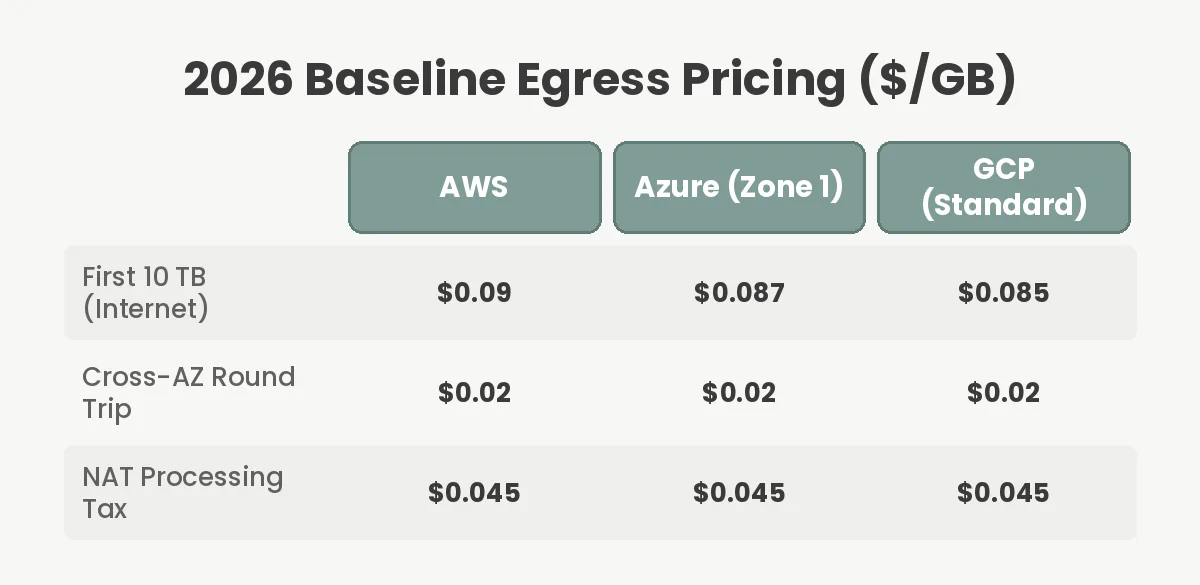
AWS and Azure maintain closely aligned base rates for standard internet egress. AWS charges $0.09 per GB for the first 10 TB of outbound internet traffic per month. This rate applies after a shared 100 GB monthly free tier. Azure closely matches this structure, charging $0.087 per GB for outbound internet egress in Zone 1, which covers the US, Canada, Europe, and the UK, following its own 100 GB free tier. These rates represent the absolute floor for unoptimized, direct-to-internet data transfer from a virtual machine or container.
All three major providers utilize the exact same model for incoming data: it costs nothing. Data entering Google Cloud, AWS, and Azure (ingress) is completely free across all three major platforms. Providers incentivize moving datasets into their ecosystem, applying friction entirely on the extraction phase.
| Cloud Provider | Tier / Zone | Base Internet Egress (per GB) | Free Tier Allowance |
|---|---|---|---|
| AWS | Standard | $0.09 | 100 GB / month |
| Azure | Zone 1 | $0.087 | 100 GB / month |
| Google Cloud | Premium Tier | $0.12 | None (First 1 TB rate) |
| Google Cloud | Standard Tier | $0.085 | None (Flat rate) |
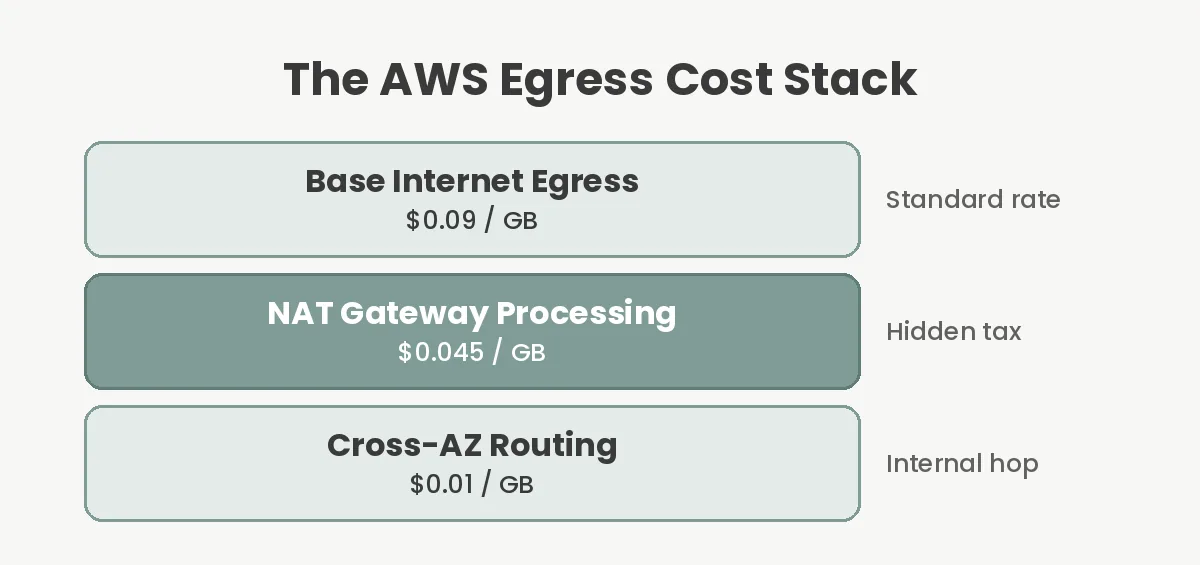
AWS data transfer pricing extends far beyond the perimeter of the Virtual Private Cloud (VPC). Internal network hops generate substantial costs before traffic ever reaches the public internet. AWS cross-Availability Zone (AZ) traffic costs $0.01 per GB in each direction, resulting in a $0.02 per GB round-trip cost for any synchronous replication or load-balanced request that crosses physical data center boundaries within the same region.
Physical distance dictates these internal charges. AWS Availability Zones operate as discrete physical data centers, often separated by tens of miles to ensure fault tolerance against localized disasters. Pushing gigabytes of state data across this physical fiber requires maintaining dedicated dark fiber networks, a cost AWS passes directly to the consumer. For example, if a legacy application architecture syncs a 500 GB relational database payload every hour across three AZs for high availability, that background process alone generates 36 TB of monthly internal traffic. At $0.02 per GB round-trip, this architectural choice quietly adds $720 to the monthly infrastructure bill before a single byte serves an actual customer.
Network misconfigurations frequently trigger unnecessary cross-AZ billing. Communicating over public or Elastic IP addresses within the exact same AWS Availability Zone triggers the $0.01 per GB cross-AZ charge. Routing that exact same traffic over private IPs remains completely free. According to recent 2026 AWS pricing analysis, forcing internal services to resolve public DNS names is a leading cause of inflated data transfer bills for early-stage infrastructure.
Architects must trace the entire path of a packet to predict the final bill. A request that hits an Application Load Balancer in AZ-A, routes to a backend target in AZ-B, and queries a database in AZ-C accumulates multiple internal transfer fees before returning the payload to the internet.
Google Cloud operates a bifurcated network model that fundamentally changes how you calculate its egress footprint. Google Cloud’s default Premium Tier egress is the highest base rate among the top three providers, starting at $0.12 per GB for the first 1 TB out to the internet. This premium uses “cold potato” routing. It carries the packet on Google’s private trans-oceanic submarine cables all the way to an edge Point of Presence (PoP) nearest the end user before handing it to a local ISP, ensuring maximum speed and reliability.
Organizations prioritizing cost over latency utilize the alternative Standard Tier for internet egress. Priced at a flat $0.085 per GB, it slightly undercuts standard AWS and Azure rates. This tier uses “hot potato” routing. When an application in GCP’s US-Central region sends a payload to a user in Berlin, the Google edge router hands the packet off to a third-party transit provider at the closest possible peering point in North America. The packet then navigates the public internet’s unpredictable multi-provider hops across the Atlantic. A heavily cited 2026 consulting post claims Google Cloud offers a generous 200 GB free egress allowance on this Standard Tier. Dedicated 2026 Google Cloud cost trackers prove this false: Standard Tier internet egress is billed at the flat $0.085 per GB rate without a 200 GB free allowance.
Enterprise networking saw massive cost shifts mid-year. Effective May 1, 2026, Google Cloud doubled its Direct Peering, CDN Interconnect, and Carrier Peering egress pricing. North American peering rates rose from $0.04 to $0.08 per GB. Companies running hybrid architectures that relied on direct interconnects to bypass public egress rates suddenly found their dedicated pipelines costing nearly as much as standard internet transfer. A media streaming company moving 100 TB monthly across a North American interconnect saw its fixed $4,000 peering bandwidth bill instantly spike to $8,000, destroying the cost-advantage of their hybrid deployment.
Microsoft Azure structures its bandwidth pricing around geographic zones and peering agreements. While the $0.087 per GB Zone 1 internet rate applies to external users, multi-region architectures benefit from specific intra-network discounts. Azure intra-continental inter-region data transfers are billed at $0.02 per GB. This applies when moving data between two regions within North America, or between two regions within Europe.
Microsoft occasionally implements region-specific pricing anomalies that architects can exploit. While cloud providers notoriously charge for cross-AZ traffic globally, Azure quietly made AZ-to-AZ data transfers within its UK South region completely free starting in 2023. Organizations operating high-throughput, highly available workloads in the UK eliminate internal replication costs entirely by consolidating inside this specific geography.
Predicting an Azure network bill requires strict adherence to Microsoft’s official bandwidth documentation. Moving data between zones (e.g., from US to Asia) incurs significantly higher inter-continental transfer rates, heavily penalizing global active-active database architectures that require synchronous write replication across oceans.

The single most destructive component to a multi-cloud network budget is the managed Network Address Translation (NAT) service. AWS NAT Gateways add an invisible data processing fee of $0.045 per GB on top of the standard internet egress rates. If a private subnet pulls a 1 GB container image from Docker Hub, you pay $0.045 to process it through the NAT Gateway, plus the standard data transfer costs.
This fee exists because network address translation is highly CPU and memory intensive. The managed NAT appliance must intercept every outbound packet, rewrite the private source IP to a public Elastic IP, dynamically map the ephemeral port, and store this connection state in memory to ensure returning packets route back to the correct private instance. When a fleet of worker nodes pulls thousands of container images simultaneously, the NAT gateway consumes significant compute resources managing these concurrent state tables. The $0.045 per GB processing tax directly monetizes this underlying compute overhead.
If a private instance pushes 1 TB of telemetry data to a third-party observability platform, the NAT Gateway processing fee equals $45, before factoring in the $90 internet egress charge. The combined effective rate becomes $0.135 per GB. Engineering teams must migrate to VPC Endpoints to route AWS API traffic internally, bypassing the NAT Gateway processing tax entirely. Interface VPC Endpoints deploy Elastic Network Interfaces (ENIs) directly into your subnet. This mechanism allows resources to communicate with services like S3 over the AWS backbone without hitting NAT state tables. For a data pipeline writing 50 TB of logs monthly, migrating from a NAT Gateway route to a VPC Endpoint instantly removes $2,250 in processing fees.
Azure NAT Gateway and Google Cloud Cloud NAT employ similar processing charges, though their tiered structures differ slightly based on hourly deployment costs versus pure bandwidth throughput. Analyzing the VPC flow logs isolates exactly which internal instances are driving high outbound traffic volumes through expensive managed gateway appliances.
Integrating a Content Delivery Network (CDN) is the most immediate mechanism for reducing cloud bandwidth costs. Cloud providers heavily discount data moving from their core compute services to their proprietary edge networks. AWS eliminates egress fees entirely for data transferred from an AWS origin, such as an S3 bucket or an EC2 instance, to its CloudFront CDN.
By forcing outbound payloads through CloudFront, the base internet egress rate drops. CloudFront’s base rate is $0.085 per GB, making it inherently cheaper than direct EC2 egress at $0.09 per GB. Furthermore, cached responses serve directly from the edge. When a client requests a static asset and receives a cache hit, the origin server processes zero outbound data transfer.
A tangible example highlights this efficiency. Consider a media platform serving 100 TB of static assets monthly. Routing this directly from an EC2 instance to the internet costs $9,000 at the standard rate. Pushing that same 100 TB through CloudFront costs $8,500. However, the true savings stem from edge caching mechanisms. A properly configured CDN achieves a 95% cache hit rate by storing responses in the PoP’s memory hierarchy. The EC2 origin only processes the 5 TB of cache misses. Because AWS waives the internal egress for those 5 TB moving to CloudFront, the application tier generates zero internal network costs. The entire 100 TB delivery is billed exclusively at the CDN edge.
Optimizing the internal caching layer prevents redundant database reads from triggering subsequent network responses. Deploying highly available memory stores minimizes the need to re-fetch identical datasets. Teams migrating web app caching layers often overlook that a well-tuned cache architecture reduces internal cross-AZ network traffic just as effectively as it reduces application latency.
Multi-cloud architectures naturally multiply network complexity, creating fertile ground for billing errors. The most common failure mode occurs when teams misunderstand how traffic routes between an AWS VPC and a GCP virtual network. Sending traffic over the public internet via VPN tunnels encrypts the payload, but the cloud provider still meters it as standard outbound internet egress at full retail rates.
Another prevalent mistake involves poorly configured DNS resolution inside container orchestration platforms. If a CoreDNS instance inside a Kubernetes cluster is configured to forward unresolved queries to a public resolver like 8.8.8.8 instead of an internal stub, the lookup returns public IP addresses for external multi-cloud services. Traffic routing to those public IPs is forced out through the NAT Gateway, hits the internet gateway, and re-enters the destination cloud, incurring maximum possible billing on both NAT processing and public egress layers.
Failing to utilize localized caching for external dependencies guarantees bloated network bills. Applications that download the exact same machine learning models or software dependencies from external repositories on every container startup waste terabytes of bandwidth. Architects must proxy these external dependencies through local artifact registries to cache the ingress data, preventing identical payloads from crossing the billing boundary repeatedly.
Legislative pressure has forced structural changes to how clouds charge for data extraction. The EU Data Act (Article 29) legally mandates that cloud providers must completely abolish “switching charges,” including exit egress fees, by January 12, 2027. Ahead of this deadline, providers launched programs claiming to eliminate data lock-in.
A massive misconception persists that the recent “free egress” announcements mean multi-cloud data transfer costs are going away. In reality, these waivers apply exclusively to one-way, permanent account migrations. AWS, Google Cloud, and Azure introduced free exit egress programs in 2024, but Azure and Google require customers to declare their intent to exit, apply via support, and complete the migration within a strict 60-day window.
Routine day-to-day multi-cloud egress, BCDR replication, and active-active data transfer are explicitly excluded from these waivers and remain fully billable. According to the UK government’s analysis of switching programmes, providers verify that you cancel your subscription and delete the original data. Organizations analyzing bare metal repatriation economics can leverage these waivers to execute the final exit, but they offer zero relief for hybrid operational workflows.

Slashing multi-cloud egress costs usually requires trading away network performance and reliability. Shifting traffic to Google Cloud’s Standard Tier saves $0.035 per GB, but it utilizes cold potato routing hand-offs. Google hands your traffic to a third-party internet service provider as quickly as possible. The packet travels across public, unpredictable transit routes rather than Google’s heavily optimized, congestion-controlled private backbone.
This architectural trade-off introduces severe jitter for real-time applications. WebRTC traffic, VoIP services, and synchronous database replication across clouds suffer from elevated packet loss when forced over cheaper tiers. Standard Tier routing is entirely inappropriate for latency-sensitive multi-cloud communication.
Similarly, relying heavily on CDN caching to reduce origin egress costs introduces cache invalidation complexities. Aggressively caching dynamic API responses lowers the AWS bandwidth bill but risks serving stale data to end users. Architects must implement sophisticated cache-control headers and automated invalidation pipelines, shifting the burden from the monthly network invoice to the engineering team’s maintenance backlog.
AWS charges $0.09 per GB for the first 10 TB of outbound internet traffic per month. This baseline rate applies after a shared 100 GB monthly free tier is exhausted across the account.
Yes, data entering Google Cloud, AWS, and Azure is completely free. Cloud providers apply zero charges to incoming traffic to encourage customers to migrate vast datasets into their proprietary storage and compute ecosystems.
AWS cross-Availability Zone traffic costs $0.01 per GB in each direction. This results in a $0.02 per GB round-trip cost when moving data between different physical data centers within the same AWS region.
No. The EU Data Act mandates the abolition of switching charges by January 12, 2027, but this applies strictly to permanent, one-way account migrations. Routine day-to-day active multi-cloud egress remains fully billable.
Google Cloud offers the Standard Tier for internet egress at a flat rate of $0.085 per GB. Contrary to some claims, this tier does not include a 200 GB free allowance.
Controlling multi-cloud egress costs in 2026 demands strict architectural discipline. You cannot treat outbound network volume as an acceptable operational byproduct. Every external API call, cross-AZ database replication, and untuned NAT Gateway deployment compounds the monthly invoice at retail rates. Teams must enforce private IP routing, bypass processing taxes using VPC endpoints, and aggressively push static assets to provider-native CDNs. Audit your flow logs to identify exactly which internal services are generating outbound internet traffic, and block any data transfer path that defaults to public routing when a private backbone alternative exists.
You Can Get More Information!