Redis vs Valkey: Migrating Web App Caching Layers in 2026
Answer: The primary operational difference between Redis and Valkey is...

Make email marketing simplified

Make email marketing simplified

Make email marketing simplified

Make email marketing simplified

Make email marketing simplified

Make email marketing simplified

Make email marketing simplified

Make email marketing simplified

Make email marketing simplified

Make email marketing simplified

Make email marketing simplified

Make email marketing simplified

Make email marketing simplified

Make email marketing simplified

Make email marketing simplified

We use cookies for our website to give you the most relevant experience by remembering your preferences. By clicking “accept”, you consent to use of ALL the cookies
This website uses cookies to improve your experience while you navigate through the website. Out of these, the cookies that are categorized as necessary are stored on your browser as they are essential for the working of basic functionalities of the website. We also use third-party cookies that help us analyze and understand how you use this website. These cookies will be stored in your browser only with your consent. You also have the option to opt-out of these cookies. But opting out of some of these cookies may affect your browsing experience.
Necessary cookies are absolutely essential for the website to function properly. These cookies ensure basic functionalities and security features of the website, anonymously.
| Cookie | Duration | Description |
|---|---|---|
| cookielawinfo-checkbox-functional | 11 months | This cookie is set by GDPR Cookie Consent plugin. The cookie is used to store the user consent for the cookies in the category “Analytics”. |
| cookielawinfo-checkbox-functional | 11 months | The cookie is set by GDPR cookie consent to record the user consent for the cookies in the category “Functional”. |
| cookielawinfo-checkbox-necessary | 11 months | This cookie is set by GDPR Cookie Consent plugin. The cookies is used to store the user consent for the cookies in the category “Necessary”. |
| cookielawinfo-checkbox-others | 11 months | This cookie is set by GDPR Cookie Consent plugin. The cookie is used to store the user consent for the cookies in the category “Other. |
| cookielawinfo-checkbox-performance | 11 months | This cookie is set by GDPR Cookie Consent plugin. The cookie is used to store the user consent for the cookies in the category “Performance”. |
| viewed_cookie_policy | 11 months | The cookie is set by the GDPR Cookie Consent plugin and is used to store whether or not user has consented to the use of cookies. It does not store any personal data. |
Functional cookies help to perform certain functionalities like sharing the content of the website on social media platforms, collect feedbacks, and other third-party features.
Performance cookies are used to understand and analyze the key performance indexes of the website which helps in delivering a better user experience for the visitors.
Analytical cookies are used to understand how visitors interact with the website. These cookies help provide information on metrics the number of visitors, bounce rate, traffic source, etc.
Advertisement cookies are used to provide visitors with relevant ads and marketing campaigns. These cookies track visitors across websites and collect information to provide customized ads.
Other uncategorized cookies are those that are being analyzed and have not been classified into a category as yet.
Cyberia Tech, Inc. respects your privacy. This Privacy Policy explains how we collect, use, and share your information. By using our services, you agree to this policy. If any other agreements conflict with this Privacy Policy, the terms of those agreements prevail.
Cyberia Tech complies with the EU-US and Swiss-US Privacy Shield Frameworks for handling personal data from the EEA, UK, and Switzerland. In case of any conflict, the Privacy Shield Principles prevail. Learn more at Privacy Shield. Key Definitions
Information linked to an individual, transferred from the EEA, UK, or Switzerland to the U.S.
Data revealing race, religion, health, sexual orientation, and similar categories.
Effective Date: [ 2026 / 10 / 25 ]
Welcome to The Cyberia Tech ! By accessing or using our website or services, you agree to
comply with and be bound by these Terms of Use and our Privacy Policy. If you do not agree with
these terms, please do not use our Services.
Loading
0 %
Your First Piece of the Puzzle in
Business Growth



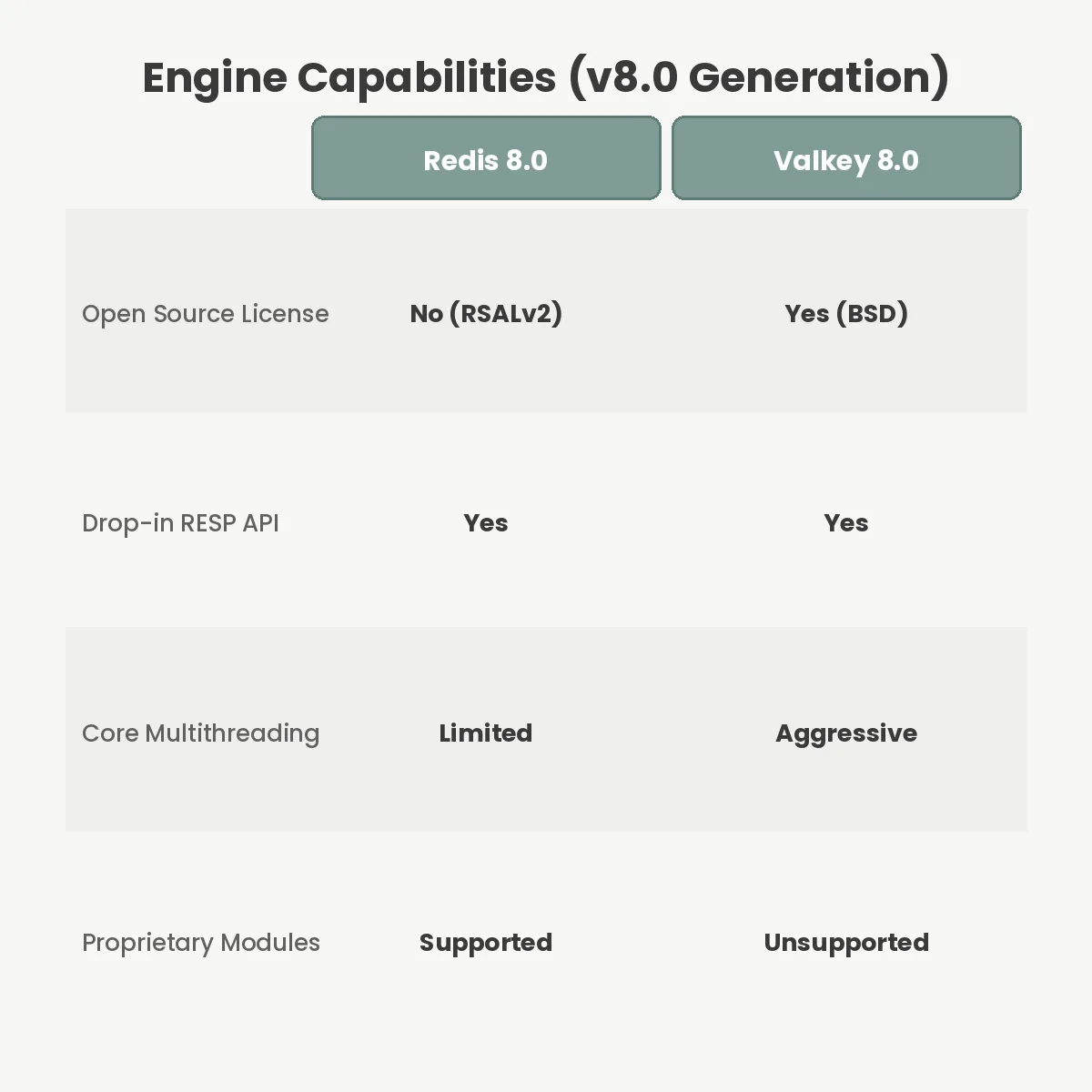
Answer: The primary operational difference between Redis and Valkey is licensing and multi-core scaling. While Redis transitioned to a restrictive dual license in 2024, Valkey remains open-source under the Linux Foundation, offering drop-in compatibility alongside architectural optimizations that yield up to 2x higher throughput on multi-vCPU virtual machines.
Caching layers operate as the critical latency buffer for high-throughput web applications. When Redis Labs abandoned the BSD license for the Server Side Public License (SSPLv1) and Redis Source Available License (RSALv2) in March 2024, infrastructure engineering teams faced a sudden compliance and cost mandate. Maintaining managed Redis suddenly meant accepting vendor lock-in or higher enterprise tiers. Enter Valkey, the Linux Foundation fork backed by AWS, Google, and Oracle. Evaluating this migration requires looking past the community politics and directly at system throughput, memory overhead, and managed service pricing models.
For over a decade, Redis served as the default in-memory datastore for session management, queueing, and transient caching. The shift to a dual-license model in March 2024 explicitly targeted cloud providers monetizing open-source software, but the collateral damage hit enterprise compliance departments. Organizations bound by strict open-source software (OSS) policies suddenly found version 7.4 and beyond out of bounds.
The Linux Foundation launched Valkey as an immediate fork of Redis 7.2.4. Because the original code was BSD-licensed, the fork retained that permissive structure. Major cloud providers instantly redirected their engineering resources into Valkey, accelerating its roadmap. By September 2024, the release of Valkey 8.0 demonstrated that the project was no longer just a legal safe harbor; it was actively diverging in its underlying C architecture.
Infrastructure teams cannot make caching decisions based purely on open-source philosophy. The datastore must integrate cleanly with existing CI/CD pipelines, observability sidecars, and automated failover systems. Fortunately, Valkey maintained absolute wire compatibility with the Redis Serialization Protocol (RESP2 and RESP3), meaning existing client libraries require zero code changes to connect to a Valkey node.
The most significant bottleneck in traditional Redis deployments is its single-threaded execution model. While Redis 6.0 introduced limited I/O threading for reading and writing to sockets, the core command execution remained pinned to a single CPU core. This architectural choice ensured atomic operations and predictable consistency but stranded compute capacity on modern multi-core instances.
Valkey 8.0 rewrote the I/O threading pipeline. Instead of just offloading network reads and writes, the engine introduced asynchronous execution for specific read-only commands and improved lock contention across dictionary rehashes. This allows background threads to process cache misses and metadata lookups without blocking the primary mutation thread.
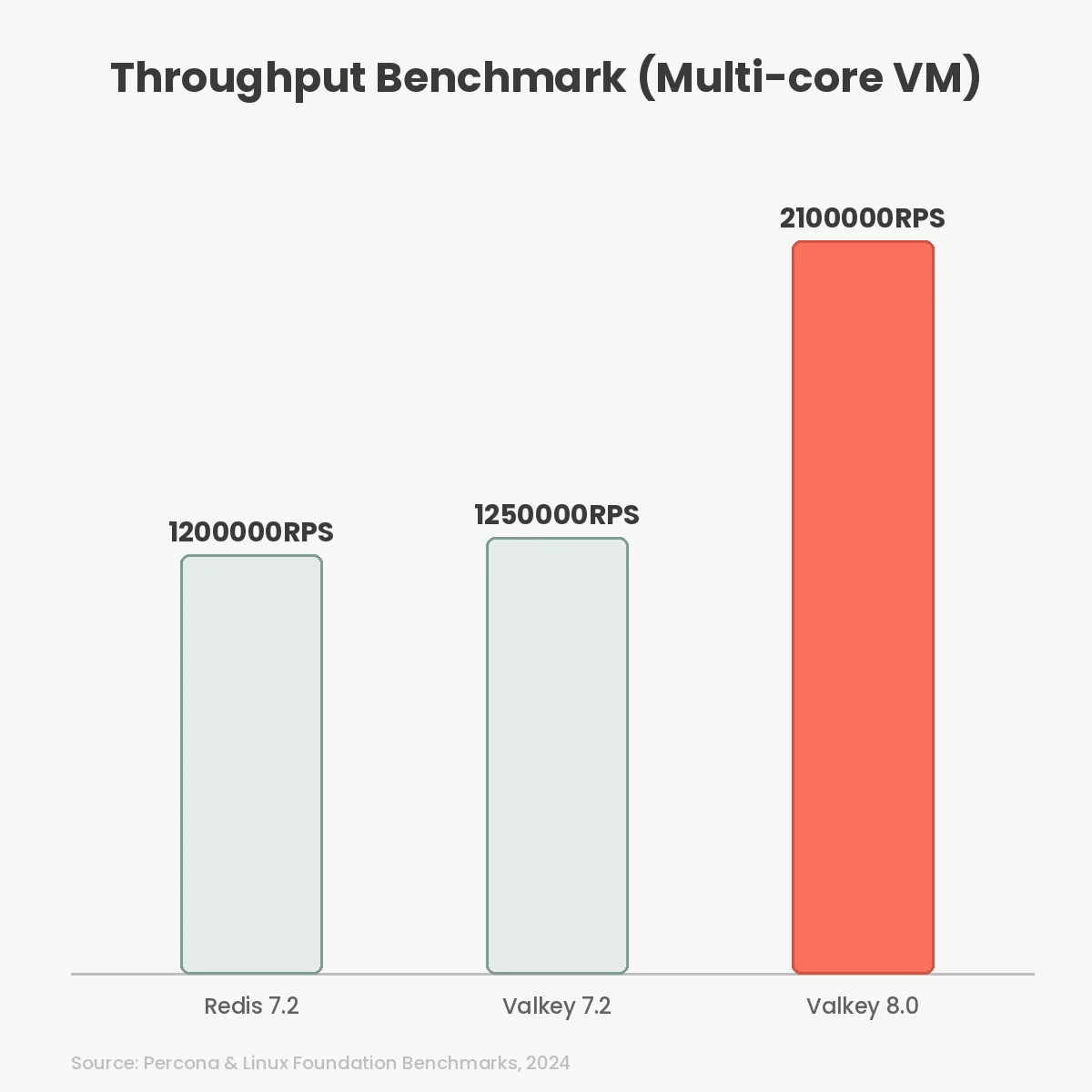
In production benchmarks running on AWS m7g (Graviton3) instances, this multi-threading optimization yields up to a 2x increase in requests per second (RPS) compared to Redis 7.2 under heavy concurrent loads. For engineering teams diagnosing high TTFB latencies, increasing throughput without scaling vertically to higher-tier VMs directly improves bottom-line infrastructure costs.
In-memory datastores are priced almost entirely by RAM capacity. When caching large JSON payloads or extensive hash dictionaries for active web sessions, pointer overhead and memory fragmentation dictate how often the eviction policies trigger. Redis relies on Jemalloc to manage heap allocations, but deeply nested keys still incur heavy metadata penalties.
Valkey 8.0 shipped with optimized dictionary structures and more aggressive memory defragmentation routines. By minimizing the structural overhead of hash tables, Valkey reduced baseline memory consumption by approximately 10% for workloads utilizing millions of small keys. This translates directly to fewer cache evictions and a higher cache hit ratio for edge nodes.
Furthermore, Valkey introduced dual-channel replication, significantly accelerating full synchronization events. When a replica node restarts or loses state, the full state transfer traditionally blocks operations. The optimized replication pipeline saturates the network link more effectively, shrinking the recovery window and preserving stability in highly available clusters. Teams building scalable web apps rely heavily on this predictable failover behavior.
The cost disparity between these two engines is already reshaping cloud budgets. Because major providers like AWS and Google Cloud can no longer offer managed services for Redis versions beyond 7.2 without licensing agreements, they have aggressively incentivized the adoption of Valkey.
In late 2024, AWS announced that Amazon ElastiCache for Valkey would be priced at a 33% discount relative to the equivalent ElastiCache for Redis nodes. This pricing strategy reflects the removal of third-party licensing fees from the cloud provider’s cost structure. For an enterprise running terabytes of distributed cache, migrating engines is often cheaper than negotiating a direct enterprise license with Redis Labs.
| Managed Service Engine | Supported Versions | Compute Pricing Relative Cost |
|---|---|---|
| ElastiCache for Redis OSS | Up to 7.2 | Baseline (100%) |
| ElastiCache for Valkey | 7.2 and 8.0 | -33% (Discounted) |
| Google Memorystore for Redis | Up to 7.2 | Baseline (100%) |
| Google Memorystore for Valkey | 7.2 | Pricing Parity / Promotional |
These pricing structures dramatically alter the math for analyzing infrastructure costs. When calculating the total cost of ownership (TCO) for a web application, dropping the monthly caching bill by one-third without sacrificing availability is a rare operational win.
Despite the financial incentives, migrating to Valkey is a mistake for architectures that rely on specific proprietary extensions. The wire compatibility guarantee applies only to the core data structures (strings, hashes, lists, sets, sorted sets). It does not apply to the Redis Stack modules.
If your application backend relies on RediSearch for complex text querying, RedisJSON for deep document mutation, or RedisGraph for relationship mapping, Valkey is not a viable destination. These modules are closed-source and cannot run inside a Valkey instance. Re-platforming away from them requires rewriting application logic to use dedicated search engines like Elasticsearch or document stores like MongoDB.
Additionally, legacy monitoring agents that parse specific Redis server banners or rely on undocumented internal command structures may break. While standard `INFO` commands map cleanly, custom observability tooling built for enterprise deployments must be validated against a Valkey staging environment before production cutover.
The most common failure mode during a migration is connection pool exhaustion caused by misconfigured client libraries. While a client library like `ioredis` (Node.js) or `Jedis` (Java) will connect to Valkey without updates, failing to adjust connection timeouts during the DNS cutover can cascade into application-wide thread blocking.
Another prevalent trap involves cluster slot mappings. Migrating a standalone node is trivial, but migrating a distributed cluster requires exact replica coordination. If a team attempts a live synchronization between a Redis 7.2 cluster and a Valkey 8.0 cluster using external tools without validating the hash slot assignments, requests for specific keys will land on the wrong shards, resulting in `MOVED` redirect loops.
Finally, protocol mismatches can trigger silent degradation. Valkey defaults to RESP3 in modern client negotiations, offering out-of-band data streams and richer data types. If an older proxy layer sits between the web servers and the cache, it may fail to parse RESP3 push messages, resulting in malformed responses parsing back to the application layer. Much like optimizing pod-to-pod routing, verifying the entire network path is mandatory.
Yes. Valkey is licensed under the permissive BSD 3-Clause license and is hosted by the Linux Foundation. It carries no commercial restrictions or vendor lock-in mechanisms, making it entirely free for enterprise deployment.
No code changes are required for core caching features. Valkey 8.0 is completely wire-compatible with the Redis API (RESP2 and RESP3). Your existing Redis client libraries will connect and issue commands normally.
Yes. Valkey supports the exact same clustering, sharding, and Sentinel-based failover architectures as Redis 7.2. It also introduces improved dual-channel replication in version 8.0 for faster state recovery.
You cannot migrate to Valkey if you rely on RediSearch, RedisJSON, or other proprietary Redis Stack modules. These modules are closed-source and incompatible with the Valkey core engine.
The decision rule for this architectural shift is binary. If your web application uses Redis purely as a key-value store for caching, session management, or rate limiting, migrate to Valkey 8.0 immediately. The 33% managed service cost reduction and 10% memory efficiency gains are too substantial to ignore, and the transition requires zero code changes. However, if your data layer is heavily coupled to proprietary Redis Stack modules like RediSearch or RedisGraph, you must either maintain commercial licensing with Redis or architect a complex migration to dedicated search and document databases before swapping the core engine.
You Can Get More Information!