AI Agent SaaS Pricing: Why Enterprise Software is Abandoning the Per-Seat Model
AI agent SaaS pricing replaces traditional per-user subscriptions with outcome-based...

Make email marketing simplified

Make email marketing simplified

Make email marketing simplified

Make email marketing simplified

Make email marketing simplified

Make email marketing simplified

Make email marketing simplified

Make email marketing simplified

Make email marketing simplified

Make email marketing simplified

Make email marketing simplified

Make email marketing simplified

Make email marketing simplified

Make email marketing simplified

Make email marketing simplified

We use cookies for our website to give you the most relevant experience by remembering your preferences. By clicking “accept”, you consent to use of ALL the cookies
This website uses cookies to improve your experience while you navigate through the website. Out of these, the cookies that are categorized as necessary are stored on your browser as they are essential for the working of basic functionalities of the website. We also use third-party cookies that help us analyze and understand how you use this website. These cookies will be stored in your browser only with your consent. You also have the option to opt-out of these cookies. But opting out of some of these cookies may affect your browsing experience.
Necessary cookies are absolutely essential for the website to function properly. These cookies ensure basic functionalities and security features of the website, anonymously.
| Cookie | Duration | Description |
|---|---|---|
| cookielawinfo-checkbox-functional | 11 months | This cookie is set by GDPR Cookie Consent plugin. The cookie is used to store the user consent for the cookies in the category “Analytics”. |
| cookielawinfo-checkbox-functional | 11 months | The cookie is set by GDPR cookie consent to record the user consent for the cookies in the category “Functional”. |
| cookielawinfo-checkbox-necessary | 11 months | This cookie is set by GDPR Cookie Consent plugin. The cookies is used to store the user consent for the cookies in the category “Necessary”. |
| cookielawinfo-checkbox-others | 11 months | This cookie is set by GDPR Cookie Consent plugin. The cookie is used to store the user consent for the cookies in the category “Other. |
| cookielawinfo-checkbox-performance | 11 months | This cookie is set by GDPR Cookie Consent plugin. The cookie is used to store the user consent for the cookies in the category “Performance”. |
| viewed_cookie_policy | 11 months | The cookie is set by the GDPR Cookie Consent plugin and is used to store whether or not user has consented to the use of cookies. It does not store any personal data. |
Functional cookies help to perform certain functionalities like sharing the content of the website on social media platforms, collect feedbacks, and other third-party features.
Performance cookies are used to understand and analyze the key performance indexes of the website which helps in delivering a better user experience for the visitors.
Analytical cookies are used to understand how visitors interact with the website. These cookies help provide information on metrics the number of visitors, bounce rate, traffic source, etc.
Advertisement cookies are used to provide visitors with relevant ads and marketing campaigns. These cookies track visitors across websites and collect information to provide customized ads.
Other uncategorized cookies are those that are being analyzed and have not been classified into a category as yet.
Cyberia Tech, Inc. respects your privacy. This Privacy Policy explains how we collect, use, and share your information. By using our services, you agree to this policy. If any other agreements conflict with this Privacy Policy, the terms of those agreements prevail.
Cyberia Tech complies with the EU-US and Swiss-US Privacy Shield Frameworks for handling personal data from the EEA, UK, and Switzerland. In case of any conflict, the Privacy Shield Principles prevail. Learn more at Privacy Shield. Key Definitions
Information linked to an individual, transferred from the EEA, UK, or Switzerland to the U.S.
Data revealing race, religion, health, sexual orientation, and similar categories.
Effective Date: [ 2026 / 11 / 18 ]
Welcome to The Cyberia Tech ! By accessing or using our website or services, you agree to
comply with and be bound by these Terms of Use and our Privacy Policy. If you do not agree with
these terms, please do not use our Services.
Loading
0 %
Your First Piece of the Puzzle in
Business Growth



AI agent SaaS pricing replaces traditional per-user subscriptions with outcome-based models, charging only when an autonomous system successfully resolves a task. Vendors like Salesforce now charge $2 per conversation, while Intercom bills $0.99 per resolution, shifting enterprise software costs from fixed headcount licenses to variable performance metrics.
The financial logic of enterprise software is fracturing. For a decade, businesses bought software by the seat. But as autonomous systems perform the work rather than just facilitating it, counting human logins no longer aligns with value. Gartner projects that 30% of new SaaS applications will adopt outcome-based or consumption pricing by 2026 precisely because of this shift. You are no longer buying software licenses; you are hiring synthetic labor. Understanding how to model this new expense category determines whether AI reduces your operating costs or quietly balloons them.
Since the cloud transition, enterprise procurement has relied on predictable licensing. A company with five hundred support representatives buys five hundred licenses. If those representatives become twice as efficient, the software vendor captures none of that upside. The usage-based pricing models popularized by infrastructure providers like AWS and Snowflake challenged this, but application-layer SaaS remained stubbornly seat-bound.
AI agents break this paradigm. When a software platform answers customer queries, processes invoices, or triages security alerts without human intervention, the concept of a “seat” becomes illogical. If a platform requires fewer human employees to operate, seat-based vendors actually lose revenue as their customers become more efficient. To survive, SaaS companies are moving to value-capture models where they tax the work completed rather than the humans managing it.
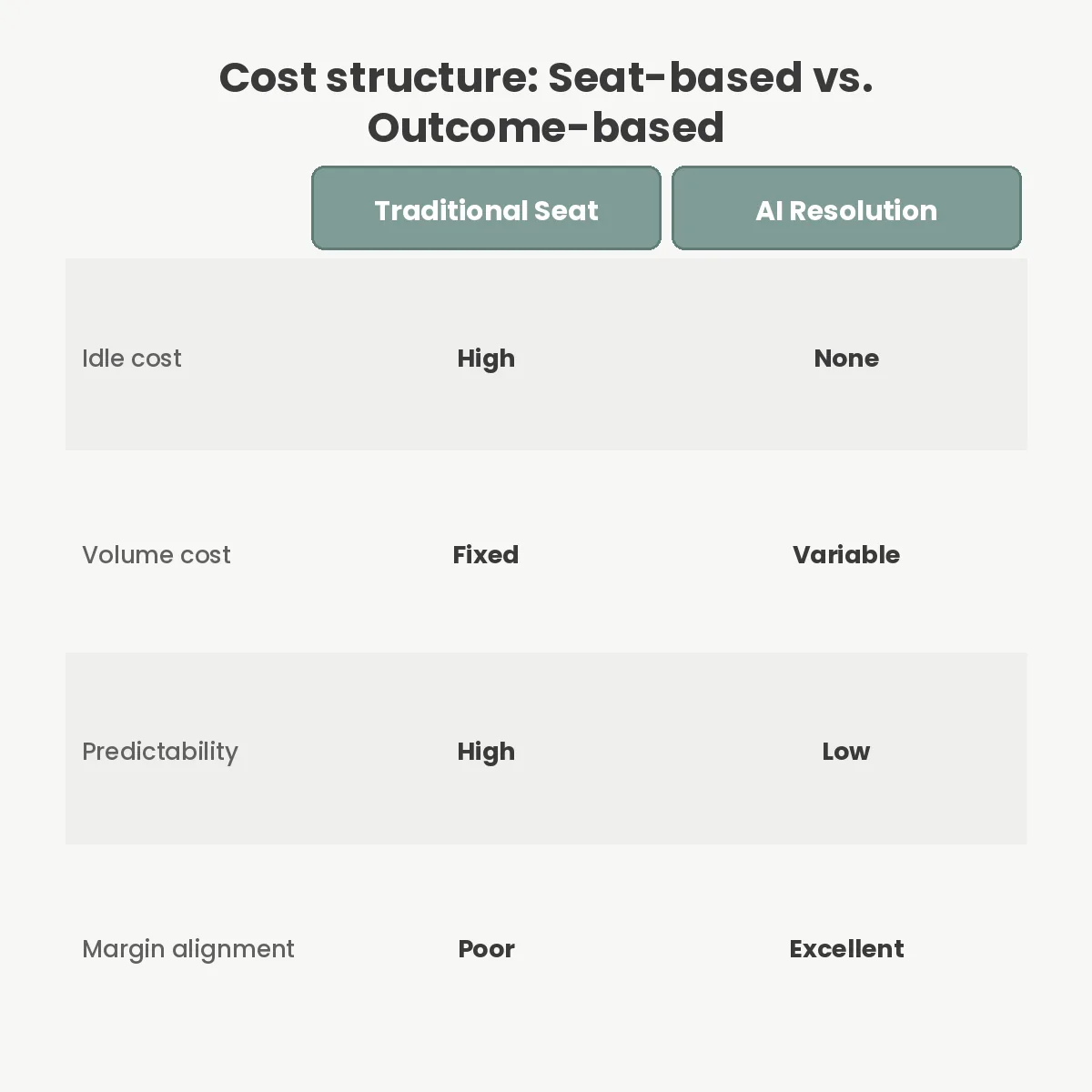
This fundamentally alters software capital allocation. Enterprise finance teams must transition from straightforward headcount multiplication to stochastic volume modeling. The cost of a platform is no longer known on January 1st; it fluctuates based on consumer demand, seasonality, and the statistical accuracy of the underlying large language model.
Outcome-based billing requires a rigid definition of success. Unlike API calls, which are billed purely on compute consumption regardless of utility, outcome pricing demands that the software achieves a specific state change. This is a complex engineering and product challenge.
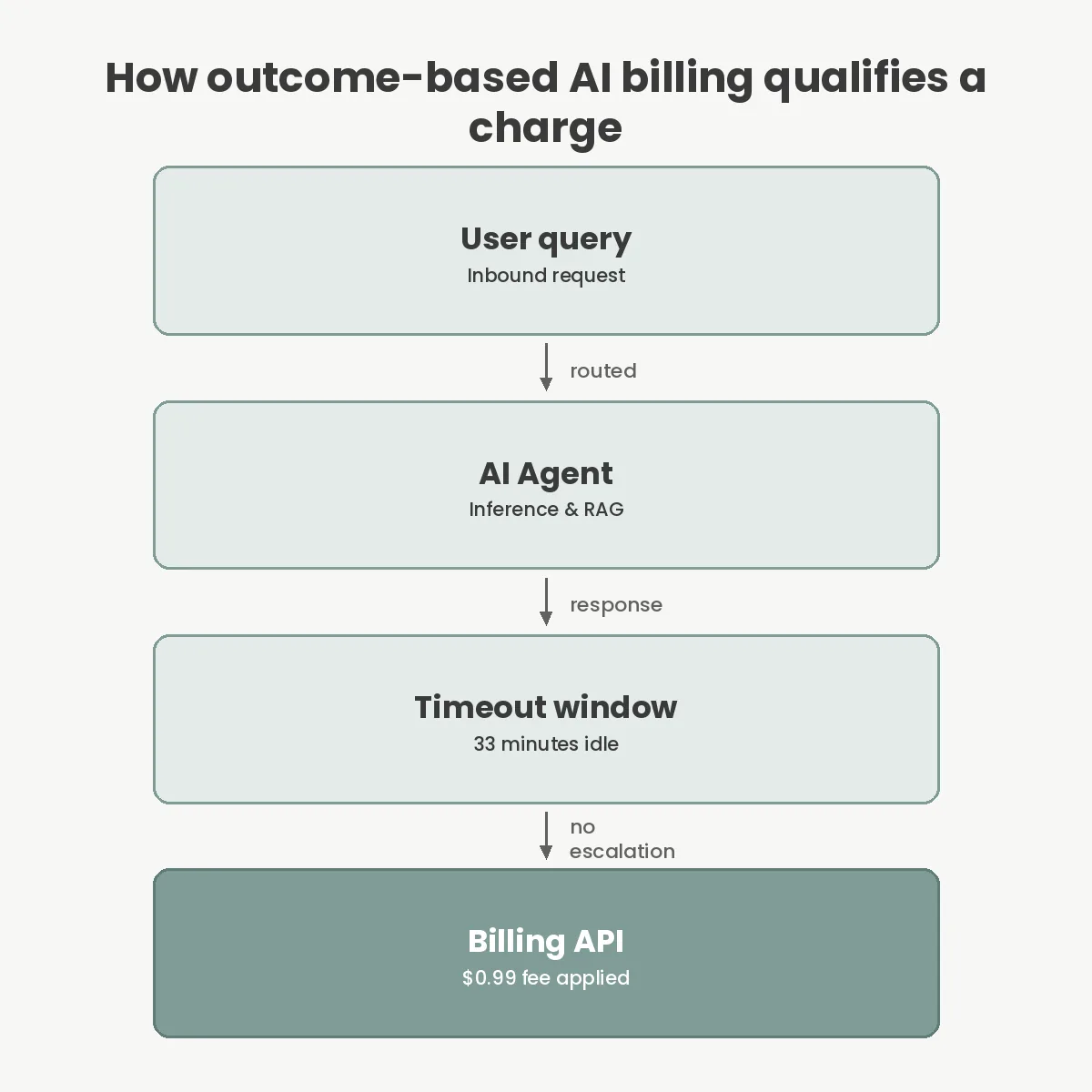
Vendors handle this by establishing deterministic triggers. In customer service, an “outcome” is typically registered when an AI provides a direct answer and the user either explicitly marks the issue as resolved or abandons the chat window for a defined duration without requesting a human escalation. If the user clicks “talk to a human,” the resolution fails, and the buyer is not charged the AI premium.
This creates a shared incentive structure. The vendor is financially motivated to utilize the most capable, accurate models to maximize their hit rate, while the enterprise buyer is motivated to expose the agent to the highest volume of tier-one queries. However, it also introduces latency in financial reporting, as true costs trail the actual compute events by whatever timeout window the vendor mandates for resolution tracking.
The market is rapidly establishing pricing norms across different tiers of AI autonomy. We are seeing a distinct split between copilot models—which augment a human and still command seat licenses—and agentic models, which operate independently and command outcome fees.
| Vendor & Product | Pricing Model | Cost Structure | Target Use Case |
|---|---|---|---|
| Salesforce Agentforce | Outcome-based | $2.00 per conversation | Enterprise CRM and autonomous external support |
| Intercom Fin | Outcome-based | $0.99 per successful resolution | High-volume transactional customer service |
| Zendesk Advanced AI | Seat-based Add-on | $50.00 per agent/month | Human-in-the-loop agent augmentation |
| Klarna (Internal Build) | Amortized CapEx | In-house infrastructure costs | Custom consumer retail support automation |
For example, Salesforce Agentforce mandates a $2 per conversation rate. This covers the underlying LLM inference, the retrieval-augmented generation (RAG) against the Salesforce data cloud, and the workflow execution. In contrast, Intercom Fin targets a slightly different tier of the market at $0.99 per resolution. These figures establish a ceiling: an internal enterprise AI build must cost significantly less than $1 per resolution in compute and maintenance to justify avoiding commercial SaaS.
To understand the enterprise appeal of these unit economics, you have to measure them against fully burdened human labor. The financial delta is not marginal; it is structural. When an enterprise replaces a fractional hour of human effort with a sub-dollar API execution, operating leverage expands dramatically.
Consider the data released by Klarna regarding its proprietary AI assistant. In 2024, the company reported that its AI handled 2.3 million customer service chats—equivalent to the workload of 700 full-time human agents. By shifting this volume away from outsourced tier-one support centers, Klarna projected $40 million in annualized savings. Even if Klarna were paying commercial rates of $1 per resolution instead of utilizing in-house infrastructure, the cost to clear 2.3 million tickets would be $2.3 million—yielding a staggering 94% gross margin on the labor replacement.
This math is accelerating enterprise SaaS consolidation. CFOs are auditing their software stacks, identifying point solutions that merely route or organize data, and replacing them with autonomous agents native to their primary systems of record. The mandate is clear: pay for work completed, not for the tools required to do the work.
Despite the attractive unit economics, outcome-based pricing introduces severe limitations in specific enterprise environments. It fails completely when query volume is high but query value is exceptionally low. If a company receives millions of spam inquiries, accidental pings, or trivial navigational requests, paying $1 to $2 per automated resolution will destroy profitability.
Furthermore, outcome pricing struggles in environments requiring prolonged, multi-session problem solving. If a B2B technical support issue takes three days and fourteen back-and-forth messages to resolve, vendors find it difficult to algorithmically define when the “resolution” actually occurred. This often forces the interaction back into human queues, meaning the buyer pays the underlying seat license for the human engineer plus the sunk inference costs of the failed AI attempt.
Finally, these models create friction in procurement predictability. Public sector entities and legacy enterprises often require fixed annual budgets. A variable software contract that scales linearly with customer complaints is inherently hostile to traditional quarterly budgeting cycles, forcing procurement teams to negotiate complex prepaid commitment tiers that resemble cloud infrastructure agreements.
Enterprise buyers consistently miscalculate the total cost of ownership (TCO) during the transition to AI agent SaaS pricing. The most frequent error is assuming a one-to-one replacement ratio between human tickets and AI tickets. AI agents remove friction, which paradoxically induces demand. When customers discover they can get instant, accurate answers without waiting on hold, they submit more queries. A 30% increase in total query volume can quickly offset the unit-cost savings.
Another major failure mode is ignoring the data pipeline costs. AI agents are entirely dependent on their context window. If the SaaS application requires continuous data ingestion from a data warehouse or external APIs to give the agent accurate context, the buyer incurs secondary infrastructure costs. You might pay the SaaS vendor $1 per resolution, but you are also paying Snowflake or Databricks for the compute required to keep the knowledge base updated.
Lastly, companies fail to model the cost of hallucinations. If an AI agent incorrectly processes a return or offers an unauthorized discount, the company bears the financial liability. The vendor’s fee for the “successful” resolution remains, while the enterprise absorbs the cost of the error. Failing to budget a risk premium for automated mistakes invalidates the entire financial model.
To navigate this transition, IT and finance must collaborate on a new evaluation framework. You can no longer assess software solely via feature matrices; you must evaluate the vendor’s routing logic, their definition of a resolution, and their dispute mechanisms for inaccurate AI actions.
Begin by establishing a baseline cost-per-resolution for your human teams. Include software licenses, hardware, salaries, benefits, and management overhead. If your fully burdened cost per ticket is $12, a $2 AI resolution fee is highly accretive. If your fully burdened human cost is $2.50 via offshore labor, the margin for error is razor-thin, and the primary benefit shifts from cost savings to industry automation and speed.
The enterprise software market is permanently altering its revenue extraction methods. Prepare to sunset your seat-license forecasting models. The era of paying for potential utility is ending; the era of paying for algorithmic execution has arrived.
Vendors typically define a resolution when the AI provides an answer and the user closes the session without requesting a human agent. Intercom, for example, measures a 33-minute window of inactivity after an AI response as a resolved ticket for billing purposes.
Seat-based pricing will remain for software that facilitates human creativity or strategic decision-making. Outcome-based models apply strictly to transactional, deterministic workflows like customer support routing, standard data entry, and basic code generation where the system completes the task autonomously without human oversight.
Finance teams must shift from static headcount models to volume-based forecasting. You calculate the historical volume of tier-one requests, multiply by the vendor’s resolution fee, and model best- and worst-case scenarios. Establishing spending caps in vendor contracts prevents unexpected budget overruns.
Most outcome-based contracts stipulate that unresolved queries—or those requiring human escalation—do not incur the resolution fee. However, if the AI confidently provides an incorrect answer that the user accepts without escalation, the vendor still charges the fee. Quality assurance remains your responsibility.
You Can Get More Information!