Drizzle vs Prisma: The Serverless ORM Trade-Off
Drizzle outperforms Prisma in serverless deployments because its zero-dependency architecture...

Make email marketing simplified

Make email marketing simplified

Make email marketing simplified

Make email marketing simplified

Make email marketing simplified

Make email marketing simplified

Make email marketing simplified

Make email marketing simplified

Make email marketing simplified

Make email marketing simplified

Make email marketing simplified

Make email marketing simplified

Make email marketing simplified

Make email marketing simplified

Make email marketing simplified

We use cookies for our website to give you the most relevant experience by remembering your preferences. By clicking “accept”, you consent to use of ALL the cookies
This website uses cookies to improve your experience while you navigate through the website. Out of these, the cookies that are categorized as necessary are stored on your browser as they are essential for the working of basic functionalities of the website. We also use third-party cookies that help us analyze and understand how you use this website. These cookies will be stored in your browser only with your consent. You also have the option to opt-out of these cookies. But opting out of some of these cookies may affect your browsing experience.
Necessary cookies are absolutely essential for the website to function properly. These cookies ensure basic functionalities and security features of the website, anonymously.
| Cookie | Duration | Description |
|---|---|---|
| cookielawinfo-checkbox-functional | 11 months | This cookie is set by GDPR Cookie Consent plugin. The cookie is used to store the user consent for the cookies in the category “Analytics”. |
| cookielawinfo-checkbox-functional | 11 months | The cookie is set by GDPR cookie consent to record the user consent for the cookies in the category “Functional”. |
| cookielawinfo-checkbox-necessary | 11 months | This cookie is set by GDPR Cookie Consent plugin. The cookies is used to store the user consent for the cookies in the category “Necessary”. |
| cookielawinfo-checkbox-others | 11 months | This cookie is set by GDPR Cookie Consent plugin. The cookie is used to store the user consent for the cookies in the category “Other. |
| cookielawinfo-checkbox-performance | 11 months | This cookie is set by GDPR Cookie Consent plugin. The cookie is used to store the user consent for the cookies in the category “Performance”. |
| viewed_cookie_policy | 11 months | The cookie is set by the GDPR Cookie Consent plugin and is used to store whether or not user has consented to the use of cookies. It does not store any personal data. |
Functional cookies help to perform certain functionalities like sharing the content of the website on social media platforms, collect feedbacks, and other third-party features.
Performance cookies are used to understand and analyze the key performance indexes of the website which helps in delivering a better user experience for the visitors.
Analytical cookies are used to understand how visitors interact with the website. These cookies help provide information on metrics the number of visitors, bounce rate, traffic source, etc.
Advertisement cookies are used to provide visitors with relevant ads and marketing campaigns. These cookies track visitors across websites and collect information to provide customized ads.
Other uncategorized cookies are those that are being analyzed and have not been classified into a category as yet.
Cyberia Tech, Inc. respects your privacy. This Privacy Policy explains how we collect, use, and share your information. By using our services, you agree to this policy. If any other agreements conflict with this Privacy Policy, the terms of those agreements prevail.
Cyberia Tech complies with the EU-US and Swiss-US Privacy Shield Frameworks for handling personal data from the EEA, UK, and Switzerland. In case of any conflict, the Privacy Shield Principles prevail. Learn more at Privacy Shield. Key Definitions
Information linked to an individual, transferred from the EEA, UK, or Switzerland to the U.S.
Data revealing race, religion, health, sexual orientation, and similar categories.
Effective Date: [ 2026 / 11 / 16 ]
Welcome to The Cyberia Tech ! By accessing or using our website or services, you agree to
comply with and be bound by these Terms of Use and our Privacy Policy. If you do not agree with
these terms, please do not use our Services.
Loading
0 %
Your First Piece of the Puzzle in
Business Growth



Drizzle outperforms Prisma in serverless deployments because its zero-dependency architecture keeps bundle sizes under 100KB and reduces cold starts to under 30ms. Prisma provides superior migration tooling and type safety, but its 15MB Rust engine requires edge workarounds like driver adapters to avoid heavy latency penalties.
Deploy a Next.js web application to a serverless platform, and your database layer suddenly becomes the bottleneck. A monolithic Node.js backend hides the cost of spinning up a database connection. Serverless exposes it. Every cold start forces your ORM to initialize. If your ORM takes 350ms just to load its query engine, your users feel it immediately. This is the decision point between Drizzle and Prisma. You are choosing between bare-metal execution speed and abstracted developer experience.
Prisma abstractions provide a massive upfront velocity boost. You do not think in terms of primary keys and constraints during the initial build. You define a relational graph in the Prisma schema file, and the generator builds the client. This abstraction is beneficial when the database is treated as a generic persistence layer. It allows teams to prototype rapidly without negotiating raw SQL syntax.
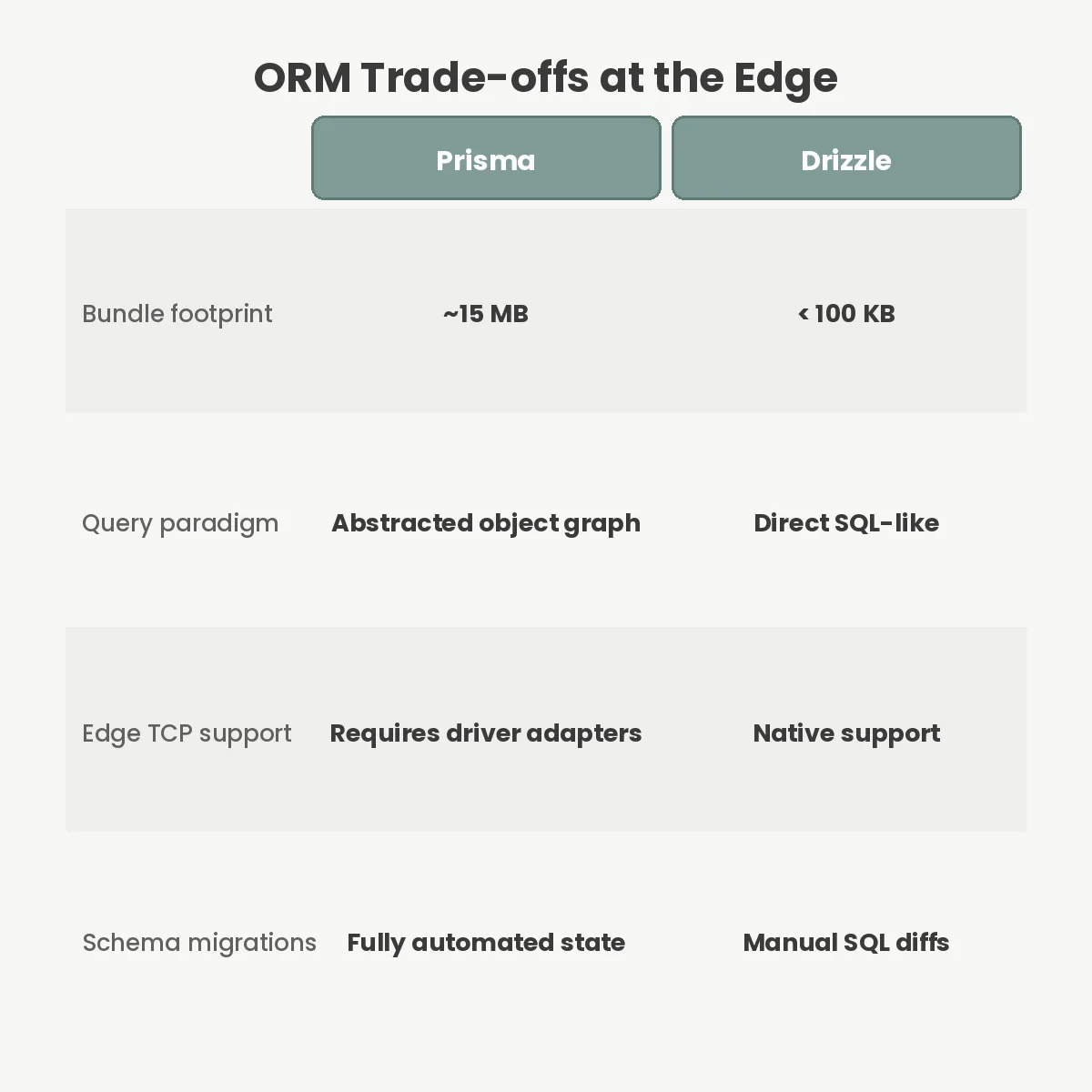
However, abstractions leak when performance bottlenecks emerge. Because Prisma generates the queries, optimizing a slow join requires understanding how the Rust engine constructs its execution plan. Drizzle operates differently. It maps TypeScript objects directly to SQL statements. If you construct a left join in Drizzle, you are writing the SQL equivalent. This removes the abstraction layer entirely.
For builders, this forces a fundamental choice. You are either paying the cognitive tax upfront by writing SQL-like syntax with Drizzle, or you are paying it later when debugging a slow Prisma query. Drizzle requires you to know database internals; Prisma tries to hide them until they break.
Serverless computing charges for execution time, but it restricts deployment size. Vercel enforces a 50MB zipped limit for serverless functions on standard plans. Cloudflare Workers enforce much tighter constraints, limiting scripts to just 1MB on the free tier. These hard limits dictate what dependencies you can include in your package.
Historically, deploying Prisma meant bundling its Rust query engine binary. This single file adds roughly 15MB to your deployment. On Vercel, this consumes a massive portion of your deployment allowance. On Cloudflare Workers, it outright breaks the deployment pipeline. Developers were forced to configure custom build steps to exclude binaries that the environment could not support.
Drizzle eliminates this constraint through its zero-dependency architecture. The entire runtime weighs under 100KB. It deploys into edge environments without triggering size warnings. Smaller bundles parse faster in the V8 JavaScript engine. A heavy payload requires CPU cycles simply to read and compile before execution begins. Drizzle avoids this overhead, leaving more memory available for actual application logic.
Every time an AWS Lambda container spins up, it must load your code into memory before executing the request handler. This initialization phase is the cold start. It occurs on the first request after a period of inactivity, or when traffic spikes force the platform to provision new instances dynamically.
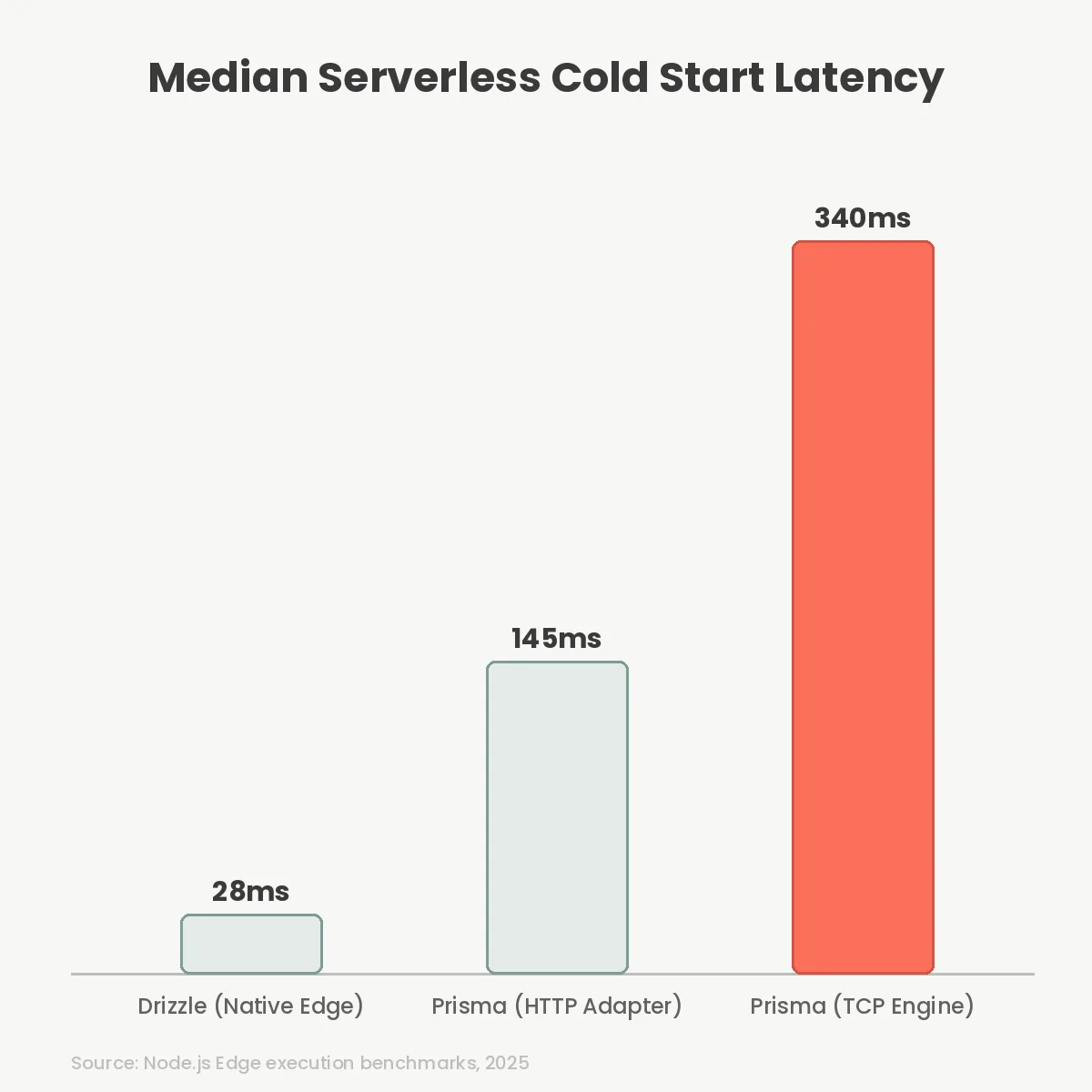
Loading a 100KB Drizzle client takes between 15 and 30 milliseconds. The V8 engine parses the small TypeScript footprint instantly. Booting the Prisma Rust engine over a TCP connection takes significantly longer. Benchmarks place Prisma cold starts between 250ms and 350ms, and that penalty occurs before the database query is even dispatched.
In a modern web application, a 300ms delay on a fresh route load is immediately noticeable to the user. If your application relies on Next.js server-side rendering, this latency compounds across parallel data fetches. Every blocked request ties up the serverless function, reducing overall throughput.
Because Drizzle relies entirely on native JavaScript execution, there is no secondary engine process to spawn. The database connection is established the moment the engine interprets the script. This creates a predictable, flat latency profile perfectly suited for ephemeral compute environments.
The Prisma team recognized this serverless friction. In version 5.4.0, they introduced Driver Adapters, fundamentally changing how the ORM connects at the edge. This provided a critical upgrade path for engineering teams locked into the ecosystem who needed to deploy to Cloudflare or Vercel Edge.
Instead of bundling the heavy Rust engine and connecting over raw TCP, Prisma now allows database queries via HTTP. Using specific adapters for serverless databases like PlanetScale, Neon, or Turso, developers bypass the local binary completely. The query generation shifts to a WebAssembly module that complies with strict environment restrictions.
| Edge Runtime | Prisma (Standard TCP) | Prisma (Driver Adapters) | Drizzle ORM |
|---|---|---|---|
| AWS Lambda | Supported (Heavy cold start) | Supported | Supported |
| Vercel Edge Functions | Fails (TCP Blocked) | Supported (HTTP only) | Supported |
| Cloudflare Workers | Fails (Size limit & TCP) | Supported (HTTP only) | Supported |
| Supabase Edge Functions | Fails (Deno constraints) | Supported | Supported |
This architectural shift mitigates the outright deployment failures on edge platforms. However, WebAssembly parsing still incurs a slight CPU overhead compared to native string concatenation. Routing all database traffic through HTTP endpoints introduces its own latency variables. A direct TCP connection maintained by a persistent container is inherently faster than establishing a new HTTP request for every database operation.
Drizzle sacrifices automated state management to achieve raw execution speed. Prisma provides an industry-leading migration system. You update the declarative schema, and Prisma calculates the exact state changes required, applying them safely to the database. It tracks applied migrations automatically.
With Drizzle, developers handle migrations manually. The tool generates SQL diffs based on your TypeScript schema changes, but you are responsible for executing, tracking, and verifying them. If a complex relational change requires a multi-step migration, Drizzle expects you to write the transition logic by hand.
It is an ORM built for engineers who demand absolute visibility into their database state. You cannot trust it to resolve complex schema conflicts automatically. You need a deep understanding of database constraints, foreign key cascades, and indexing strategies to use it effectively.
For product teams accustomed to Prisma handling the database layer, this manual intervention slows down feature velocity. A misconfigured migration in Drizzle can easily drop columns or lock tables in production. It requires highly rigorous code review processes for all database schema changes.
Prisma’s generated types are exhaustive and precise. The autocomplete in VS Code handles deep relational joins perfectly. When you include nested relations in a Prisma query, the resulting TypeScript object matches the exact shape of the data returned. Drizzle historically lacked this capability.
Drizzle v0.30.0 closed this gap by introducing the relational query API. It allows nested data fetching similar to Prisma, without abandoning the zero-dependency architecture. The types are derived directly from your TypeScript schema definitions, rather than a separate compiled artifact.
This requires more boilerplate than a concise Prisma schema file, but it keeps the single source of truth strictly inside your codebase. There is no separate generator step required before you can start coding.
This structural approach prevents the desync issues that sometimes occur in Prisma, where the generated client does not match the actual deployed database schema. Drizzle guarantees that if the TypeScript compiles, the underlying query structure is syntactically valid.
Developers frequently deploy Next.js applications to serverless environments without configuring connection pooling. A serverless function scaling to 500 concurrent instances will exhaust your primary Postgres connection limit instantly. This causes cascading failures as subsequent database requests are dropped.
Using PgBouncer or a managed pooler is strictly mandatory in these architectures. See our guide on connection pooling for implementation details. You must route serverless database traffic through a proxy that can multiplex queries to a single persistent connection.
Another failure mode is over-fetching data. Running heavy aggregation queries via Drizzle on every single page load defeats the purpose of fast edge compute. If the target data changes infrequently, you must implement an edge cache instead of hitting the relational database repeatedly.
Refer to our Redis vs Valkey breakdown for evaluating in-memory options. Relying solely on your ORM to optimize poorly structured data access patterns will fail at scale, regardless of your chosen tool.
If you are building a standard web application on long-lived Docker containers, choose Prisma. Read our modular monolith architecture guide for structuring persistent backends. The developer velocity gained from Prisma’s schema engine drastically outweighs the memory overhead.
In a persistent environment, the cold start penalty does not exist. The Rust engine boots exactly once and remains resident in memory. Prisma’s superior migration tooling and abstracted data modeling provide a massive return on investment for the engineering team.
If you are deploying exclusively to Vercel, Cloudflare, or AWS Lambda, choose Drizzle. The sub-100KB footprint and native edge compatibility eliminate deployment friction. You trade automated migrations for predictable, low-latency execution.
Yes, but only by using Prisma Driver Adapters and connecting via HTTP or WebSockets. You cannot run the standard Prisma TCP query engine on Cloudflare Workers due to the 1MB script size limit and missing Node.js TCP APIs. This configuration requires a compatible serverless database.
Drizzle does not handle connection pooling natively. Because it is strictly a query builder, you must configure a connection pool at the driver level using tools like Postgres.js or rely on external poolers like Supabase. This separation of concerns keeps the ORM lightweight but requires more architectural planning.
Drizzle is a zero-dependency TypeScript library. It translates JavaScript object methods directly into SQL strings. There is no secondary engine to boot, parse, or synchronize, keeping the initialization latency under 30ms on serverless platforms. This native execution model drastically outperforms systems that require loading external binaries into memory.
Yes, if you are unfamiliar with SQL. Prisma abstracts relational logic into object-oriented calls. Drizzle requires you to understand SQL joins, foreign keys, and indexing, as its syntax mirrors raw SQL structure almost exactly. Engineering teams without extensive database experience will face a steeper learning curve when migrating to Drizzle.
Choosing between Drizzle and Prisma is a decision about deployment targets, not just syntax. If your infrastructure relies on ephemeral serverless compute, the heavy lifting of Prisma’s engine becomes a liability. Drizzle removes that friction entirely.
Audit your current cold start times. If your API routes take more than 500ms to resolve a simple database fetch, inspect your ORM initialization step. Switching to Drizzle requires a migration of your data access layer, but the predictable, sub-50ms latency is worth the effort for high-traffic web applications.
You Can Get More Information!