Caddy vs NGINX: Evaluating Reverse Proxies for Modern Web Apps
Caddy and NGINX are both highly capable reverse proxies, but...

Make email marketing simplified

Make email marketing simplified

Make email marketing simplified

Make email marketing simplified

Make email marketing simplified

Make email marketing simplified

Make email marketing simplified

Make email marketing simplified

Make email marketing simplified

Make email marketing simplified

Make email marketing simplified

Make email marketing simplified

Make email marketing simplified

Make email marketing simplified

Make email marketing simplified

We use cookies for our website to give you the most relevant experience by remembering your preferences. By clicking “accept”, you consent to use of ALL the cookies
This website uses cookies to improve your experience while you navigate through the website. Out of these, the cookies that are categorized as necessary are stored on your browser as they are essential for the working of basic functionalities of the website. We also use third-party cookies that help us analyze and understand how you use this website. These cookies will be stored in your browser only with your consent. You also have the option to opt-out of these cookies. But opting out of some of these cookies may affect your browsing experience.
Necessary cookies are absolutely essential for the website to function properly. These cookies ensure basic functionalities and security features of the website, anonymously.
| Cookie | Duration | Description |
|---|---|---|
| cookielawinfo-checkbox-functional | 11 months | This cookie is set by GDPR Cookie Consent plugin. The cookie is used to store the user consent for the cookies in the category “Analytics”. |
| cookielawinfo-checkbox-functional | 11 months | The cookie is set by GDPR cookie consent to record the user consent for the cookies in the category “Functional”. |
| cookielawinfo-checkbox-necessary | 11 months | This cookie is set by GDPR Cookie Consent plugin. The cookies is used to store the user consent for the cookies in the category “Necessary”. |
| cookielawinfo-checkbox-others | 11 months | This cookie is set by GDPR Cookie Consent plugin. The cookie is used to store the user consent for the cookies in the category “Other. |
| cookielawinfo-checkbox-performance | 11 months | This cookie is set by GDPR Cookie Consent plugin. The cookie is used to store the user consent for the cookies in the category “Performance”. |
| viewed_cookie_policy | 11 months | The cookie is set by the GDPR Cookie Consent plugin and is used to store whether or not user has consented to the use of cookies. It does not store any personal data. |
Functional cookies help to perform certain functionalities like sharing the content of the website on social media platforms, collect feedbacks, and other third-party features.
Performance cookies are used to understand and analyze the key performance indexes of the website which helps in delivering a better user experience for the visitors.
Analytical cookies are used to understand how visitors interact with the website. These cookies help provide information on metrics the number of visitors, bounce rate, traffic source, etc.
Advertisement cookies are used to provide visitors with relevant ads and marketing campaigns. These cookies track visitors across websites and collect information to provide customized ads.
Other uncategorized cookies are those that are being analyzed and have not been classified into a category as yet.
Cyberia Tech, Inc. respects your privacy. This Privacy Policy explains how we collect, use, and share your information. By using our services, you agree to this policy. If any other agreements conflict with this Privacy Policy, the terms of those agreements prevail.
Cyberia Tech complies with the EU-US and Swiss-US Privacy Shield Frameworks for handling personal data from the EEA, UK, and Switzerland. In case of any conflict, the Privacy Shield Principles prevail. Learn more at Privacy Shield. Key Definitions
Information linked to an individual, transferred from the EEA, UK, or Switzerland to the U.S.
Data revealing race, religion, health, sexual orientation, and similar categories.
Effective Date: [ 2026 / 11 / 23 ]
Welcome to The Cyberia Tech ! By accessing or using our website or services, you agree to
comply with and be bound by these Terms of Use and our Privacy Policy. If you do not agree with
these terms, please do not use our Services.
Loading
0 %
Your First Piece of the Puzzle in
Business Growth



Caddy and NGINX are both highly capable reverse proxies, but they prioritize entirely different infrastructure trade-offs. NGINX relies on a C-based event loop to maximize raw request throughput and minimize latency at the bare metal level. Caddy sacrifices single-digit microsecond latency to provide automatic TLS provisioning, native HTTP/3 support, and memory-safe Go architecture by default.
Selecting a reverse proxy dictates how an infrastructure handles ingress routing, SSL termination, and protocol upgrades. For decades, NGINX has been the default choice, defining the standard for event-driven web servers across the industry. However, operating NGINX natively requires managing external certificate rotation scripts, configuring explicit protocol bindings, and wrangling complex configuration file syntaxes. The operational cost of maintaining manual TLS pipelines and debugging memory-related edge cases often outweighs the raw compute savings. Evaluating these two servers requires looking past basic benchmark numbers to understand their underlying concurrency models and state management mechanisms.
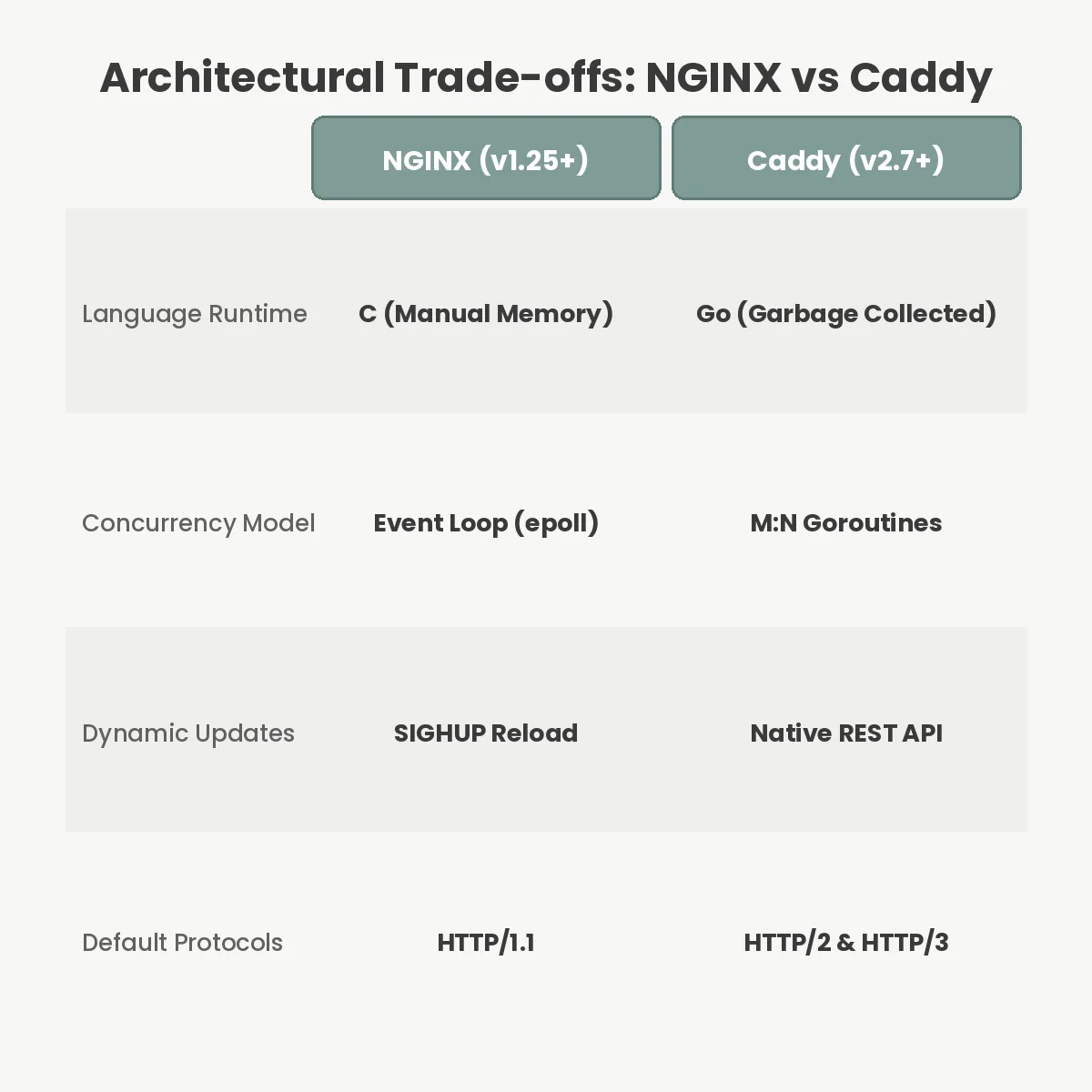
NGINX achieves its performance through a highly optimized, single-threaded event loop driven by the kernel. Written entirely in C, it utilizes system calls like epoll on Linux or kqueue on BSD to monitor thousands of network sockets simultaneously. When a packet arrives, the kernel notifies the NGINX worker process, which immediately executes the necessary instructions without waiting for blocking I/O operations. Because workers are pinned to CPU cores, NGINX entirely avoids the overhead of context switching. This allows a 10MB NGINX process to serve tens of thousands of concurrent connections with incredibly predictable memory utilization.
Caddy implements a fundamentally different concurrency model by leveraging the Go programming language runtime. Instead of an explicit event loop, Caddy spawns a lightweight logical thread, known as a goroutine, for every incoming network connection. The Go scheduler multiplexes these thousands of goroutines onto a small pool of actual operating system threads. Go allocates an initial 2KB stack per goroutine. This means 100,000 idle connections consume roughly 200MB of RAM purely for scheduling context—substantially higher than NGINX’s footprint.
The primary advantage of Caddy’s architecture is memory safety. Because NGINX is written in C, it requires manual memory management, exposing it to vulnerabilities like CVE-2022-41741, a memory corruption flaw in its module processing. Go is a garbage-collected language. The garbage collector prevents buffer overflows and use-after-free vulnerabilities natively. The trade-off is that Go’s garbage collector introduces microsecond pauses during execution, creating slight latency jitter that NGINX strictly avoids.
Certificate management is the most significant operational divergence between the two proxies. NGINX operates strictly as a web server; it relies on external agents like Certbot or acme.sh to negotiate with Let’s Encrypt. These external daemons run via system cron jobs, generate certificates on disk, and then issue a reload signal to the NGINX master process. If the cron job fails, or if permissions on the /etc/letsencrypt/ directory change, the application suffers an outage.
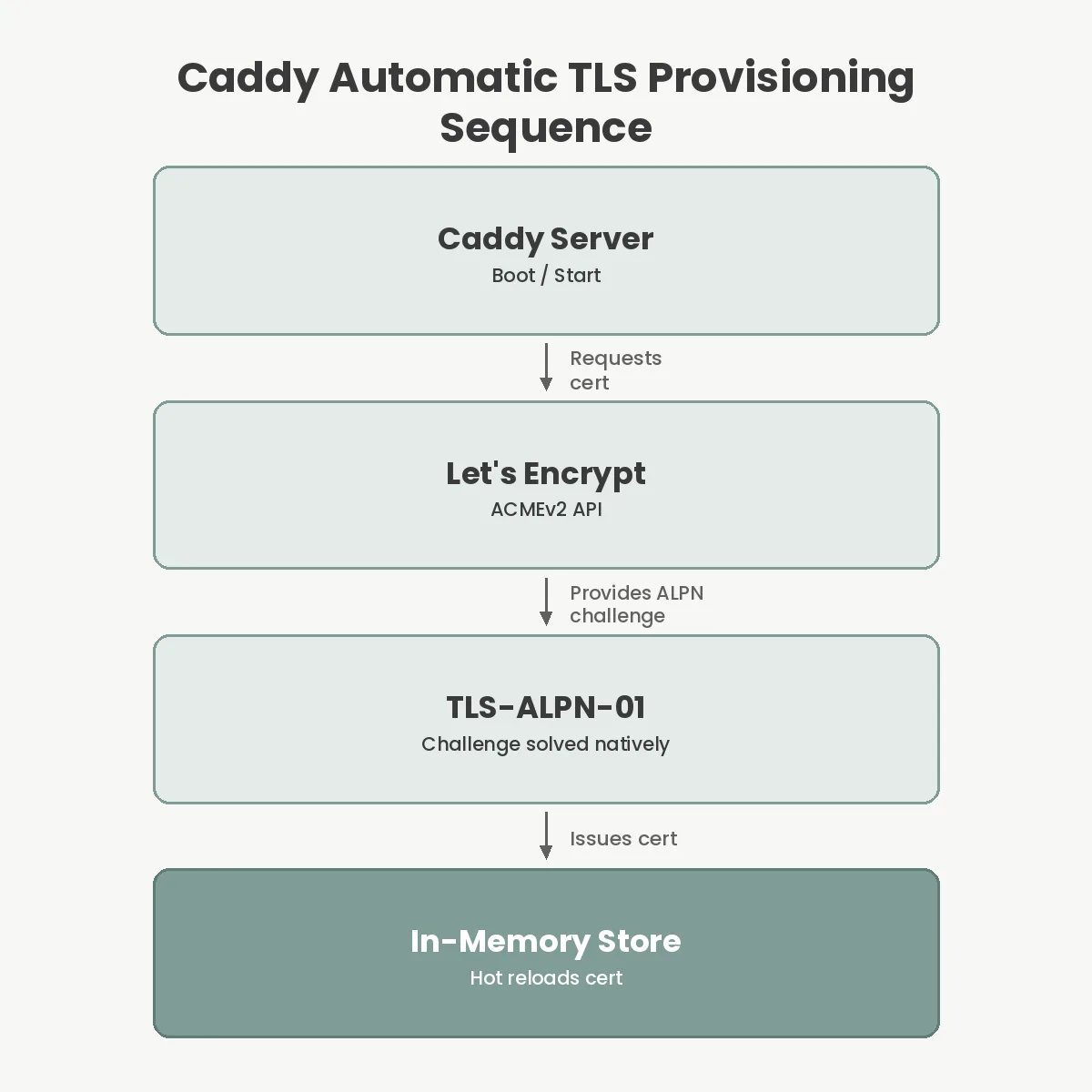
Caddy absorbs certificate management directly into the proxy binary. It implements a native ACMEv2 client and a background state machine that tracks certificate expirations internally. When you specify a domain in a Caddy configuration, the server automatically connects to Let’s Encrypt or ZeroSSL, provisions the certificate, and stores it. It handles renewals weeks in advance without human intervention or external cron dependencies.
This automation is highly resilient because Caddy natively supports the TLS-ALPN-01 challenge. When Let’s Encrypt initiates validation, it connects over port 443 and negotiates TLS. During the ClientHello phase, the Application-Layer Protocol Negotiation extension includes acme-tls/1. Caddy detects this exact extension before standard HTTP routing begins and serves a dynamic, ephemeral certificate containing the challenge response. This entirely bypasses port 80 routing issues, which frequently break legacy NGINX HTTP-01 validations relying on .well-known/acme-challenge disk directories.
Modern HTTP/3 protocol implementations solve TCP head-of-line blocking by migrating transport to QUIC over UDP. NGINX introduced HTTP/3 support into its mainline branch in version 1.25.0, released in May 2023. Implementing it requires explicit configuration. Engineers must define separate listener directives for UDP, enable the quic parameter, configure alt-svc headers manually so browsers know the upgrade path exists, and ensure their firewall rules pass UDP traffic on port 443.
Caddy takes a prescriptive, zero-configuration approach to modern protocols. HTTP/3 is enabled by default. If a client attempts to connect using QUIC, Caddy simply accepts the UDP traffic and processes the request. The alt-svc headers are injected automatically on HTTP/1.1 and HTTP/2 responses. If the network drops UDP packets—a common occurrence on restrictive corporate networks enforcing strict zero-trust network access boundaries—Caddy falls back to HTTP/2 seamlessly.
This zero-configuration approach extends to cipher suites. NGINX requires administrators to manually specify allowed SSL protocols and ciphers, leading to outdated configurations as security standards evolve. Caddy continuously updates its default TLS configuration to match Mozilla’s recommended cipher suites, dropping support for compromised algorithms upon binary upgrades without requiring configuration file mutations.
Modifying a running NGINX instance requires executing nginx -s reload. This command sends a SIGHUP signal to the master process. The master verifies the new .conf syntax, forks new worker processes, and sends a graceful shutdown signal to the old workers. Old workers stop accepting new connections but remain in memory until existing requests finish. This mechanism is battle-tested, but during heavy traffic spikes, reloading can double the memory consumption temporarily and cause PID exhaustion.
Caddy manages state dynamically via a native REST API running on localhost:2019. The core configuration is actually a JSON structure, and the standard Caddyfile is merely an adapter that compiles down to this JSON. You can send a delta JSON payload via a standard HTTP PUT request to update specific routes or upstream targets. The internal state machine mutates directly in memory. Listeners are re-bound natively without OS-level process forking.
For applications managing dynamic ingress routing, such as a modular monolith boundaries deployment splitting traffic among newly spun-up containers, Caddy’s API prevents the CPU spikes associated with constant NGINX SIGHUP signals. The exact configuration state can be queried programmatically via a GET request, making infrastructure-as-code verifications instantaneous.
Raw hardware utilization is where NGINX remains undisputed. Operating close to the kernel layer, NGINX leverages zero-copy file transmission (sendfile) and tight CPU cache alignment. On a standard 8-core instance, an optimally tuned NGINX process can saturate a 10 Gbps network link while consuming negligible CPU cycles. If your infrastructure relies heavily on aggressive web application caching layers to serve static payloads at millions of requests per second, NGINX is the strict mathematical optimal choice.
Caddy’s abstractions incur a measurable compute penalty at extreme scale. Pushing Caddy past 100,000 requests per second requires significantly more CPU power than NGINX. Furthermore, the Go garbage collector forces entire process heaps to be scanned periodically. Under massive concurrent load, these garbage collection cycles will introduce tail latencies in the 99th percentile (p99) that C-based systems do not experience.
Both systems exhibit specific failure modes when misconfigured. In NGINX, the most frequent vulnerability vector is path traversal caused by malformed proxy_pass trailing slashes. If a location block lacks a trailing slash but the proxy target includes one, attackers can traverse directories upstream. Furthermore, standard NGINX tuning requires manually overriding operating system file descriptor limits.
| System Limit | NGINX Directive Requirement | Caddy Configuration Approach |
|---|---|---|
| File Descriptors | worker_rlimit_nofile |
Managed implicitly via OS `ulimit` (systemd) |
| Max Connections | worker_connections |
apps.http.servers.max_connections |
| Buffer Sizes | client_body_buffer_size |
Handled dynamically by Go memory allocator |
Caddy’s primary operational failure mode involves automated scaling environments. Because Caddy automatically negotiates certificates, spinning up 20 instances behind an auto-scaling group without a shared storage backend for the /data directory will cause all 20 nodes to request certificates simultaneously. This instantly triggers Let’s Encrypt rate limits, locking the domain out of TLS provisioning for a week. Administrators must configure clustered Caddy instances to share TLS state via Redis, Consul, or shared file systems.
No, NGINX achieves higher raw request throughput and lower latency due to its C-based event loop. Caddy prioritizes operational automation and memory safety, introducing slight overhead from Go garbage collection, which remains negligible for standard web application workloads.
Yes, for the vast majority of web infrastructure. Caddy natively supports load balancing, reverse proxying, and static file serving. However, applications requiring complex custom C modules or absolute minimum latency overhead for high-frequency networking typically retain NGINX.
Caddy automatically requests, provisions, and renews SSL certificates using the ACME protocol via Let’s Encrypt or ZeroSSL. It natively handles HTTP and TLS-ALPN challenges directly in memory without requiring external cron jobs or third-party validation scripts.
Yes, starting with mainline version 1.25.0 released in May 2023, NGINX supports HTTP/3 and QUIC natively. However, unlike Caddy which enables it by default, NGINX requires explicit configuration directives to open UDP listeners and broadcast discovery headers.
Selecting between these proxies requires measuring operational engineering time against raw compute efficiency. If an infrastructure serves tens of millions of concurrent connections at the extreme edge, NGINX remains the strict requirement for maximizing silicon utilization and limiting tail latencies. Its kernel-level event loop is unmatched for sheer data transmission scale.
For the majority of internal microservices, standard public APIs, and modern web applications, the compute overhead of Caddy is entirely invisible. By eliminating manual certificate rotation scripts, removing external cron dependencies, and defaulting to modern secure protocols, Caddy provides an architectural baseline that prevents configuration drift. Engineering teams building new web applications should default to Caddy to eliminate TLS management overhead, migrating to NGINX only when precise performance profiling demonstrates a strict requirement for C-level latency optimizations.
You Can Get More Information!