The Hidden Cost of Context Switching in Your Tech Stack
A financial breakdown of how much fragmented productivity apps and constant notification switching cost your enterprise.

Make email marketing simplified

Make email marketing simplified

Make email marketing simplified

Make email marketing simplified

Make email marketing simplified

Make email marketing simplified

Make email marketing simplified

Make email marketing simplified

Make email marketing simplified

Make email marketing simplified

Make email marketing simplified

Make email marketing simplified

Make email marketing simplified

Make email marketing simplified

Make email marketing simplified

We use cookies for our website to give you the most relevant experience by remembering your preferences. By clicking “accept”, you consent to use of ALL the cookies
This website uses cookies to improve your experience while you navigate through the website. Out of these, the cookies that are categorized as necessary are stored on your browser as they are essential for the working of basic functionalities of the website. We also use third-party cookies that help us analyze and understand how you use this website. These cookies will be stored in your browser only with your consent. You also have the option to opt-out of these cookies. But opting out of some of these cookies may affect your browsing experience.
Necessary cookies are absolutely essential for the website to function properly. These cookies ensure basic functionalities and security features of the website, anonymously.
| Cookie | Duration | Description |
|---|---|---|
| cookielawinfo-checkbox-functional | 11 months | This cookie is set by GDPR Cookie Consent plugin. The cookie is used to store the user consent for the cookies in the category “Analytics”. |
| cookielawinfo-checkbox-functional | 11 months | The cookie is set by GDPR cookie consent to record the user consent for the cookies in the category “Functional”. |
| cookielawinfo-checkbox-necessary | 11 months | This cookie is set by GDPR Cookie Consent plugin. The cookies is used to store the user consent for the cookies in the category “Necessary”. |
| cookielawinfo-checkbox-others | 11 months | This cookie is set by GDPR Cookie Consent plugin. The cookie is used to store the user consent for the cookies in the category “Other. |
| cookielawinfo-checkbox-performance | 11 months | This cookie is set by GDPR Cookie Consent plugin. The cookie is used to store the user consent for the cookies in the category “Performance”. |
| viewed_cookie_policy | 11 months | The cookie is set by the GDPR Cookie Consent plugin and is used to store whether or not user has consented to the use of cookies. It does not store any personal data. |
Functional cookies help to perform certain functionalities like sharing the content of the website on social media platforms, collect feedbacks, and other third-party features.
Performance cookies are used to understand and analyze the key performance indexes of the website which helps in delivering a better user experience for the visitors.
Analytical cookies are used to understand how visitors interact with the website. These cookies help provide information on metrics the number of visitors, bounce rate, traffic source, etc.
Advertisement cookies are used to provide visitors with relevant ads and marketing campaigns. These cookies track visitors across websites and collect information to provide customized ads.
Other uncategorized cookies are those that are being analyzed and have not been classified into a category as yet.
Cyberia Tech, Inc. respects your privacy. This Privacy Policy explains how we collect, use, and share your information. By using our services, you agree to this policy. If any other agreements conflict with this Privacy Policy, the terms of those agreements prevail.
Cyberia Tech complies with the EU-US and Swiss-US Privacy Shield Frameworks for handling personal data from the EEA, UK, and Switzerland. In case of any conflict, the Privacy Shield Principles prevail. Learn more at Privacy Shield. Key Definitions
Information linked to an individual, transferred from the EEA, UK, or Switzerland to the U.S.
Data revealing race, religion, health, sexual orientation, and similar categories.
Effective Date: [ 2026 / 11 / 25 ]
Welcome to The Cyberia Tech ! By accessing or using our website or services, you agree to
comply with and be bound by these Terms of Use and our Privacy Policy. If you do not agree with
these terms, please do not use our Services.
Loading
0 %
Your First Piece of the Puzzle in
Business Growth



A productivity software stack is the structured collection of digital tools your team uses to communicate, manage tasks, document knowledge, and automate workflows. For founders, CTOs, and product owners in 2026, building an enterprise productivity software stack means architecting an ecosystem where these applications connect logically without creating redundant data silos or causing your subscription budget to spiral out of control.
You are likely managing a bloated digital footprint. According to BetterCloud’s 2026 data, the average organisation runs 118 SaaS applications, marking an 11% year-over-year jump from 2025. That application sprawl sounds impressive until you realise 51% of those purchased software licenses sit entirely unused. Read this guide to evaluate your current toolset, eliminate functional overlaps, and understand how the shift toward usage-based AI pricing fundamentally alters your procurement strategy. By the end, you will be able to map out a streamlined ecosystem of digital workspace tools, plugging hidden budget leaks and finally giving your developers their focused building time back.
You cannot buy productivity by simply issuing corporate credit cards. A true software stack operates like a data pipeline for your business. When an engineer updates a technical spec in your knowledge base, that change must propagate to the product manager’s tracking board and notify the support team’s messaging channel. This requires moving beyond basic native integrations and understanding the underlying webhooks and API architectures that dictate how freely your data can move between disconnected servers.
If your tools do not talk to each other, you are not running a stack; you are managing a digital junk drawer. Structuring your architecture requires layering applications by their core function. You need an identity layer to handle authentication via SAML or OAuth, a storage layer for permanent documentation, a communication layer for routing temporary human interactions, and an automation layer to glue the disparate APIs together. Each layer must have a strict mandate. The moment you allow your real-time chat tool to act as permanent file storage, the structural integrity of your stack collapses.
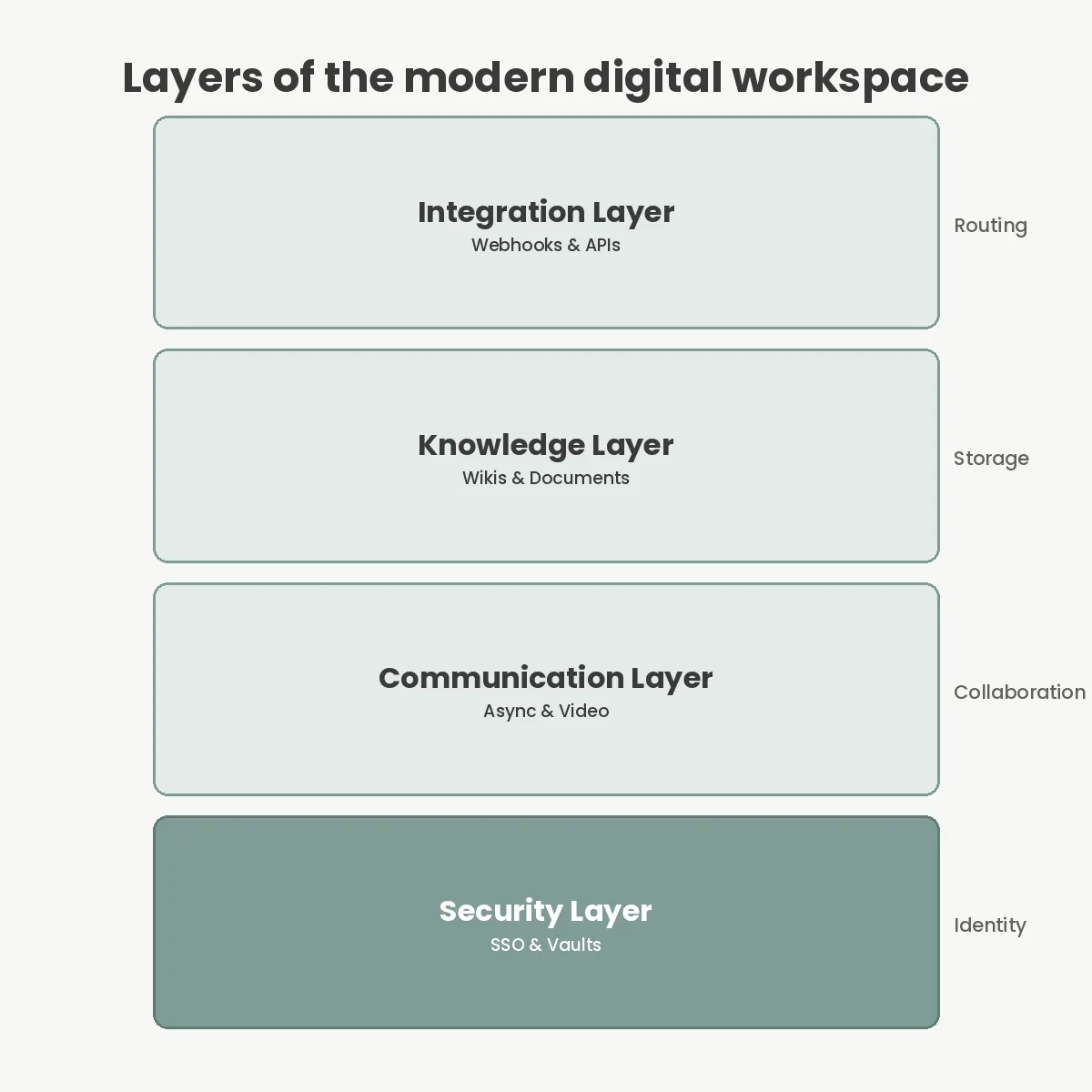
Collaboration falls into two distinct categories: synchronous interactions that require immediate human attention, and asynchronous tasks that sit in a queue until the recipient is ready to process them. Mixing these two modes is the quickest way to destroy engineering focus. When you try to track complex technical project requirements inside a fast-moving chat channel, critical data gets buried under conversational noise because chat platforms fundamentally lack state management.
Consider a bug report. If a QA tester drops a bug into a general Slack channel, it quickly scrolls out of view as other conversations occur. A dedicated project management tool, however, assigns state variables (To Do, In Progress, Done) and metadata (Priority, Assignee) to the task. Your team needs clear boundaries between immediate discussion and deep work. Messaging platforms handle the real-time routing, while dedicated project management software stores the asynchronous state. We strongly recommend configuring communication guidelines before buying any new software to ensure tools are used for their intended purpose. To structure this boundary correctly, review our detailed guide on identifying real-time and async tools.
The foundation of your synchronous communication layer is usually a persistent chat application. However, vendor pricing and feature limits have shifted significantly. The Slack Free plan now restricts search and visibility to a strict 90-day message history limit, caps integrations at exactly 10 apps, and aggressively deletes older data after one year. This happens because storing unindexed, infinite text streams for millions of non-paying workspaces is financially unsustainable for the vendor. This limitation makes the free tier entirely unsuitable for any business relying on chat history for legal compliance or institutional memory.
Moving to paid tiers requires accurate budget forecasting. Despite conflicting reports from automated pricing aggregators claiming massive price hikes, manual verification of late-2026 vendor data confirms the standard Slack Pro tier costs $7.25 per seat per month when billed annually. You must map these per-seat costs against your actual active headcount, deliberately disabling accounts the moment an external contractor finishes a project. Otherwise, shadow IT expenses inflate your bill because you pay for provisioned seats rather than actively utilized accounts.
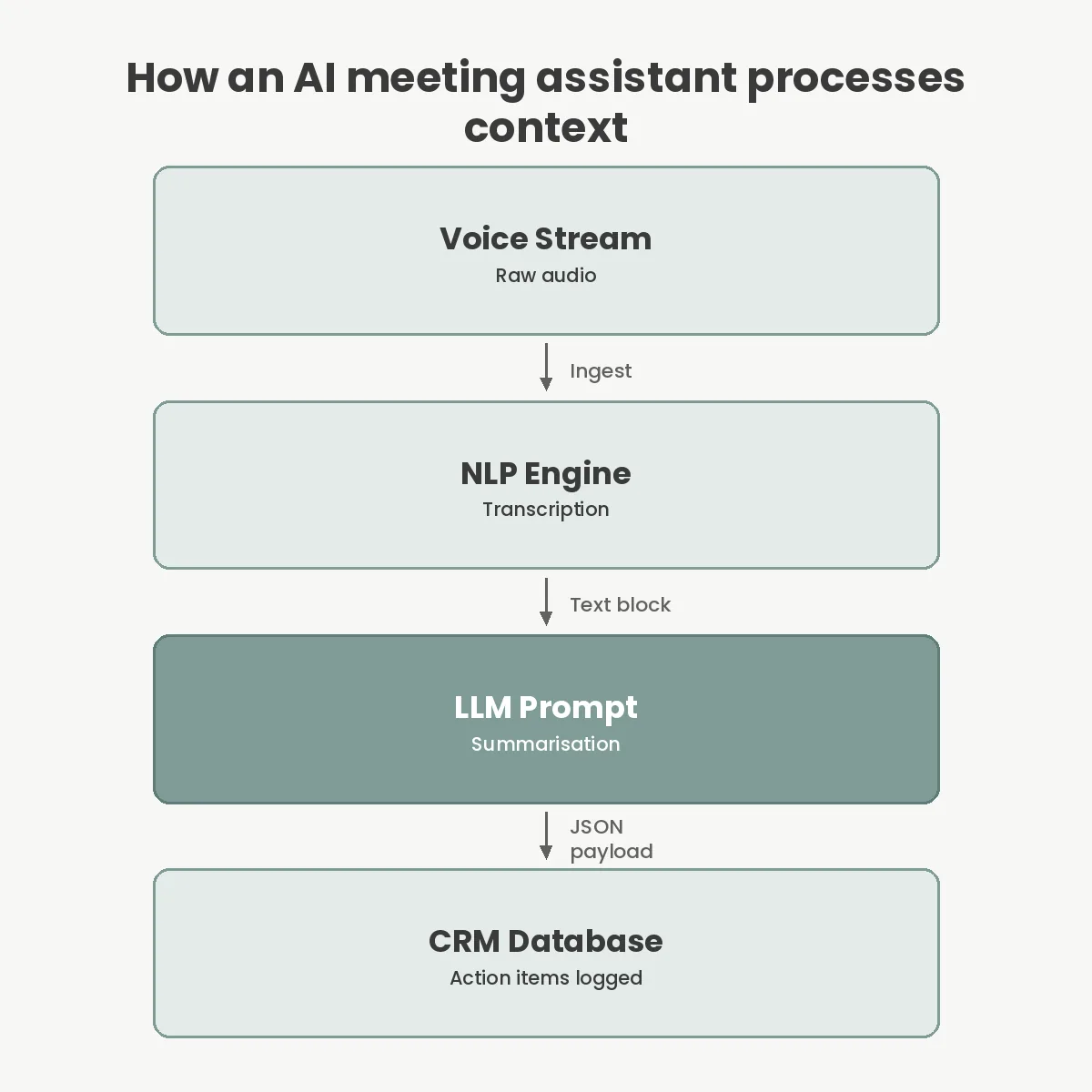
Video meetings traditionally function as black holes for information. An hour of technical discussion occurs, but if nobody manually types out the decisions, the context evaporates the moment the call ends. AI meeting assistants solve this by joining your calls as virtual participants. They capture the raw audio stream, run it through natural language processing models for transcription, and output structured summaries directly to your CRM or project board.
These bots extract action items and speaker highlights without human intervention by converting the transcript into a prompt for a Large Language Model. The LLM is instructed to output a specific JSON payload, allowing the bot to map a spoken sentence like “I will send the contract by Tuesday” directly into the “Next Steps” date field of your Salesforce dashboard. The market is currently dominated by tools like Fathom, Otter.ai, and Fireflies, each offering different integration depths. Choosing the right bot depends heavily on your privacy constraints and where you need the resulting text routed. To compare their specific transcription limits and compliance standards, explore our analysis of the leading AI meeting bots.
Your documentation layer serves as the single source of truth for your business logic. When an employee leaves, their knowledge should remain easily searchable within the system. The architecture of your wiki dictates how easily your team finds information. Some tools rely on strict hierarchical folder trees, forcing users to click through endless nested directories that awkwardly mimic outdated local hard drives.
Others use flat, object-oriented database structures where every page acts as a discrete record that can be filtered and linked across multiple views. In a graph-based tool, a product specification is a node, and a Jira ticket is another node; the relationship between them forms a bidirectional edge. Selecting the right knowledge base architecture prevents your documentation from becoming an unmaintained graveyard of outdated specs. To understand the fundamental differences in these storage models, read our breakdown on comparing popular team knowledge bases.
Static documents trap data. Modern enterprise productivity software relies on block-based, component architecture. Instead of emailing a static spreadsheet file back and forth, you embed a live data table directly into a meeting agenda. When a project manager updates a cell during the call, that exact component instantly reflects the change in the associated chat channel and the main project dashboard.
Under the hood, these platforms use Conflict-free Replicated Data Types (CRDTs). The CRDT protocol ensures that even if two people edit the same cell simultaneously from different time zones, the system mathematically merges the changes without locking the document or requiring a manual page refresh. This component approach prevents version control nightmares. The major players in this space approach syncing differently, with some relying heavily on proprietary graphs to keep paragraphs and lists updated across email and chat simultaneously. To see how these flexible workspaces handle data blocks in 2026, dive into our evaluation of flexible workspace data models.
No matter how well you select your core applications, you will eventually need to connect tools that lack native integrations. The integration layer of your stack relies on middleware web applications that listen for specific trigger events—like a new client form submission—and automatically fire corresponding actions across other platforms via APIs. This removes the need to write fragile Python scripts that break every time a vendor updates their endpoint payload structure.
These automation platforms differ significantly in how they route data. Some force you into simple, linear, step-by-step sequences. Others offer complex visual canvases where you can branch logic, run parallel tasks, and set up error-handling paths if a third-party server times out. Advanced routing can mathematically check if a user ID exists in your database before deciding whether to create a new profile or simply update an existing one. Choosing the wrong middleware limits your operational scale. To evaluate routing complexity and task execution limits, consult our comparison on choosing automation middleware.
As you add more digital workspace tools to your pipeline, you drastically increase your attack surface. Expecting employees to remember dozens of complex passwords guarantees they will reuse weak credentials across vital infrastructure. You must implement a dedicated security layer that centralises access while protecting the raw credentials from the vendor hosting them.
Modern enterprise vaults use zero-knowledge architecture. The master password hashes locally on the user’s physical device to create the decryption key. The central server only stores an encrypted, unreadable blob of data. Because the AES-256 encryption happens entirely in the local browser before the data ever travels over the network, if the vendor is breached, the attackers get nothing useful. To evaluate administrative controls and encryption protocols, review our guide to evaluating team credential vaults.
A fragmented calendar destroys developer output. When human managers try to coordinate schedules across time zones, they inevitably scatter 30-minute meetings randomly throughout the day, leaving engineers with frustrating 45-minute gaps that are too short for meaningful coding but too long to waste. AI scheduling assistants fix this by applying advanced bin-packing algorithms to your team’s collective calendar.
These algorithms mathematically solve the computational knapsack problem by evaluating the fixed capacity of your workday against the variable sizes of your tasks. They constantly monitor task deadlines and meeting requirements, automatically reshuffling individual work blocks to create contiguous hours of uninterrupted focus time. When an urgent client call runs over, the system dynamically shifts the remaining tasks into open slots later in the week without manual intervention. To see how these scheduling algorithms protect maker time, examine our review of intelligent calendar management apps.
There is a dangerous misconception that context switching is just a momentary disruption—merely a few seconds lost to clicking between a chat window and a code editor. The reality is far worse. Your brain operates much like a computer’s Random Access Memory (RAM). When you switch from writing a complex Python script to answering a Slack message, your brain must literally page out the intricate logic of the code and page in the social context of the chat. Every application switch triggers this steep context-loading cost.
On average, it takes a worker 9.5 minutes to fully return to a productive workflow after a digital switch. According to 2022 research, the average knowledge worker toggles between digital applications nearly 1,200 times per day. This constant friction costs employees approximately four hours a week—nearly 10% of their total working time. Over a year, that equates to roughly five working weeks lost entirely to navigating poor software architecture. To understand the financial impact of this friction, read our analysis on measuring the cost of context switching.
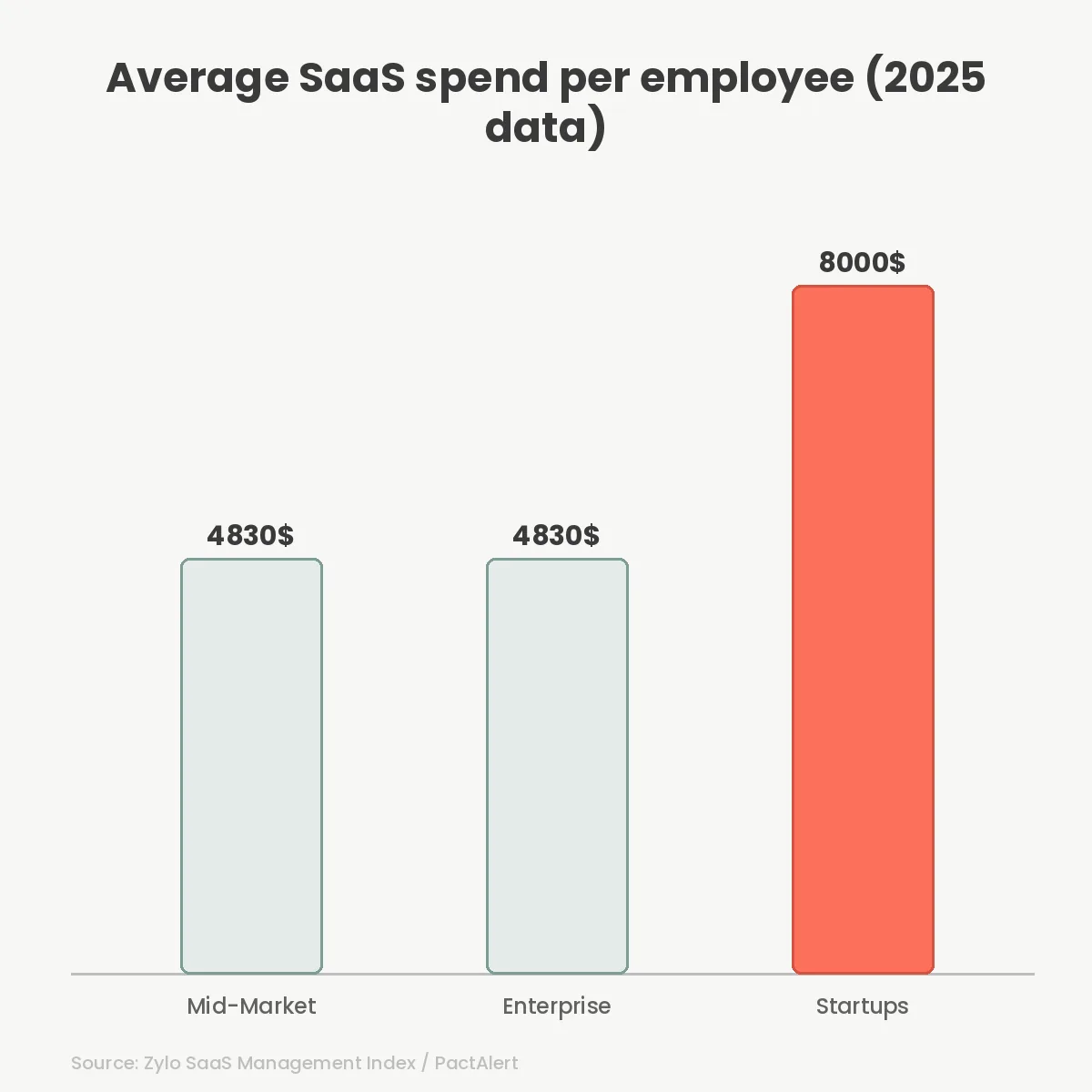
The financial side of a productivity stack often spirals out of control due to decentralised purchasing. Average SaaS spend across all company sizes sits at $4,830 per employee per year. Shockingly, startups actually spend significantly more per employee than large enterprises, averaging $8,000 per head. Startups tend to buy monthly plans via individual credit cards without the leverage to negotiate volume discounts or the oversight of a formal procurement team.
Centralising your purchasing strategy stops this leak. Decentralised buying also bypasses crucial security reviews, meaning product teams might adopt tools that actively violate your SOC2 compliance standards. You must track renewal dates, consolidate duplicate functionality, and enforce strict approval workflows before any new software enters the building. To learn how to plug these financial leaks and structure your buying process, study our breakdown of common enterprise software buying errors.
| Organisation Stage | Procurement Method | Average SaaS Spend (Per Employee) | Primary Risk |
|---|---|---|---|
| Early Startup (1-20) | Decentralised credit cards | $8,000 | Overpaying on monthly tiers |
| Mid-Market (50-250) | Department-level budgets | $5,200 | Duplicate app functionality |
| Enterprise (500+) | Centralised IT procurement | $4,830 | Unused bulk licenses |
You cannot optimise what you cannot see. Because 51% of purchased SaaS software licenses are currently unused, auditing your existing stack is the most profitable IT exercise you can perform. Manual spreadsheet audits fail because they rely on department heads self-reporting their usage. Employees will consistently claim they need an expensive software tool they haven’t logged into for six months just to guard their departmental resources.
Modern audits rely on automated discovery and license optimization platforms. These systems connect directly to your single sign-on (SSO) provider or financial ledger to track actual, verified login events by parsing SAML authentication tokens. According to Gartner in 2026, 93% of organizations experienced reduced SaaS spend leakage after implementing these automated discovery mechanisms. To run your own inventory process based on real telemetry data rather than guesswork, follow our methodology for executing a digital workspace audit.
Purchasing the perfect software solves nothing if your team refuses to use it. Dumping a new task management system onto your engineers without mapping out the standard operating procedures will only result in active resistance. Implementation requires structured change management, starting with a clear definition of what data absolutely belongs in the new system versus the legacy platform.
You must configure strict role-based access control (RBAC) to ensure users only see the dashboards relevant to their specific jobs, migrate legacy data cleanly, and run a limited pilot program with a small cohort of power users to identify friction points. Running parallel systems during a brief transition period ensures no mission-critical data is lost if the new workflow stumbles. Only after the workflow is proven should you roll the platform out to the wider business. To ensure high adoption rates for your newly purchased tools, follow our comprehensive step-by-step rollout checklist.
While large enterprises require strict governance and automated discovery platforms, forcing heavy architectural compliance onto an early-stage startup will actively strangle its agility. If your company has fewer than ten employees, implementing complex identity providers (IdPs) and forcing every web app behind single sign-on creates an unnecessary administrative tax. Every time a developer wants to test a new AI tool, they would have to submit a provisioning ticket.
At the early stages, visibility is natural. You can visually see what your engineering team is working on. Over-engineering a productivity software stack before you have achieved product-market fit actively distracts your founders from talking to customers. Start with a simple chat tool, a basic document repository, and a shared password vault. Introduce strict procurement workflows and automated integration layers only when manual coordination begins to break down, typically around the 30-employee mark.
The most dangerous trap in architecting a modern workplace tech stack today is treating all AI tools like traditional software. The main budget threat has shifted from application volume to underlying billing structures. Nearly 40% of AI-powered SaaS applications are now billed via usage-based models rather than flat subscriptions. Instead of paying a flat rate per seat, you are frequently paying per compute cycle or LLM token generated.
If you implement an AI tool to summarise customer support tickets, and your support volume spikes by 300% due to a server outage, your software bill will spike proportionally because the bot must process three times as many text tokens. Failing to logically model these variable costs destroys predictable budget forecasting. Before committing to AI workflows, you must heavily scrutinise how the vendor monetises compute consumption. Learn how to accurately model these variable costs by exploring our analysis on usage-based AI pricing models.
| Tool Category | Legacy Approach (Pre-2024) | Modern Approach (2026) | Cost Mechanism |
|---|---|---|---|
| Meeting Notes | Manual typing by junior staff | AI bot joins and extracts JSON | Flat per-seat or usage-based |
| Calendar Routing | Human negotiation via email | Bin-packing algorithm reshuffles blocks | Flat monthly subscription |
| Data Integration | Custom Python scripts | Visual node-based middleware | Per task execution / API call |
| Knowledge Base | Static nested folder hierarchies | Object-oriented graph databases | Flat per-seat license |
It is the complete collection of digital applications your team uses to communicate, document knowledge, and manage workflows. A modern workplace tech stack integrates these tools to prevent data silos, reduce subscription sprawl, and automate repetitive administrative tasks across your business.
The average company spends $4,830 per employee annually on software subscriptions. However, startups often spend closer to $8,000 per head because they purchase monthly licenses via credit cards without the leverage to negotiate volume discounts through a dedicated procurement team.
Nearly 40% of AI-powered workplace applications now charge based on actual usage rather than a flat monthly fee per seat. This shift forces organizations to monitor consumption closely, as spikes in workload can instantly trigger unpredictable budget overruns if left unchecked.
You force employees into constant context switching. The average knowledge worker toggles between applications nearly 1,200 times a day. Each switch carries a cognitive penalty, costing employees roughly four hours of lost focus time every single week as their brain reloads context.
You should deploy automated discovery platforms that connect directly to your single sign-on provider. Relying on spreadsheets and self-reporting fails. Automated tools read actual login logs to highlight inactive accounts, helping organizations reclaim the 51% of software licenses that sit unused.
Fixing your productivity software stack requires stepping back from individual tool features and looking at the holistic flow of information through your business. If your engineers complain about constant interruptions and missing spec sheets, your issue is not the lack of a tool; it is a broken architectural boundary between your communication layer and your storage layer.
Start by identifying your most expensive subscription leaks. Run an automated discovery process against your identity logs to find the 51% of seats currently gathering dust. If you are a startup founder trying to stop burning cash on uncoordinated tool purchases, read our guide on avoiding SaaS procurement mistakes next. If you are a technical leader trying to protect your team’s deep work, head straight to our analysis on identifying real-time and async tools to begin constructing proper communication boundaries today.
You Can Get More Information!