How to Calculate and Reduce Multi-Cloud Egress Costs in 2026
Learn how to model, forecast, and structurally reduce data egress fees when operating across multiple cloud providers.

Make email marketing simplified

Make email marketing simplified

Make email marketing simplified

Make email marketing simplified

Make email marketing simplified

Make email marketing simplified

Make email marketing simplified

Make email marketing simplified

Make email marketing simplified

Make email marketing simplified

Make email marketing simplified

Make email marketing simplified

Make email marketing simplified

Make email marketing simplified

Make email marketing simplified

We use cookies for our website to give you the most relevant experience by remembering your preferences. By clicking “accept”, you consent to use of ALL the cookies
This website uses cookies to improve your experience while you navigate through the website. Out of these, the cookies that are categorized as necessary are stored on your browser as they are essential for the working of basic functionalities of the website. We also use third-party cookies that help us analyze and understand how you use this website. These cookies will be stored in your browser only with your consent. You also have the option to opt-out of these cookies. But opting out of some of these cookies may affect your browsing experience.
Necessary cookies are absolutely essential for the website to function properly. These cookies ensure basic functionalities and security features of the website, anonymously.
| Cookie | Duration | Description |
|---|---|---|
| cookielawinfo-checkbox-functional | 11 months | This cookie is set by GDPR Cookie Consent plugin. The cookie is used to store the user consent for the cookies in the category “Analytics”. |
| cookielawinfo-checkbox-functional | 11 months | The cookie is set by GDPR cookie consent to record the user consent for the cookies in the category “Functional”. |
| cookielawinfo-checkbox-necessary | 11 months | This cookie is set by GDPR Cookie Consent plugin. The cookies is used to store the user consent for the cookies in the category “Necessary”. |
| cookielawinfo-checkbox-others | 11 months | This cookie is set by GDPR Cookie Consent plugin. The cookie is used to store the user consent for the cookies in the category “Other. |
| cookielawinfo-checkbox-performance | 11 months | This cookie is set by GDPR Cookie Consent plugin. The cookie is used to store the user consent for the cookies in the category “Performance”. |
| viewed_cookie_policy | 11 months | The cookie is set by the GDPR Cookie Consent plugin and is used to store whether or not user has consented to the use of cookies. It does not store any personal data. |
Functional cookies help to perform certain functionalities like sharing the content of the website on social media platforms, collect feedbacks, and other third-party features.
Performance cookies are used to understand and analyze the key performance indexes of the website which helps in delivering a better user experience for the visitors.
Analytical cookies are used to understand how visitors interact with the website. These cookies help provide information on metrics the number of visitors, bounce rate, traffic source, etc.
Advertisement cookies are used to provide visitors with relevant ads and marketing campaigns. These cookies track visitors across websites and collect information to provide customized ads.
Other uncategorized cookies are those that are being analyzed and have not been classified into a category as yet.
Cyberia Tech, Inc. respects your privacy. This Privacy Policy explains how we collect, use, and share your information. By using our services, you agree to this policy. If any other agreements conflict with this Privacy Policy, the terms of those agreements prevail.
Cyberia Tech complies with the EU-US and Swiss-US Privacy Shield Frameworks for handling personal data from the EEA, UK, and Switzerland. In case of any conflict, the Privacy Shield Principles prevail. Learn more at Privacy Shield. Key Definitions
Information linked to an individual, transferred from the EEA, UK, or Switzerland to the U.S.
Data revealing race, religion, health, sexual orientation, and similar categories.
Effective Date: [ 2026 / 11 / 26 ]
Welcome to The Cyberia Tech ! By accessing or using our website or services, you agree to
comply with and be bound by these Terms of Use and our Privacy Policy. If you do not agree with
these terms, please do not use our Services.
Loading
0 %
Your First Piece of the Puzzle in
Business Growth



An enterprise cloud network security checklist requires stateful Security Group rule consolidation to avoid the 1,000-rule-per-interface hard limit, strict stateless NACL ephemeral port boundaries, least-privilege east-west microsegmentation, and automated egress DNS filtering. Hardening these controls blocks unauthorized ingress, stops internal lateral traversal, and halts data exfiltration across mission-critical Virtual Private Cloud (VPC) environments.
A single misconfigured security rule turns isolated production cloud workloads into pivot points for ransomware and data exfiltration. Over-permissive rules, runaway firewall rulesets hitting Elastic Network Interface (ENI) quotas, and open egress routes cost organizations millions in breached databases and regulatory fines. Ensuring absolute boundary hygiene requires engineering teams to audit every layer of the cloud networking architecture systematically. This verifiable audit checklist establishes zero-trust controls across Layer 3 to Layer 7 network boundaries.
AWS Security Groups allow 60 inbound rules and 60 outbound rules by default per group. However, AWS Documentation (2026) specifies that the true hard architectural ceiling is enforced per Elastic Network Interface, where the product of rules per security group and security groups per network interface cannot exceed 1,000 rules, as confirmed in the AWS General Reference documentation on VPC quotas.
A Stateful Firewall is a network filter that tracks active connection states, automatically allowing inbound or outbound return traffic regardless of explicit reverse rules. When security teams add broad CIDR lists directly into individual security groups, they risk hitting this 1,000-rule limit during automated autoscaling events or container deployments. Exceeding this limit causes deployment failures and prevents new workload interfaces from binding to the network.
To eliminate rule bloat, engineers must replace repetitive IP ranges with customer-managed prefix lists and security group references. In stateful Security Groups, referencing a security group ID or customer-managed prefix list counts as one rule each for IPv4 and IPv6 toward quota calculations. This optimization compresses hundreds of individual IP CIDR entries into a single manageable entity without exhausting network interface quotas.
Control 5.4 of the CIS AWS Foundations Benchmark mandates that default security groups restrict all traffic. According to AWS Security Hub guidelines for the CIS AWS Foundations Benchmark (2026), administrators must strip all inbound and outbound rules from the default security group in every VPC. Disabling communication on default groups ensures that newly launched instances cannot accidentally inherit unmonitored connectivity.
Stateless Network ACLs evaluate traffic sequentially using numbered rules without maintaining connection state tables. AWS Documentation (2026) specifies that NACLs carry a default quota of 20 inbound and 20 outbound rules per NACL, expandable to a maximum of 40 inbound and 40 outbound rules (80 total). A default NACL allows all inbound and outbound traffic, whereas a newly created custom NACL implicitly denies all ingress and egress traffic until rules are explicitly configured.
Ephemeral Ports are short-lived, dynamically allocated transport ports chosen by client operating systems from a predefined high-port range to receive response traffic from server endpoints. Because Network ACLs do not track state, returning traffic initiated by outbound requests (such as an external API call or package repository pull over port 443) must be explicitly granted entry on high-numbered ports via inbound NACL rules.
Generic network configurations often open the entire TCP port range 1024–65535 to satisfy stateless return paths. This configuration exposes listening background services to unauthenticated network probes. Operating system kernels allocate distinct ephemeral port windows, as outlined in IANA / RFC 6335 (2025) and verified in the AWS re:Post networking documentation. Production NACLs must restrict ephemeral apertures to the specific operating systems deployed within that subnet boundary.
| Operating System / Standard | Ephemeral Port Range | Direction Required | Security Implication |
|---|---|---|---|
| Standard Linux Kernels | TCP 32768–60999 | Inbound Return | Excludes system daemons below port 32768 |
| Windows Server & IANA Default | TCP 49152–65535 | Inbound Return | Limits port aperture to top 16,384 ports |
| Generic Cloud Documentation | TCP 1024–65535 | Inbound Return | High Risk: Exposes registered application services |
Teams building complex, segmented environments frequently encounter routing loops and dropped packets when NACLs drop return traffic. Understanding baseline VPC plumbing prevents these misconfigurations, as detailed in our guide on costly VPC subnet and routing mistakes.
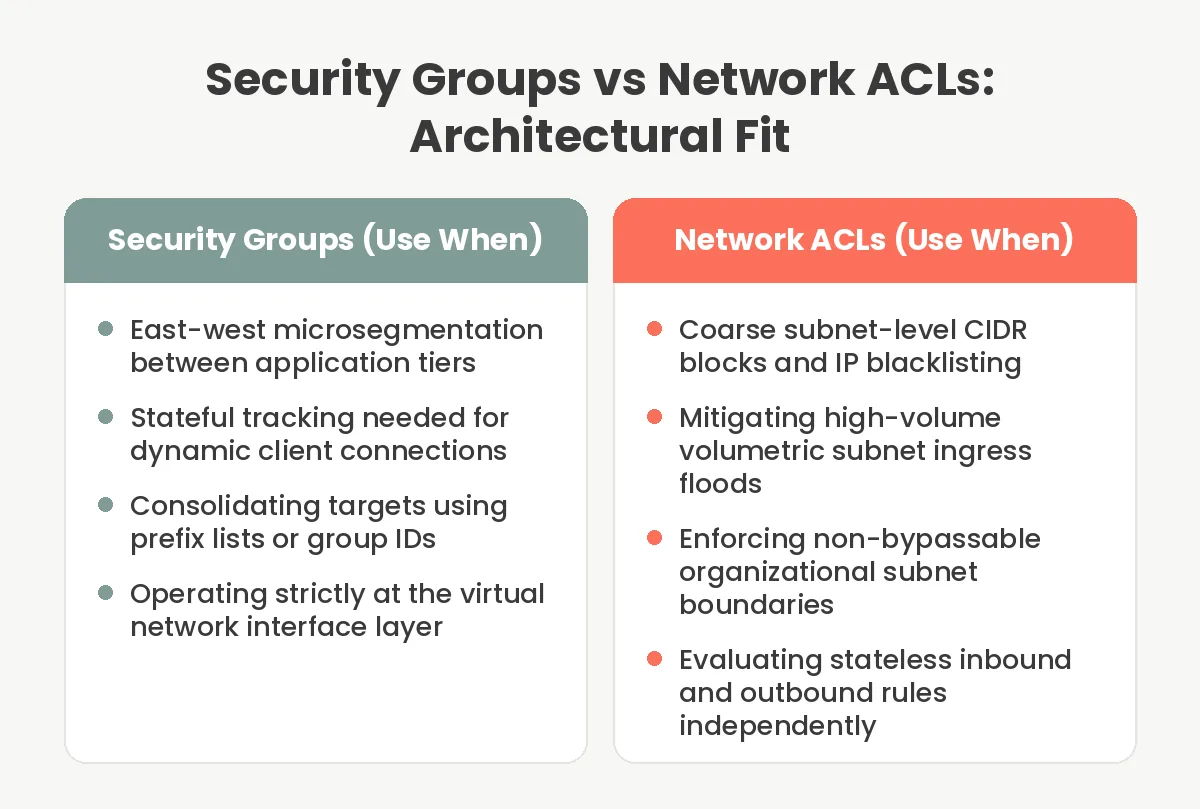
East-West Microsegmentation is the practice of isolating and restricting lateral network communication between workloads, tiers, or microservices within the same cloud network boundary. Allowing flat, unsegmented communication across an entire VPC CIDR block (such as 10.0.0.0/16) enables an adversary who compromises a single public-facing web server to query internal caching nodes, database clusters, and management interfaces without friction.
Security Group chaining provides the foundational mechanism for east-west isolation. Rather than permitting inbound traffic from wide subnet CIDRs, inbound rules on database and application tiers must only accept connections where the source is the security group ID of the authorized client tier. For example, a PostgreSQL database security group should only permit port 5432 ingress from the backend application Security Group ID.
Security group ID referencing functions across both local VPC peering connections and intra-VPC workloads. When microservices scale across multiple VPC environments, architects must decide between peering or centralized hubs. Evaluating AWS Transit Gateway vs VPC Peering helps identify where security group references can be preserved natively to enforce strict microsegmentation policies across accounts.
Default VPC configurations allow unrestricted outbound traffic via Internet Gateways or NAT Gateways, creating a massive exfiltration vector for compromised workloads. Modern network hardening requires outbound filtering to block connections to unauthorized external IP addresses and malicious domains. Implementing outbound controls forms the core of zero-egress cloud network architectures.
Route 53 Resolver DNS Firewall is a managed VPC-level DNS filtering service that blocks outbound DNS lookups toward malicious or unauthorized domain names before any IP packet is routed. According to Amazon Route 53 pricing (2026), the service bills $0.60 per million DNS queries inspected for the first 1 billion queries per month ($0.40 per million queries thereafter), alongside $0.0005 per domain name stored in a domain list per month.
AWS Documentation (2026) confirms that Route 53 Resolver DNS Firewall enforces a default quota of 5 DNS Firewall rule group associations per VPC and up to 100 rules per rule group. Administrators can deploy managed AWS Threat Intelligence domain lists to block known command-and-control (C2) domains automatically, or enforce strict domain allowlists for highly compliant subnets to prevent unauthorized external API consumption.
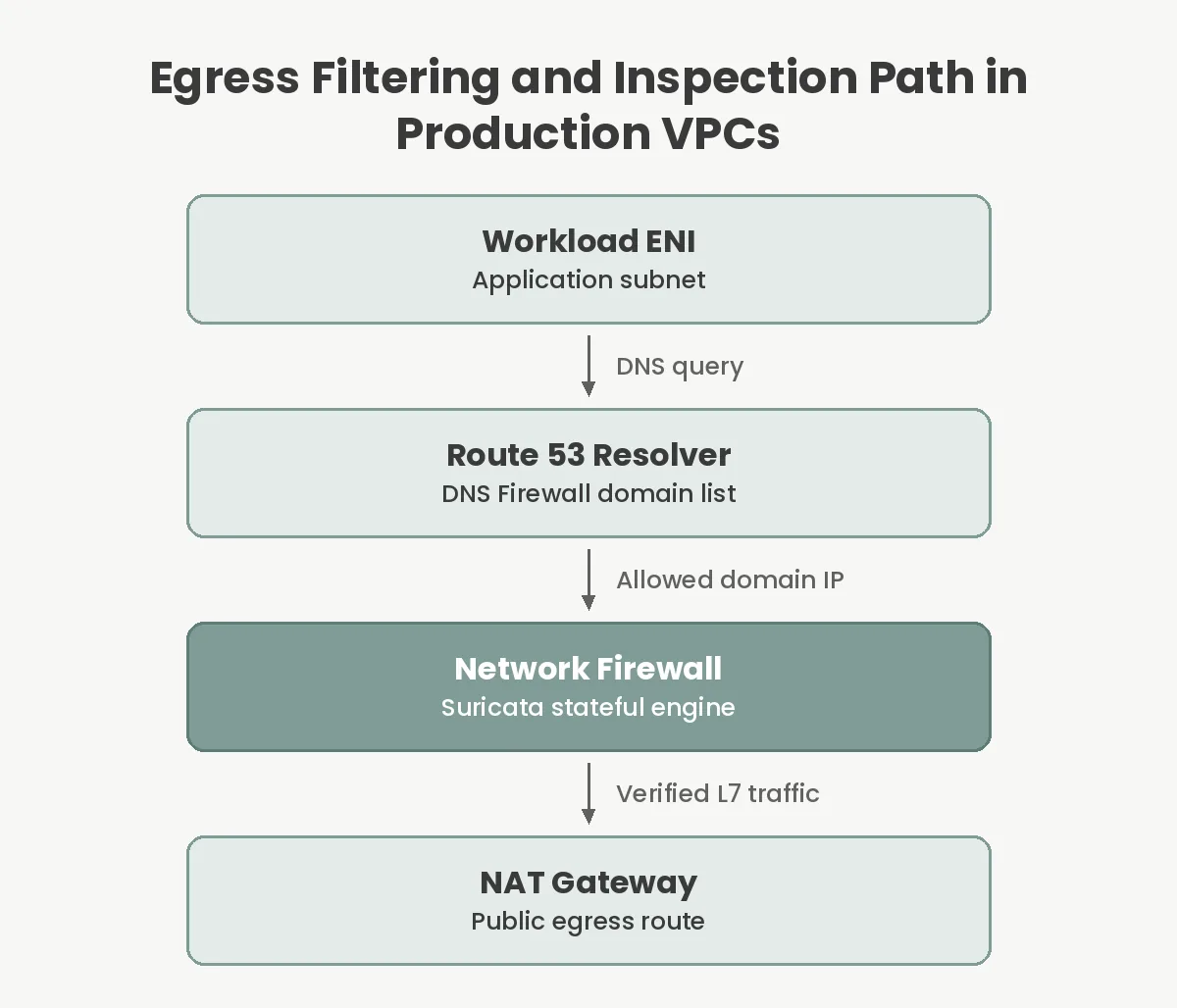
Route 53 Resolver DNS Firewall cannot intercept direct IP communication where an attacker bypasses the VPC DNS resolver by hardcoding external public IP addresses. Mitigating non-DNS data exfiltration requires stateful deep packet inspection deployed inline with outbound network routes. AWS Network Firewall provides managed Layer 7 inspection powered by the open-source Suricata rules engine.
An official AWS Announcement on May 28, 2024, confirmed an increase in the stateful rule quota for AWS Network Firewall to 50,000 rules per firewall policy, while expanding Suricata rule length capacity to 8,192 characters. This scale allows enterprises to enforce extensive Transport Layer Security (TLS) Server Name Indication (SNI) filtering rules, blocking outbound traffic to any domain not explicitly verified on a central corporate allowlist.
Architects must evaluate the financial overhead of inline deep packet inspection. AWS Network Firewall Pricing (2026) lists charges of $0.395 per firewall endpoint per hour in US East regions, plus $0.065 per gigabyte of traffic processed. Dedicated Route 53 Resolver inbound and outbound endpoints bill at $0.125 per ENI per hour according to AWS Documentation (2025), requiring a minimum of two IP addresses across distinct Availability Zones for high availability ($182.50 base monthly cost per endpoint pair before query processing fees).
The 1,000-rule ceiling applies directly to each individual Elastic Network Interface rather than the underlying EC2 instance. When container workloads or multi-homed appliances attach secondary ENIs to expand network throughput, they create distinct firewall boundary contexts. Attaching multiple network interfaces resets the rule counter for the new ENI, which allows teams to bypass per-instance quota ceilings.
Adding secondary network interfaces introduces asymmetric routing risks if security group rules are not mirrored across interfaces. Linux routing kernels drop asymmetric return packets by default when reverse path filtering (rp_filter) detects response traffic exiting an interface different from the arrival interface. This operational discrepancy causes intermittent connection drops that elude standard network logging.
Auditing procedures must verify that every network interface attached to an instance shares identical egress constraints. Unattached secondary ENIs left in a subnet without restrictive security groups provide open ingress pathways if inadvertently bound to public IP addresses during maintenance procedures.
A frequent failure mode in production VPCs is the assumption that Network ACLs replace stateful Security Groups. Because custom NACLs are stateless, engineers struggling with connection drops frequently open broad ingress rules (such as 0.0.0.0/0 on ports 1024–65535) to restore outbound HTTP/HTTPS functionality. This action completely neutralizes the subnet perimeter, leaving internal host firewalls as the sole barrier against unauthorized probing.
Another prevalent failure mode involves relying solely on Route 53 Resolver DNS Firewall for data loss prevention. DNS firewalls do not inspect Layer 4 TCP payloads or raw IP packets. Threat actors who hardcode malicious destination IPs into exfiltration scripts bypass DNS resolution entirely. Without inline stateful firewalls inspecting outbound packets, DNS-only filtering provides false operational confidence.
Teams also neglect security group auditing over time, creating “ghost rules” targeting decommissioned IP ranges or deleted peer VPC interfaces. When an infrastructure team provisions new subnets reusing old CIDRs, obsolete security group rules automatically grant trust to those newly provisioned resources. Periodic security group rule auditing is necessary to prune dangling references and enforce least-privilege policies.
Deploying AWS Network Firewall across every non-production subnet introduces unjustified operational and financial costs. For development environments, staging clusters, and small internal utility workloads, paying $0.395 hourly per endpoint plus $0.065 per gigabyte processed inflates infrastructure budgets rapidly without mitigating critical data risks. Route 53 Resolver DNS Firewall provides sufficient threat mitigation for development tiers at a fraction of the cost.
High-throughput data streaming pipelines processing petabytes of encrypted telemetry, video streams, or machine learning training sets should avoid inline Layer 7 network firewalls. Processing massive data volumes through Network Firewall inspection engines introduces microsecond latency penalties and steep data processing charges. In these architectures, routing data directly through localized VPC endpoints offers strict isolation without processing fees, as outlined in our guide to reducing NAT Gateway costs with VPC Endpoints.
Organizations standardizing container platforms may also find network security better managed via an eBPF-based Container Network Interface (CNI) rather than cloud VPC firewalls. Using eBPF eliminates iptables connection-tracking overhead while enforcing Layer 7 policies directly in the Linux kernel, as analyzed in our breakdown of eBPF vs iptables for modern networking.

The immediate step for securing production cloud networks is running an automated inventory of all Elastic Network Interfaces to calculate rule usage against the 1,000-rule architectural limit. Identify default security groups across every active AWS region and execute automated scripts to remove all ingress and egress permissions in compliance with CIS Benchmark Control 5.4.
Next, evaluate custom NACL configurations to narrow broad 1024–65535 ephemeral port windows down to Linux (32768–60999) or Windows (49152–65535) allocations based on actual host workloads. Finally, deploy Route 53 Resolver DNS Firewall rule groups across production VPCs to intercept malicious C2 domains, reserving inline AWS Network Firewall inspection endpoints exclusively for high-compliance subnets processing sensitive data.
Security Groups are stateful firewalls operating at the network interface layer that automatically track connection states. Network ACLs are stateless, ordered rule lists operating at the subnet boundary that evaluate inbound and outbound packets independently without tracking connection sessions.
Stateless Network ACLs do not remember outbound connections initiated by internal clients. Because returning server responses arrive on dynamically assigned client ports, administrators must open explicit inbound ephemeral port ranges (Linux 32768–60999; Windows 49152–65535) to receive external network traffic.
AWS Security Groups allow 60 inbound and 60 outbound rules by default. The hard limit enforces that the number of rules per security group multiplied by the number of security groups per network interface cannot exceed 1,000 total rules per Elastic Network Interface.
Route 53 Resolver DNS Firewall does not block direct IP-based exfiltration. The service only intercepts domain lookups routed through Route 53 Resolver; stopping exfiltration targeting hard-coded public IP addresses requires inline stateful packet inspection like AWS Network Firewall.
Prevent lateral movement by enforcing east-west microsegmentation using Security Group chaining. Configure database and internal service security groups to only accept inbound traffic referencing the specific security group ID of the calling application tier rather than broad subnet CIDR ranges.
You Can Get More Information!