How to Calculate and Reduce Multi-Cloud Egress Costs in 2026
Learn how to model, forecast, and structurally reduce data egress fees when operating across multiple cloud providers.

Make email marketing simplified

Make email marketing simplified

Make email marketing simplified

Make email marketing simplified

Make email marketing simplified

Make email marketing simplified

Make email marketing simplified

Make email marketing simplified

Make email marketing simplified

Make email marketing simplified

Make email marketing simplified

Make email marketing simplified

Make email marketing simplified

Make email marketing simplified

Make email marketing simplified

We use cookies for our website to give you the most relevant experience by remembering your preferences. By clicking “accept”, you consent to use of ALL the cookies
This website uses cookies to improve your experience while you navigate through the website. Out of these, the cookies that are categorized as necessary are stored on your browser as they are essential for the working of basic functionalities of the website. We also use third-party cookies that help us analyze and understand how you use this website. These cookies will be stored in your browser only with your consent. You also have the option to opt-out of these cookies. But opting out of some of these cookies may affect your browsing experience.
Necessary cookies are absolutely essential for the website to function properly. These cookies ensure basic functionalities and security features of the website, anonymously.
| Cookie | Duration | Description |
|---|---|---|
| cookielawinfo-checkbox-functional | 11 months | This cookie is set by GDPR Cookie Consent plugin. The cookie is used to store the user consent for the cookies in the category “Analytics”. |
| cookielawinfo-checkbox-functional | 11 months | The cookie is set by GDPR cookie consent to record the user consent for the cookies in the category “Functional”. |
| cookielawinfo-checkbox-necessary | 11 months | This cookie is set by GDPR Cookie Consent plugin. The cookies is used to store the user consent for the cookies in the category “Necessary”. |
| cookielawinfo-checkbox-others | 11 months | This cookie is set by GDPR Cookie Consent plugin. The cookie is used to store the user consent for the cookies in the category “Other. |
| cookielawinfo-checkbox-performance | 11 months | This cookie is set by GDPR Cookie Consent plugin. The cookie is used to store the user consent for the cookies in the category “Performance”. |
| viewed_cookie_policy | 11 months | The cookie is set by the GDPR Cookie Consent plugin and is used to store whether or not user has consented to the use of cookies. It does not store any personal data. |
Functional cookies help to perform certain functionalities like sharing the content of the website on social media platforms, collect feedbacks, and other third-party features.
Performance cookies are used to understand and analyze the key performance indexes of the website which helps in delivering a better user experience for the visitors.
Analytical cookies are used to understand how visitors interact with the website. These cookies help provide information on metrics the number of visitors, bounce rate, traffic source, etc.
Advertisement cookies are used to provide visitors with relevant ads and marketing campaigns. These cookies track visitors across websites and collect information to provide customized ads.
Other uncategorized cookies are those that are being analyzed and have not been classified into a category as yet.
Cyberia Tech, Inc. respects your privacy. This Privacy Policy explains how we collect, use, and share your information. By using our services, you agree to this policy. If any other agreements conflict with this Privacy Policy, the terms of those agreements prevail.
Cyberia Tech complies with the EU-US and Swiss-US Privacy Shield Frameworks for handling personal data from the EEA, UK, and Switzerland. In case of any conflict, the Privacy Shield Principles prevail. Learn more at Privacy Shield. Key Definitions
Information linked to an individual, transferred from the EEA, UK, or Switzerland to the U.S.
Data revealing race, religion, health, sexual orientation, and similar categories.
Effective Date: [ 2026 / 11 / 26 ]
Welcome to The Cyberia Tech ! By accessing or using our website or services, you agree to
comply with and be bound by these Terms of Use and our Privacy Policy. If you do not agree with
these terms, please do not use our Services.
Loading
0 %
Your First Piece of the Puzzle in
Business Growth



To design a zero egress cloud architecture, enforce strict intra-zone data isolation by configuring gateway VPC endpoints for cloud storage, deploying multi-zone PrivateLink interfaces for managed services, and enabling zone-aware routing across microservices. This layout prevents cross-AZ egress optimization leaks, eliminating up to 80% or more of inter-subnet and outbound data processing fees.
Default cloud network topologies silently inflate enterprise invoices through cross-zone and outbound traffic surcharges. In large-scale Kubernetes and distributed database deployments, engineering teams frequently watch cloud data transfer costs climb to thousands of dollars every month despite flat compute usage. A single misconfigured NAT route or unoptimized RPC service will ping-pong gigabytes of telemetry across subnets, triggering repeated per-gigabyte penalties. Understanding your routing foundation is essential; review our Cloud Networking Architecture: The 2026 Engineering Guide for overarching infrastructure strategies.
A zero egress cloud architecture is a network design pattern that confines internal network traffic within localized availability zones and eliminates direct internet and inter-zone transit fees through local routing primitives. The design relies on VPC endpoint routing, PrivateLink interfaces, and zone-aware service discovery mechanisms to handle workload communication locally.
Cloud service providers treat cross-zone traffic and external internet data transfers as metered revenue streams. When an application node in Availability Zone A queries a cache node or database replica in Availability Zone B, the provider bills for traffic exiting Zone A and entering Zone B. A zero-egress framework treats availability zones as completely isolated network silos for standard service communication.
In addition to cost reduction, this architecture hardens workload security boundaries. By stripping public IP allocation and default internet gateways from application environments, workloads communicate through private network interfaces. This isolation drastically reduces attack surfaces while shielding clusters from outbound internet disruptions.
Cloud data transfer costs accumulate through three distinct paths: internet egress transit, NAT gateway data processing, and cross-availability zone inter-subnet transfers. Provider billing engines meter every packet that crosses physical data center boundaries, private subnet borders, or internet gateways.
In Amazon Web Services, standard public internet egress ranges from $0.08 to $0.09 per gigabyte on initial tiers according to the AWS 2026 Data Transfer pricing schedule. Placing workloads in private subnets with a managed NAT Gateway does not bypass this metering. Instead, the AWS 2026 pricing schedule levies an additional $0.045 per gigabyte NAT data processing fee on top of the hourly $0.045 NAT gateway provisioning rate.
Cross-AZ data movement represents an even more pervasive expense across modern clusters. The AWS 2026 EC2 pricing schedule charges $0.01 per gigabyte for data sent across zones, and another $0.01 per gigabyte for data received by the destination node in the peer zone, producing an effective $0.02 per gigabyte round trip. A 100-terabyte intra-cluster analytical job spanning three availability zones generates $2,000 in transit charges under these AWS 2026 rates solely from inter-zone crossing. When teams neglect subnet routing tables, our guide on costly VPC subnet and routing mistakes shows how rapidly these fees multiply.
Building an egress-isolated topology requires replacing generic multi-tier internet routes with three foundational cloud primitives: local gateway routes, localized interface endpoints, and topology-conscious service discovery. Combining these components stops unmonitored lateral and outbound packet leakage.
Every availability zone must host its own isolated subnet tiers: public, private compute, and data persistence. Public subnets contain only edge ingress proxies or application load balancers. Private compute subnets must never hold a direct route to an Internet Gateway (igw-*) or an unmonitored default 0.0.0.0/0 NAT entry.
Compute workloads must communicate with cloud control planes, object storage, and managed databases via private IP space. Routing tables point managed platform traffic to private endpoints rather than resolving external public endpoints across the internet edge.
Workloads running inside Zone A should resolve upstream service targets located inside Zone A. Microservices should traverse inter-zone links only when local application instances degrade or experience capacity outages.
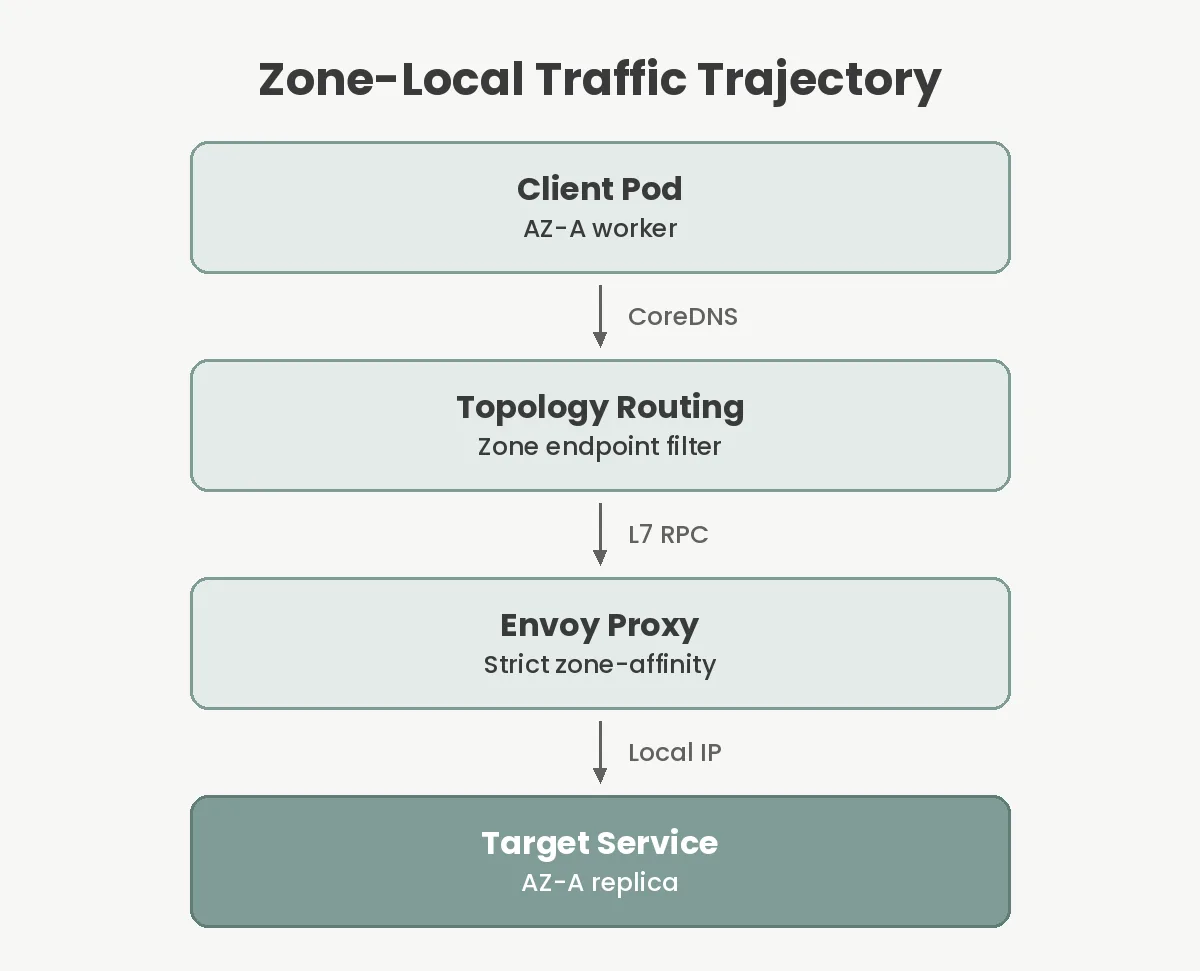
Topology-aware routing in Kubernetes and zone-aware load balancing in Envoy proxy restrict network traffic to the exact availability zone where the requesting client resides. This mechanism removes cross-AZ egress optimization leaks by modifying service discovery endpoints to prioritize local backend pods.
In modern container deployments, the Kubernetes kube-proxy component historically spread service requests evenly across all endpoints in a cluster, completely blind to zone boundaries. If an application runs across three zones, roughly 67% of all inter-service requests cross availability zone boundaries under standard round-robin distribution, accumulating billing charges on every single remote call.
To fix this, teams apply the service.kubernetes.io/topology-mode: Auto annotation to Kubernetes Service resources. When enabled, the control plane checks node capacity per zone. If endpoints are distributed proportionally to node CPU capacities, the endpoint slice controller allocates traffic strictly to endpoints in the caller’s zone. For advanced cluster networking layers, exploring eBPF vs iptables architectures highlights how modern container network plugins enforce these zone filters directly in the Linux kernel.
Operating zone-aware routing requires understanding the controller’s safety circuit breaker. When the ratio of endpoints to zone capacity deviates by more than roughly 20%, the Kubernetes EndpointSlice controller automatically disables topology hints. It then falls back to cluster-wide routing to prevent pod overload. Maintaining sufficient replica headroom across all zones ensures the controller remains in its money-saving local routing mode.
Replacing AWS NAT Gateways with Gateway and Interface VPC Endpoints routes private subnet traffic directly into cloud provider backbones without incurring NAT processing rates. This swap redirects heavy object storage and managed service payloads away from billable NAT paths.
Gateway VPC Endpoints for Amazon S3 and Amazon DynamoDB are provisioned directly inside VPC route tables without hourly charges or per-gigabyte data processing fees under AWS 2026 network pricing rules. By inserting prefix list routes (such as pl-63a5400a for S3) into your private route table, S3 traffic routes directly across the AWS internal software-defined network. This change eliminates the $0.045 per gigabyte NAT data processing charge documented in AWS 2026 pricing tables instantly. Teams evaluating this shift can consult our analysis of AWS NAT Gateway costs and VPC endpoints.
For services requiring Interface Endpoints (AWS PrivateLink), such as Amazon ECR, Secrets Manager, or internal microservices, AWS provisions elastic network interfaces (ENIs) with private IP addresses. Interface endpoints carry a cost of $0.01 per AZ-hour and $0.01 per gigabyte processed according to AWS 2026 PrivateLink rates. While not completely free, moving data through PrivateLink saves $0.035 per gigabyte compared to routing that same data through a standard NAT Gateway at the AWS 2026 rate of $0.045 per gigabyte.
The breakeven equation between a NAT Gateway and PrivateLink interface endpoints comes down to transfer volume versus static availability zone provisioning. A NAT Gateway incurs $0.045 per hour per availability zone ($32.40 monthly) plus $0.045 per gigabyte processed in 2026. An Interface Endpoint incurs $0.01 per hour per AZ ($7.20 monthly) plus $0.01 per gigabyte. When an application downloads large container images or queries cloud APIs frequently, interface endpoints pay for themselves within hours while slashing the variable data tax.
Direct VPC Peering eliminates the per-gigabyte processing fees imposed by centralized Transit Gateways for high-bandwidth point-to-point connections. While AWS Transit Gateway simplifies multi-account routing hubs, it assesses a $0.02 per gigabyte processing fee on all transit payloads under the AWS 2026 pricing schedule.
When high-volume database replication or cross-cluster streaming occurs between two specific VPCs, configure direct VPC Peering connections instead of routing through a centralized hub. Direct VPC peering carries zero data processing surcharges under AWS 2026 specifications; traffic between peered VPCs incurs only the standard cross-AZ fee of $0.01 per gigabyte if zones do not align, or zero dollars if communication stays within the same availability zone.
To maintain a zero-egress posture across multiple accounts, ensure that VPC Peering routing tables map subnets using matching Availability Zone IDs (such as use1-az1). Provider zone letter mappings (such as us-east-1a) differ across cloud accounts; mapping by explicit Zone ID guarantees traffic stays on identical physical infrastructure without traversing cross-zone links. For architectural trade-offs, review our breakdown of AWS Transit Gateway vs VPC Peering.
Consider a machine learning inference cluster streaming 50 terabytes of feature vectors monthly from an ingestion VPC to a training VPC. Routing this stream through an AWS Transit Gateway costs $1,000 per month just for data processing at the AWS 2026 rate of $0.02 per gigabyte. Establishing a direct VPC Peering connection and aligning both clusters in identical Zone IDs cuts that processing fee to $0.00, reducing the invoice for that data pipeline to zero.

Envoy proxy and HashiCorp Consul implement zone-aware routing by measuring round-trip locality and assigning strict weighting to endpoints matching the local zone. When Envoy receives an upstream request, its locality-weighted load balancer directs 100% of traffic to healthy hosts inside the identical zone.
To configure zone affinity in Envoy, operators supply the locality.zone attribute inside the node’s bootstrap definition. In the upstream cluster configuration, setting zone_aware_lb_config instructs the cluster to prefer endpoints with matching locality coordinates. If all local hosts remain healthy, no packets ever leave the physical boundary of that availability zone.
Consul achieves identical behavior through its locality prioritizing engine. By registering service instances with their respective cloud availability zone tags, Consul DNS and Connect proxies route incoming service lookups to the nearest local instance. Remote zone endpoints serve strictly as failover targets when local health checks return unhealthy statuses.
When utilizing Envoy’s locality weight configuration, operators define a primary tier for the local zone and a secondary failover tier for adjacent zones. Envoy continuously tracks endpoint health via active gRPC or HTTP health checks. If local zone endpoint availability drops below a defined threshold, Envoy gradually shifts a proportionate percentage of traffic to neighbor zones, preserving application availability without permanently hemorrhaging cross-zone fees during steady state.
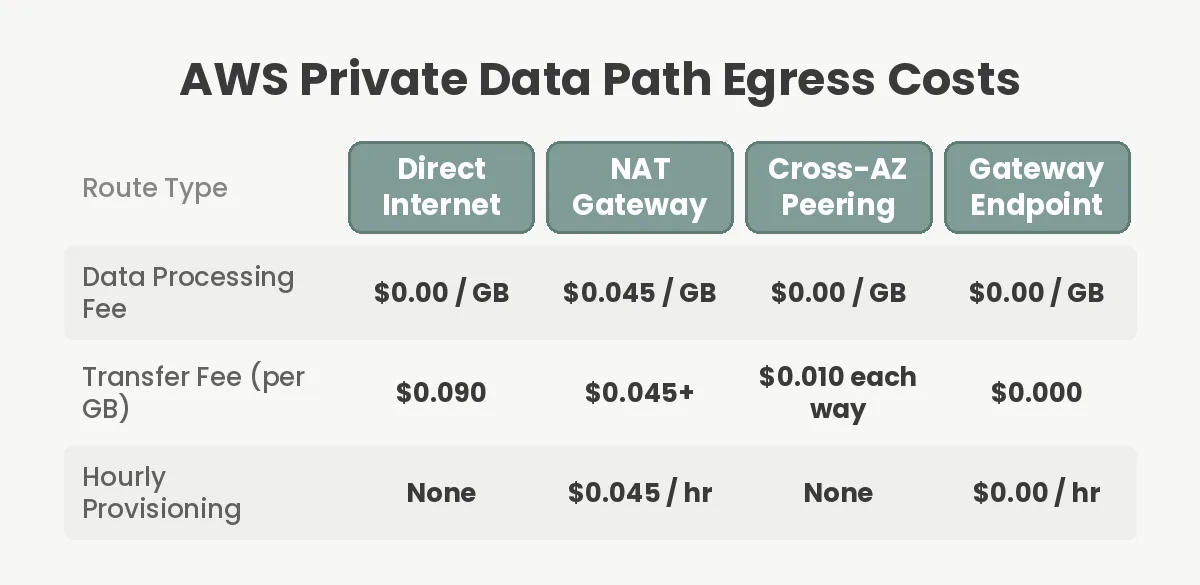
The total cost of traversing cloud networks depends heavily on the selected routing primitive, the protocol boundary, and whether packets cross zone or internet borders. The table below details AWS data transfer fees across private routing choices based on published AWS 2026 infrastructure pricing.
| Route Primitive | Hourly Baseline Fee | Data Processing Fee (per GB) | Cross-AZ Transit Fee (per GB) | Public Internet Fee (per GB) |
|---|---|---|---|---|
| Internet Gateway (IGW) | $0.00 | $0.00 | Not applicable | $0.090 |
| NAT Gateway | $0.045 / hour | $0.045 | $0.010 (if cross-zone) | $0.090 |
| Gateway VPC Endpoint | $0.00 | $0.00 | $0.00 | $0.00 |
| Interface VPC Endpoint | $0.010 / AZ-hour | $0.010 | $0.00 (when zone-local) | $0.00 |
| VPC Peering (Same AZ) | $0.00 | $0.00 | $0.00 | $0.00 |
| VPC Peering (Cross-AZ) | $0.00 | $0.00 | $0.010 (each direction) | $0.00 |
| AWS Transit Gateway | $0.050 / attachment | $0.020 | Included in processing | $0.00 |
The financial takeaway is obvious: Gateway VPC endpoints offer complete cost avoidance for object storage, while direct VPC Peering and zone-local interface endpoints eliminate the high compounding surcharges of NAT Gateways and Transit Gateways. According to AWS 2026 pricing schedules, replacing a NAT Gateway path with an S3 Gateway Endpoint entirely wipes out the $0.045 per gigabyte penalty on object storage requests.
Furthermore, evaluating data paths requires assessing total transfer volumes against hourly attachment minimums. While an AWS Transit Gateway attachment costs $0.05 per hour ($36 per month) plus $0.02 per gigabyte processed under AWS 2026 pricing, VPC Peering costs $0.00 per hour with zero processing charges. For sustained high-throughput links between core application VPCs, peering delivers pure margin improvement.

Strict zone-local network architectures should not be deployed when backend service workloads exhibit severe traffic skew or when microservice fleets lack sufficient pod replicas to guarantee high availability per zone. Imposing zone-affinity under asymmetric load causes node saturation and cascading service failures.
In environments where an upstream service runs hundreds of replicas but a downstream internal dependency runs only two pods total across three zones, strict zone-aware routing forces an entire zone to drop or queue traffic. The availability zone lacking a local replica receives zero local routes, forcing sudden failover spikes.
Furthermore, small startups running low-bandwidth microservices (under 500 gigabytes of monthly cross-zone data) will waste engineering hours configuring topology-aware controllers. When monthly cross-AZ fees sit below $20 based on AWS 2026 rates of $0.02 per gigabyte round-trip, the operational complexity of managing isolated subnet tiers, Envoy bootstrap filters, and multiple endpoint slices exceeds the cost savings.
Workloads relying on single-instance stateful sets or active-passive database clustering also gain little from strict zone routing. If your primary relational database sits exclusively in Zone A, forcing read-write queries from microservices in Zone B or Zone C to find a local database endpoint is technically impossible without distributed multi-master replication engines. Forcing locality on fundamentally centralized backends introduces artificial latency layers without cost benefits.
The most common failure mode in zero-egress implementations is deploying single-subnet VPC interface endpoints, which forces workloads in other availability zones to traverse inter-zone links to reach the private endpoint. This error reintroduces cross-AZ egress fees while simultaneously adding an interface endpoint processing charge.
When an engineer provisions an Interface Endpoint for Amazon ECR in only us-east-1a, compute instances residing in us-east-1b resolve that endpoint’s private IP in Zone A. Under the AWS 2026 pricing structure, those instances incur the $0.01 per gigabyte cross-AZ transmission fee, the $0.01 per gigabyte cross-AZ receiving fee, and the $0.01 per gigabyte Interface Endpoint processing fee. The attempt to optimize costs ends up costing $0.03 per gigabyte.
Another frequent oversight occurs during Kubernetes horizontal pod autoscaling. If an HPA controller scales down pods in Zone B while traffic remains high, topology-aware routing can leave remaining Zone B pods overwhelmed with requests. Kubernetes clusters must maintain balanced pod distributions across all zones using topologySpreadConstraints before enabling strict zone routing.
Teams also routinely forget to disable cross-zone load balancing on internal AWS Application Load Balancers (ALBs). By default, ALBs distribute incoming HTTP requests evenly across targets in all enabled availability zones. If cross-zone load balancing remains active on an internal ALB, the load balancer deliberately routes traffic across zone boundaries, generating $0.02 per gigabyte in transit costs under AWS 2026 rates on every cross-routed request.
Begin your zero-egress migration by exporting cloud billing telemetry to isolate network charges by line item. Identify the specific subnets generating NAT Gateway processing and cross-AZ data fees. Immediately insert free Gateway VPC Endpoints for Amazon S3 and DynamoDB into all private route tables, removing storage transfer loads from NAT paths. Next, audit internal load balancers to disable unneeded cross-zone distribution, and activate topologySpreadConstraints alongside topology-aware routing across your Kubernetes services. Enforcing zone locality across internal infrastructure permanently caps network costs while sharpening overall system resilience.
Cross-AZ data transfer in AWS costs $0.01 per gigabyte for outbound transmission and another $0.01 per gigabyte for inbound reception. This pricing model results in a total cost of $0.02 per gigabyte for standard round-trip microservice or database traffic passing across availability zone borders.
Gateway VPC Endpoints for Amazon S3 and Amazon DynamoDB are completely free of hourly provisioning fees and data processing charges. Adding them to VPC route tables routes private subnet requests directly to AWS services without incurring NAT processing or standard internet egress expenses.
Topology-aware routing saves money by filtering endpoint slices to route service calls strictly to pods running within the caller’s availability zone. This prevents kube-proxy from randomly balancing requests across zones, eliminating the $0.02 per gigabyte cross-AZ cloud network transit fee.
An Interface VPC Endpoint is cheaper than a NAT Gateway whenever target service bandwidth exceeds endpoint hourly costs, charging $0.01 per gigabyte processed compared to the $0.045 per gigabyte fee charged by AWS NAT Gateways for identical data volumes.
You Can Get More Information!