The Financial Impact of Usage-Based SaaS Pricing in the Enterprise
Usage-based SaaS pricing aligns software costs directly with measurable consumption...

Make email marketing simplified

Make email marketing simplified

Make email marketing simplified

Make email marketing simplified

Make email marketing simplified

Make email marketing simplified

Make email marketing simplified

Make email marketing simplified

Make email marketing simplified

Make email marketing simplified

Make email marketing simplified

Make email marketing simplified

Make email marketing simplified

Make email marketing simplified

Make email marketing simplified

We use cookies for our website to give you the most relevant experience by remembering your preferences. By clicking “accept”, you consent to use of ALL the cookies
This website uses cookies to improve your experience while you navigate through the website. Out of these, the cookies that are categorized as necessary are stored on your browser as they are essential for the working of basic functionalities of the website. We also use third-party cookies that help us analyze and understand how you use this website. These cookies will be stored in your browser only with your consent. You also have the option to opt-out of these cookies. But opting out of some of these cookies may affect your browsing experience.
Necessary cookies are absolutely essential for the website to function properly. These cookies ensure basic functionalities and security features of the website, anonymously.
| Cookie | Duration | Description |
|---|---|---|
| cookielawinfo-checkbox-functional | 11 months | This cookie is set by GDPR Cookie Consent plugin. The cookie is used to store the user consent for the cookies in the category “Analytics”. |
| cookielawinfo-checkbox-functional | 11 months | The cookie is set by GDPR cookie consent to record the user consent for the cookies in the category “Functional”. |
| cookielawinfo-checkbox-necessary | 11 months | This cookie is set by GDPR Cookie Consent plugin. The cookies is used to store the user consent for the cookies in the category “Necessary”. |
| cookielawinfo-checkbox-others | 11 months | This cookie is set by GDPR Cookie Consent plugin. The cookie is used to store the user consent for the cookies in the category “Other. |
| cookielawinfo-checkbox-performance | 11 months | This cookie is set by GDPR Cookie Consent plugin. The cookie is used to store the user consent for the cookies in the category “Performance”. |
| viewed_cookie_policy | 11 months | The cookie is set by the GDPR Cookie Consent plugin and is used to store whether or not user has consented to the use of cookies. It does not store any personal data. |
Functional cookies help to perform certain functionalities like sharing the content of the website on social media platforms, collect feedbacks, and other third-party features.
Performance cookies are used to understand and analyze the key performance indexes of the website which helps in delivering a better user experience for the visitors.
Analytical cookies are used to understand how visitors interact with the website. These cookies help provide information on metrics the number of visitors, bounce rate, traffic source, etc.
Advertisement cookies are used to provide visitors with relevant ads and marketing campaigns. These cookies track visitors across websites and collect information to provide customized ads.
Other uncategorized cookies are those that are being analyzed and have not been classified into a category as yet.
Cyberia Tech, Inc. respects your privacy. This Privacy Policy explains how we collect, use, and share your information. By using our services, you agree to this policy. If any other agreements conflict with this Privacy Policy, the terms of those agreements prevail.
Cyberia Tech complies with the EU-US and Swiss-US Privacy Shield Frameworks for handling personal data from the EEA, UK, and Switzerland. In case of any conflict, the Privacy Shield Principles prevail. Learn more at Privacy Shield. Key Definitions
Information linked to an individual, transferred from the EEA, UK, or Switzerland to the U.S.
Data revealing race, religion, health, sexual orientation, and similar categories.
Effective Date: [ 2026 / 11 / 03 ]
Welcome to The Cyberia Tech ! By accessing or using our website or services, you agree to
comply with and be bound by these Terms of Use and our Privacy Policy. If you do not agree with
these terms, please do not use our Services.
Loading
0 %
Your First Piece of the Puzzle in
Business Growth



Usage-based SaaS pricing aligns software costs directly with measurable consumption rather than static employee headcounts, effectively eliminating idle licensing waste. Enterprises typically transition to consumption models when inactive seat rates exceed 25%, preferring to exchange the predictability of flat-rate billing for the strict unit-economic efficiency of pay-as-you-go architectures.
The enterprise software market is actively abandoning the traditional per-user license. For decades, procurement teams purchased software seats in bulk, accepting heavy volume discounts in exchange for guaranteed annual recurring revenue. The financial reality of this model is grim: a 2025 Gartner analysis indicates that roughly 30% of provisioned enterprise seats remain entirely idle or severely underutilized. As IT budgets tighten, Chief Financial Officers are scrutinizing this exact waste. The decision between a flat-rate seat and a metered consumption API call determines whether your operational expenses scale with actual business value or simply bloat alongside employee headcount.
Instead of charging a flat $50 per user per month regardless of activity, usage-based SaaS pricing meters discrete events. Depending on the product architecture, this metric might be database queries executed, gigabytes of network egress, individual API calls, or unique customer transactions processed. This forces the vendor’s infrastructure cost basis to map identically to the customer’s derived value. If a team member logs in but executes zero reports, a seat-based model charges full price. A consumption model registers zero billable events.
This architectural shift requires fundamentally different software engineering from the vendor. Traditional multi-tenant applications partition data logically but assume a relatively stable baseline of compute overhead per user. True consumption platforms operate on heavily elastic serverless backends, spinning compute resources up and down to match real-time tenant demand. According to OpenView Partners’ 2024 State of Usage-Based Pricing report, 61% of software companies now incorporate some form of usage metering, a sharp increase driven by the maturation of these dynamic infrastructure primitives.
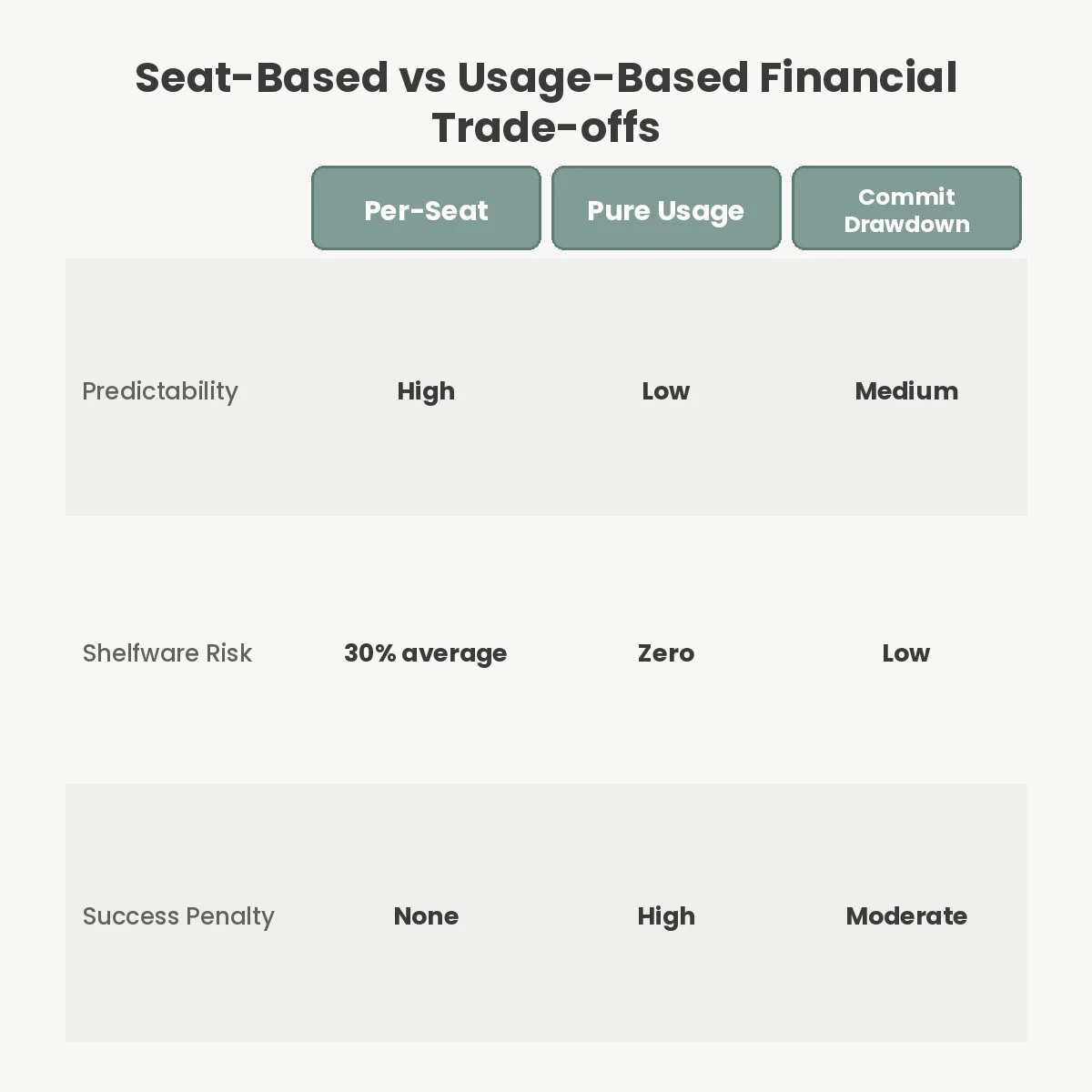
Transitioning from predictable annual contracts to variable monthly invoices fundamentally alters corporate financial planning. The primary advantage of a seat-based license is budgetary certainty; the primary flaw is structural inefficiency. Procurement teams must calculate exactly how much a lack of predictability costs their specific organization against the savings of eliminating idle accounts.
| Financial Metric | Seat-Based Licensing | Usage-Based Pricing | Hybrid (Committed Drawdown) |
|---|---|---|---|
| Budget Predictability | High (Fixed annual OPEX) | Low (Variable monthly OPEX) | Medium (Pre-purchased credits) |
| Shelfware Risk | High (Average 30% waste) | Zero (Pay only for execution) | Low (Assuming accurate forecasting) |
| Cost Scalability | Step-functions (Buying blocks) | Linear (Cost maps to load) | Tiered (Volume discounts apply) |
| Success Penalty | None (Viral usage is free) | High (Viral usage breaks budget) | Moderate (Overage rates apply) |
Enterprises evaluating this shift often look to comprehensive vendor consolidation initiatives to capture a holistic view of their active utilization. A single monolithic platform charging by the seat might appear cost-effective on paper, but if only 40% of the features are actively queried, the underlying unit economics are highly unfavorable.
The term “shelfware” refers to software that is purchased but never deployed or utilized. In a traditional enterprise sales motion, vendors incentivize shelfware through aggressive tiering. A vendor might offer 1,000 seats at $20 each, but heavily discount a 5,000-seat tier to $12 each. The procurement team purchases the 5,000-seat block to secure the lower unit price, fully aware they only have 2,500 active employees. The remaining 2,500 seats sit empty.
Research from ProfitWell demonstrates that forcing customers onto unoptimized seat tiers actively harms long-term relationships. Their telemetry analysis shows that when a customer’s actual seat utilization drops below 40%, the probability of churn at renewal spikes by 15-20%. The customer eventually realizes they are subsidizing the vendor’s profit margins without extracting commensurate value. Usage-based pricing mathematically eliminates this scenario, as the invoice natively shrinks to match declining engagement.
Despite its efficiency, consumption billing introduces a distinct corporate risk known as the “success penalty.” If a software implementation becomes wildly successful internally, or if a customer-facing API experiences a sudden viral spike in traffic, the associated operational expense scales linearly and immediately. For heavily bootstrapped organizations, managing this variable burn rate is a matter of survival.
Usage-based pricing is actively dangerous for predictable, baseline workloads that run 24/7. An enterprise running a continuous background data synchronization process will pay vastly more by the gigabyte on a metered connection than they would on a flat-rate dedicated pipe. Additionally, without strict internal monitoring, an engineering error—such as an infinite loop calling a paid API—can generate a catastrophic bill over a single weekend. Flat-rate seating caps your maximum financial exposure; metered consumption mathematically unbounds it.
The most frequent failure mode when migrating to a metered model occurs during cost forecasting. Organizations routinely extrapolate their current monthly seat cost into a presumed consumption baseline without analyzing the depth of their actual usage. If power users are executing complex, compute-heavy tasks that were previously subsidized by the flat rate, the new metered bill will heavily exceed the historical seat cost.
Another critical mistake is failing to implement granular billing alerts. Enterprises transitioning to usage billing must configure hard budgetary limits and automated circuit breakers. Relying solely on the vendor’s end-of-month invoice guarantees that budget overruns are only discovered weeks after the capital has been spent. This reactive posture undermines the entire financial thesis of agile consumption.
To balance the predictability of seats with the fairness of metering, the enterprise market has largely settled on the Minimum Viable Commitment (MVC), often called a committed drawdown contract. In this structure, the enterprise pre-purchases a bulk pool of consumption credits annually. Because the cash is paid upfront and guaranteed, the vendor discounts the per-unit consumption rate by 15-25% compared to pure pay-as-you-go pricing.
This model drives aggressive valuations in public markets. For example, Snowflake’s Q4 2024 investor relations filings highlighted a 131% net revenue retention (NRR) rate driven purely by consumption expansion rather than headcount growth. Similarly, the 2025 Bessemer Venture Partners (BVP) Cloud Index notes that companies successfully deploying usage-based pricing trade at a 1.5x revenue multiple premium compared to pure seat-based peers. The drawdown model provides vendors with baseline security while allowing enterprises to scale operations efficiently.
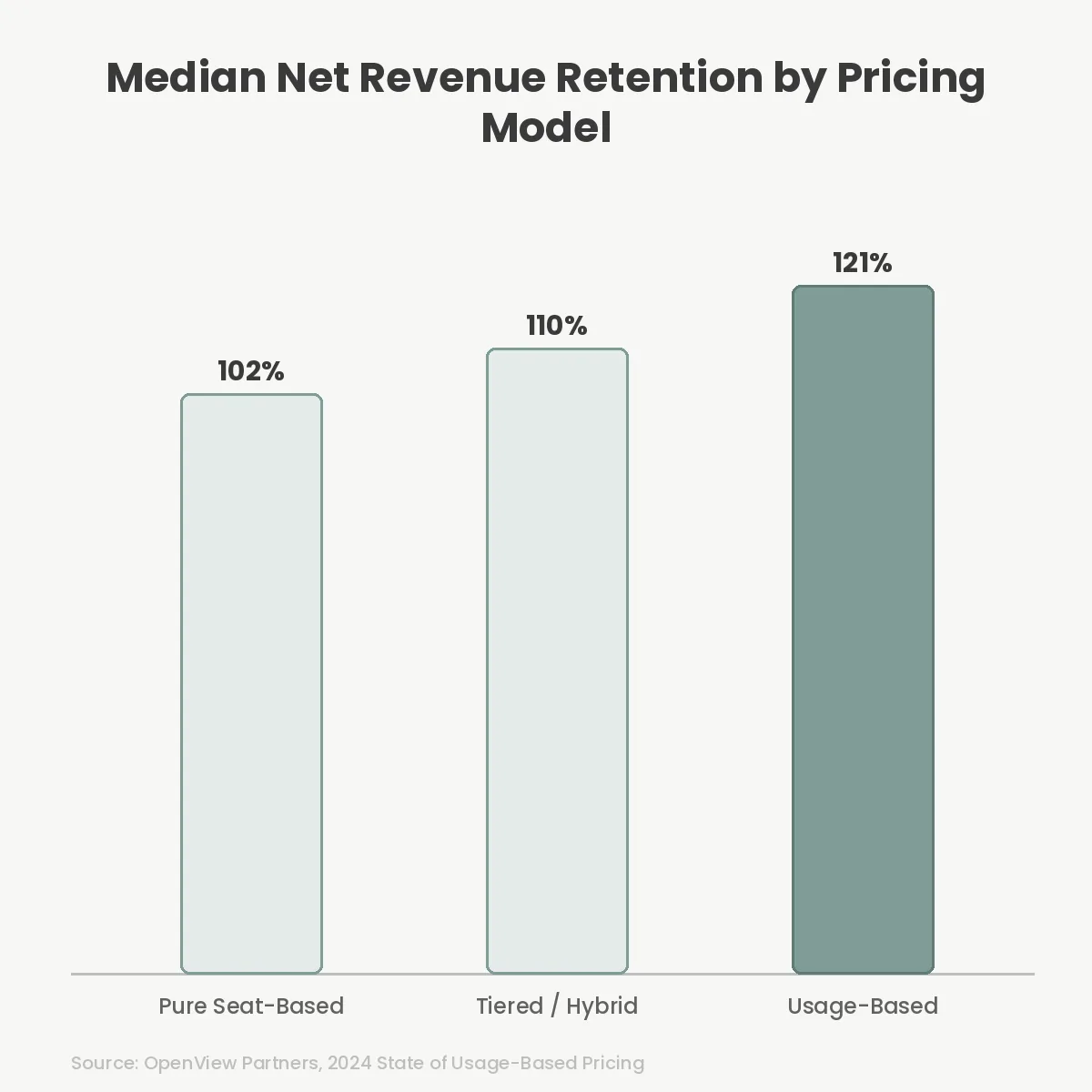
Succeeding with metered software requires treating SaaS expenses as dynamic infrastructure. Financial controllers must partner with engineering teams to deploy centralized telemetry platforms that monitor API calls, storage accumulation, and active compute seconds across third-party vendors. Establishing a FinOps cloud strategy is no longer restricted to AWS or Azure workloads; the discipline now applies equally to massive SaaS deployments.
Before signing a consumption contract, insist that the vendor provides real-time, programmatic access to billing telemetry via API. If a vendor obscures usage data behind a 24-hour delay or a manual dashboard, they are actively preventing your organization from implementing automated financial controls. True usage-based partnerships mandate complete transparency into the marginal cost of every transaction.
By understanding the exact cost per query or cost per active session, business leaders can finally correlate software expenditure directly with revenue generation. This fundamentally shifts the SaaS conversation from a procurement negotiation to an exercise in gross margin optimization.
The primary risk is unpredictable variable costs during traffic spikes. If a product scales unexpectedly, the associated software consumption bill scales linearly, potentially destroying quarterly OPEX budgets if hard caps, alerts, or circuit breakers are not actively configured in advance.
Financial teams forecast variable pricing by analyzing historical telemetry data, calculating a baseline cost-per-transaction, and applying expected corporate growth multipliers. They typically secure predictable budgetary floors by negotiating minimum viable commitments in exchange for heavily discounted unit rates.
Vendors favor consumption metrics because they automatically capture revenue upside from highly active, growing accounts without requiring cumbersome contract renegotiations. This dynamic correlates directly with higher net revenue retention rates and triggers increased valuation multiples on public equity markets.
Industry benchmarks strongly suggest that if more than 25% of provisioned seats remain inactive over a 90-day period, the aggregate financial drain of that shelfware outweighs the budgetary predictability of flat-rate licensing, making a transition to metered billing mandatory.
The transition from seat-based licensing to usage-based SaaS pricing requires a fundamental shift in how enterprises manage software expenditures. Procurement is no longer a localized event occurring once a year at renewal time; it is a continuous operational discipline. Organizations must immediately audit their existing SaaS deployments to identify the percentage of inactive seats. If your shelfware rate exceeds the 25% threshold, mandate that all future vendor negotiations prioritize consumption models or heavily discounted hybrid drawdowns, ensuring every dollar spent maps directly to executed business value.
You Can Get More Information!