The Economics of BYOC: Why Enterprise SaaS is Abandoning Multi-Tenant
Bring Your Own Cloud (BYOC) is an enterprise SaaS deployment...

Make email marketing simplified

Make email marketing simplified

Make email marketing simplified

Make email marketing simplified

Make email marketing simplified

Make email marketing simplified

Make email marketing simplified

Make email marketing simplified

Make email marketing simplified

Make email marketing simplified

Make email marketing simplified

Make email marketing simplified

Make email marketing simplified

Make email marketing simplified

Make email marketing simplified

We use cookies for our website to give you the most relevant experience by remembering your preferences. By clicking “accept”, you consent to use of ALL the cookies
This website uses cookies to improve your experience while you navigate through the website. Out of these, the cookies that are categorized as necessary are stored on your browser as they are essential for the working of basic functionalities of the website. We also use third-party cookies that help us analyze and understand how you use this website. These cookies will be stored in your browser only with your consent. You also have the option to opt-out of these cookies. But opting out of some of these cookies may affect your browsing experience.
Necessary cookies are absolutely essential for the website to function properly. These cookies ensure basic functionalities and security features of the website, anonymously.
| Cookie | Duration | Description |
|---|---|---|
| cookielawinfo-checkbox-functional | 11 months | This cookie is set by GDPR Cookie Consent plugin. The cookie is used to store the user consent for the cookies in the category “Analytics”. |
| cookielawinfo-checkbox-functional | 11 months | The cookie is set by GDPR cookie consent to record the user consent for the cookies in the category “Functional”. |
| cookielawinfo-checkbox-necessary | 11 months | This cookie is set by GDPR Cookie Consent plugin. The cookies is used to store the user consent for the cookies in the category “Necessary”. |
| cookielawinfo-checkbox-others | 11 months | This cookie is set by GDPR Cookie Consent plugin. The cookie is used to store the user consent for the cookies in the category “Other. |
| cookielawinfo-checkbox-performance | 11 months | This cookie is set by GDPR Cookie Consent plugin. The cookie is used to store the user consent for the cookies in the category “Performance”. |
| viewed_cookie_policy | 11 months | The cookie is set by the GDPR Cookie Consent plugin and is used to store whether or not user has consented to the use of cookies. It does not store any personal data. |
Functional cookies help to perform certain functionalities like sharing the content of the website on social media platforms, collect feedbacks, and other third-party features.
Performance cookies are used to understand and analyze the key performance indexes of the website which helps in delivering a better user experience for the visitors.
Analytical cookies are used to understand how visitors interact with the website. These cookies help provide information on metrics the number of visitors, bounce rate, traffic source, etc.
Advertisement cookies are used to provide visitors with relevant ads and marketing campaigns. These cookies track visitors across websites and collect information to provide customized ads.
Other uncategorized cookies are those that are being analyzed and have not been classified into a category as yet.
Cyberia Tech, Inc. respects your privacy. This Privacy Policy explains how we collect, use, and share your information. By using our services, you agree to this policy. If any other agreements conflict with this Privacy Policy, the terms of those agreements prevail.
Cyberia Tech complies with the EU-US and Swiss-US Privacy Shield Frameworks for handling personal data from the EEA, UK, and Switzerland. In case of any conflict, the Privacy Shield Principles prevail. Learn more at Privacy Shield. Key Definitions
Information linked to an individual, transferred from the EEA, UK, or Switzerland to the U.S.
Data revealing race, religion, health, sexual orientation, and similar categories.
Effective Date: [ 2026 / 11 / 24 ]
Welcome to The Cyberia Tech ! By accessing or using our website or services, you agree to
comply with and be bound by these Terms of Use and our Privacy Policy. If you do not agree with
these terms, please do not use our Services.
Loading
0 %
Your First Piece of the Puzzle in
Business Growth



Bring Your Own Cloud (BYOC) is an enterprise SaaS deployment model where the software vendor hosts the management control plane, but the data plane runs entirely within the customer’s cloud environment. This architecture ensures sensitive data never leaves the customer’s Virtual Private Cloud (VPC), satisfying compliance mandates while maintaining managed orchestration.
Enterprise buyers are refusing to hand over their proprietary data to multi-tenant software vendors. With data gravity increasing and cross-Availability Zone egress fees consuming up to 30% of gross margins, traditional managed services face an economic breaking point. According to a 2024 Redpoint Ventures analysis, over 60% of new data infrastructure startups now launch with a BYOC option from day one. Vendors face a clear decision: either build single-tenant architectures that deploy into the customer’s cloud, or lose the enterprise market entirely.
Centralizing thousands of customers onto a single managed infrastructure cluster used to be the cornerstone of software margins. That calculus breaks down when operating high-throughput data tools. Every byte sent out of a customer’s AWS environment into a vendor’s cloud incurs a networking toll. Cloud providers extract a heavy premium on data egress, making centralized data ingestion highly inefficient at scale.
If an enterprise pushes terabytes of telemetry data into a vendor’s multi-tenant managed Kafka or observability platform, the vendor must factor those networking penalties into their pricing. This forces the vendor to charge exorbitant rates just to protect their gross margin. For massive scale, this model is fundamentally uneconomical for both parties, as the customer ends up subsidizing the SaaS vendor’s architectural inefficiencies.
The alternative eliminates the transit entirely. By adopting a BYOC architecture, companies like WarpStream have demonstrated that running the data plane directly in the customer’s VPC can reduce cross-AZ networking costs by up to 80%. The software operates precisely where the data already lives. The customer pays the base cloud compute rate without the vendor’s markup, and the vendor avoids operating a massive, expensive centralized infrastructure.
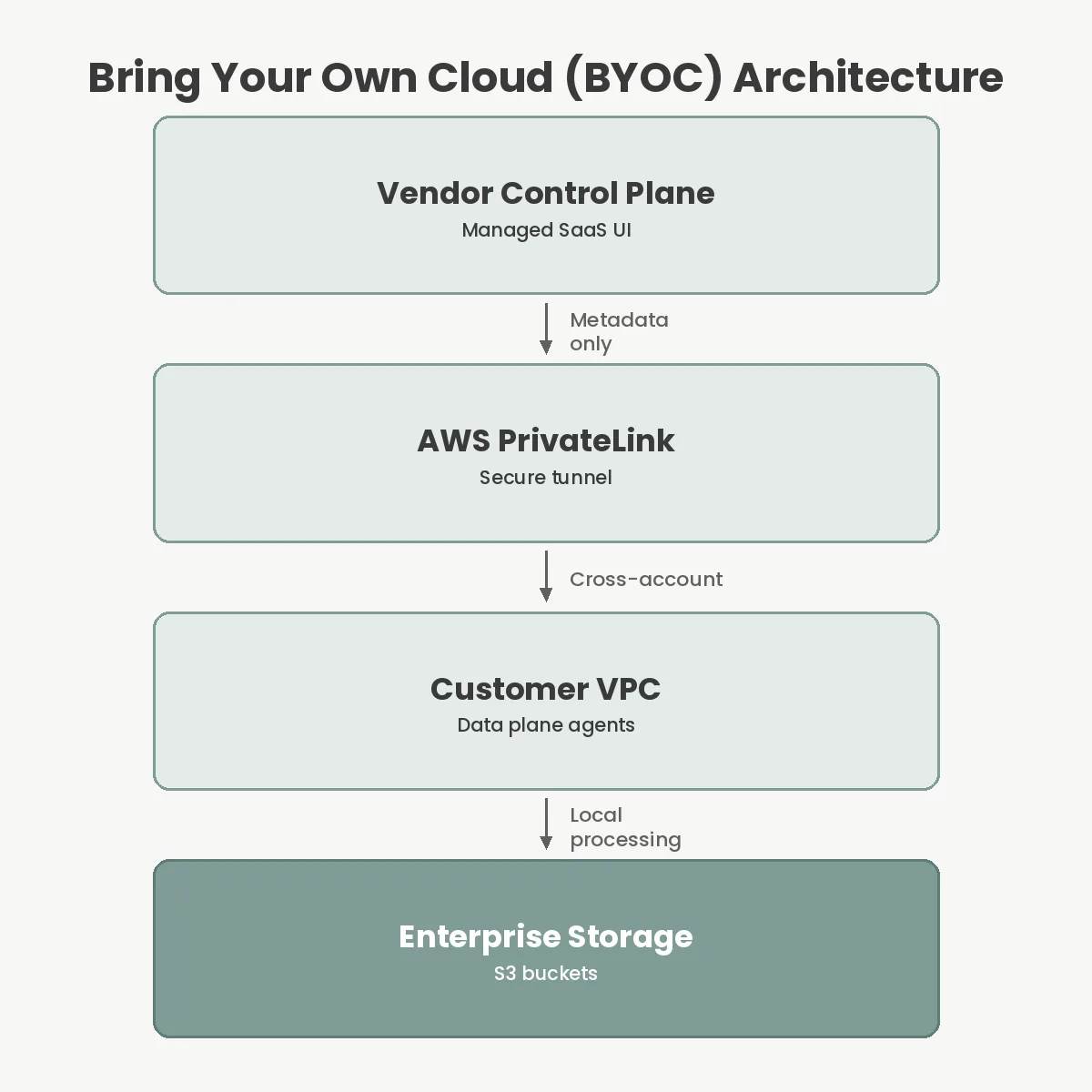
BYOC requires a strict architectural split between orchestration and execution. The vendor hosts a centralized control plane. This web application handles user authentication, metadata management, billing, and the user interface. It never touches the raw enterprise data, remaining entirely oblivious to the specific contents of the workloads it manages.
The data plane consists of the actual compute engines, storage buckets, and agents that process the workload. These components are deployed directly into the customer’s AWS or GCP account using infrastructure-as-code tools like Terraform or Helm. The vendor manages the lifecycle of these data plane agents remotely, but the raw data remains physically confined to the customer’s storage infrastructure, ensuring complete data sovereignty.
Communication between the two planes must traverse a secure boundary. Vendors typically rely on technologies like AWS PrivateLink to establish a secure, private tunnel. AWS PrivateLink charges $0.01 per gigabyte processed plus $0.01 per hour per Availability Zone. This creates a predictable, low-cost metadata stream. The orchestration commands flow in, and telemetry metrics flow out, but the proprietary dataset stays locked inside the customer’s perimeter.
Data sovereignty requirements are forcing organizations to rethink procurement. Regulated industries such as finance, healthcare, and defense operate under strict compliance frameworks that prohibit moving personally identifiable information (PII) outside approved network boundaries. A multi-tenant SaaS vendor must undergo agonizing security reviews to prove they can safely handle this data. These SOC2 and HIPAA audits often drag procurement cycles out for six to nine months.
If the vendor proposes a BYOC deployment, the security posture changes entirely. Because the vendor never possesses the raw data, the risk profile shrinks. Procurement cycles accelerate because the enterprise security team retains complete physical control over the network perimeters and encryption keys. You can read more about how strict data controls are reshaping corporate policy in our analysis of shadow AI governance.
When ClickHouse Cloud introduced a BYOC offering in 2024, they specifically targeted these regulated enterprises. By allowing organizations to store their columnar data in their own S3 buckets while ClickHouse managed the query orchestration, they unlocked deals that a purely multi-tenant architecture could never win. This localized compliance approach avoids duplicating the entire SaaS stack across multiple restricted regions.
Shifting to BYOC alters the fundamental unit economics of building software. In a multi-tenant model, the vendor pays the cloud provider for the underlying compute and storage, marks up the cost, and sells it to the customer. This requires the vendor to constantly optimize their own infrastructure to maintain gross margins. Databricks originally popularized the classical BYOC model by deploying compute clusters directly into the customer’s AWS account, allowing the customer to utilize their negotiated enterprise discount programs (EDP) with AWS directly.
Under BYOC, the SaaS vendor shifts the compute and storage bill directly to the customer. The customer pays their cloud provider for the EC2 instances and S3 buckets used by the data plane. The vendor only charges for the software license, the control plane operations, and the management service. This structure dramatically improves the vendor’s gross margin percentage, as they are no longer reselling low-margin infrastructure compute. We have explored similar economic shifts in our breakdown of usage-based SaaS pricing.
There is a commercial catch. Because the vendor is no longer capturing the cloud infrastructure spend, the top-line revenue per customer drops. To compensate, vendors often institute steep minimum commitments. Confluent Cloud’s dedicated and BYOC tiers, for example, typically require minimum annual commits exceeding $50,000.
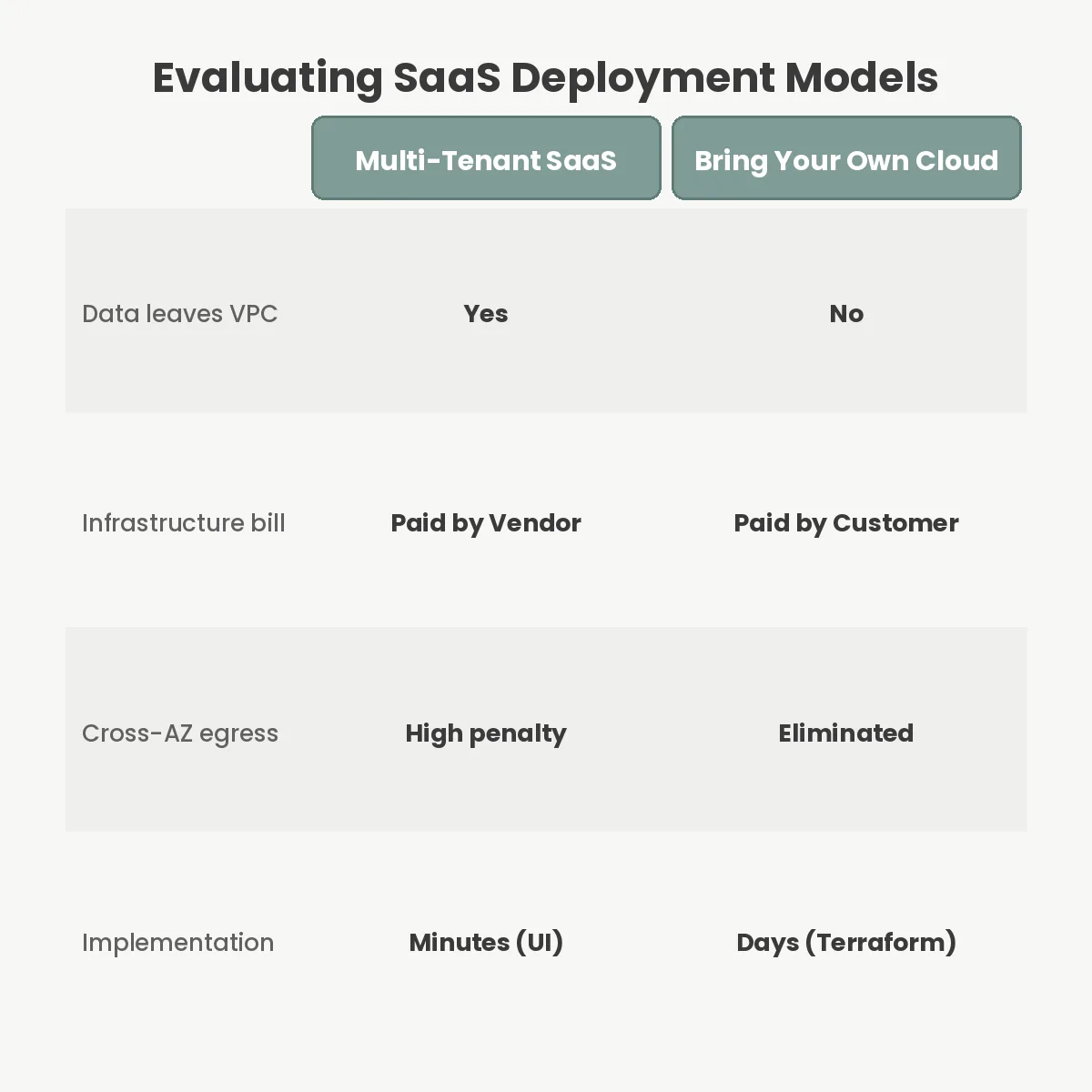
| Cost Component | Multi-Tenant SaaS | Bring Your Own Cloud (BYOC) |
|---|---|---|
| Compute (EC2) | Paid by SaaS Vendor | Paid by Customer |
| Storage (S3) | Paid by SaaS Vendor | Paid by Customer |
| Cross-AZ Egress | Vendor absorbs (High) | Eliminated or Customer pays base rate |
| Vendor Gross Margin | 60% – 70% | 85% – 95% |
Deploying software into a foreign cloud account introduces severe friction. A standard SaaS product takes three minutes and a credit card to provision. A BYOC product requires the customer to provision cross-account IAM roles, configure VPC subnets, and deploy Terraform modules. This technical barrier disqualifies smaller teams who lack dedicated cloud engineering resources, restricting the total addressable market to mature organizations.
The vendor also loses direct access to the infrastructure. If a query runs slowly or a node crashes, the vendor’s engineering team cannot easily SSH into the machine to debug the kernel. They must rely entirely on the telemetry data forwarded back to their control plane. If the network link fails, the vendor is flying blind, severely degrading their ability to offer high-tier technical support and service level agreements.
Cost unpredictability remains a significant hurdle. While the vendor’s software license fee might be flat, the customer is now responsible for the underlying infrastructure bill. If the BYOC agent scales up aggressively to handle a spike in traffic, the customer will receive an unexpected invoice from AWS. This requires buyers to maintain strict FinOps monitoring, similar to the strategies discussed in our cloud repatriation economics guide.
Vendors often fail by assuming the customer has infinite cloud quotas. A BYOC deployment might require specific instance types, such as storage-optimized AWS i4i instances. If the customer’s AWS account has a default vCPU limit that prevents launching these instances, the automated deployment will fail silently or hang indefinitely. Pre-flight checks are mandatory to verify quotas before provisioning.
Identity and Access Management (IAM) permission sprawl creates major security vulnerabilities. Vendors frequently request overly broad AWS permissions to ensure their automated provisioning scripts succeed. If a vendor requests blanket access instead of scoping permissions to a single designated bucket, the enterprise security team will immediately reject the deployment. Compounding this, VPC endpoints and NAT Gateway costs can skyrocket if network routes are poorly configured by the customer.
Version drift is the most dangerous failure mode in BYOC. In multi-tenant SaaS, the vendor forces software updates upon everyone simultaneously. In BYOC, the customer controls the infrastructure and can refuse to apply the Terraform update that upgrades the data plane agent. Over time, the vendor ends up supporting dozens of outdated, fragmented software versions scattered across different enterprise accounts, eliminating the primary efficiency benefit of the cloud.
BYOC is a deployment model where a software vendor hosts the management control plane, while the compute and storage data plane runs inside the customer’s private cloud account. This ensures the vendor manages the software without ever possessing the customer’s raw, sensitive data.
It shifts the cost burden rather than eliminating it. The customer pays their cloud provider directly for compute and storage without the SaaS vendor’s markup. However, the enterprise takes on the financial risk of scaling spikes and must manage their own cloud financial operations.
Traditional on-premise software requires the customer to manually install, monitor, patch, and update the application. In a BYOC model, the vendor automates these operations remotely via a secure tunnel to the control plane, delivering a managed SaaS experience within a private network.
Highly regulated sectors such as financial services, healthcare, defense, and public sector organizations benefit the most. These industries operate under strict compliance frameworks like HIPAA or FedRAMP, which explicitly prohibit moving sensitive proprietary data outside of tightly controlled corporate network perimeters.
Choosing between multi-tenant SaaS and BYOC comes down to evaluating your engineering maturity versus your compliance requirements. If your organization lacks dedicated cloud engineers and Terraform expertise, standard managed SaaS remains the only practical choice. However, for enterprises managing massive data gravity and strict regulatory mandates, sending proprietary information over the internet is no longer viable. BYOC offers the operational convenience of managed software without compromising network perimeters. Before committing to a vendor’s BYOC tier, audit your internal AWS limits, scrutinize the IAM policies they request, and ensure your FinOps team is prepared to absorb the data plane infrastructure bill.
You Can Get More Information!