The Financial Impact of Usage-Based SaaS Pricing in the Enterprise
Usage-based SaaS pricing aligns software costs directly with measurable consumption...

Make email marketing simplified

Make email marketing simplified

Make email marketing simplified

Make email marketing simplified

Make email marketing simplified

Make email marketing simplified

Make email marketing simplified

Make email marketing simplified

Make email marketing simplified

Make email marketing simplified

Make email marketing simplified

Make email marketing simplified

Make email marketing simplified

Make email marketing simplified

Make email marketing simplified

We use cookies for our website to give you the most relevant experience by remembering your preferences. By clicking “accept”, you consent to use of ALL the cookies
This website uses cookies to improve your experience while you navigate through the website. Out of these, the cookies that are categorized as necessary are stored on your browser as they are essential for the working of basic functionalities of the website. We also use third-party cookies that help us analyze and understand how you use this website. These cookies will be stored in your browser only with your consent. You also have the option to opt-out of these cookies. But opting out of some of these cookies may affect your browsing experience.
Necessary cookies are absolutely essential for the website to function properly. These cookies ensure basic functionalities and security features of the website, anonymously.
| Cookie | Duration | Description |
|---|---|---|
| cookielawinfo-checkbox-functional | 11 months | This cookie is set by GDPR Cookie Consent plugin. The cookie is used to store the user consent for the cookies in the category “Analytics”. |
| cookielawinfo-checkbox-functional | 11 months | The cookie is set by GDPR cookie consent to record the user consent for the cookies in the category “Functional”. |
| cookielawinfo-checkbox-necessary | 11 months | This cookie is set by GDPR Cookie Consent plugin. The cookies is used to store the user consent for the cookies in the category “Necessary”. |
| cookielawinfo-checkbox-others | 11 months | This cookie is set by GDPR Cookie Consent plugin. The cookie is used to store the user consent for the cookies in the category “Other. |
| cookielawinfo-checkbox-performance | 11 months | This cookie is set by GDPR Cookie Consent plugin. The cookie is used to store the user consent for the cookies in the category “Performance”. |
| viewed_cookie_policy | 11 months | The cookie is set by the GDPR Cookie Consent plugin and is used to store whether or not user has consented to the use of cookies. It does not store any personal data. |
Functional cookies help to perform certain functionalities like sharing the content of the website on social media platforms, collect feedbacks, and other third-party features.
Performance cookies are used to understand and analyze the key performance indexes of the website which helps in delivering a better user experience for the visitors.
Analytical cookies are used to understand how visitors interact with the website. These cookies help provide information on metrics the number of visitors, bounce rate, traffic source, etc.
Advertisement cookies are used to provide visitors with relevant ads and marketing campaigns. These cookies track visitors across websites and collect information to provide customized ads.
Other uncategorized cookies are those that are being analyzed and have not been classified into a category as yet.
Cyberia Tech, Inc. respects your privacy. This Privacy Policy explains how we collect, use, and share your information. By using our services, you agree to this policy. If any other agreements conflict with this Privacy Policy, the terms of those agreements prevail.
Cyberia Tech complies with the EU-US and Swiss-US Privacy Shield Frameworks for handling personal data from the EEA, UK, and Switzerland. In case of any conflict, the Privacy Shield Principles prevail. Learn more at Privacy Shield. Key Definitions
Information linked to an individual, transferred from the EEA, UK, or Switzerland to the U.S.
Data revealing race, religion, health, sexual orientation, and similar categories.
Effective Date: [ 2026 / 11 / 03 ]
Welcome to The Cyberia Tech ! By accessing or using our website or services, you agree to
comply with and be bound by these Terms of Use and our Privacy Policy. If you do not agree with
these terms, please do not use our Services.
Loading
0 %
Your First Piece of the Puzzle in
Business Growth



Modular monolith architecture structures a single deployable web application into strictly isolated internal domains. It provides the team autonomy of distributed microservices without the inherent network latency or serialization overhead. For most engineering teams, modular monoliths reduce infrastructure costs while maintaining rapid feature velocity.
Distributed systems are expensive. You break an application into thirty microservices to solve an organizational scaling problem, only to inherit an infrastructure nightmare. Network hops replace function calls. Distributed tracing becomes mandatory just to read logs. When Amazon Prime Video migrated its audio/video monitoring service from a serverless microservices architecture back to a monolith, they cut infrastructure costs by 90%. The decision you face is not about whether to enforce domain boundaries. It is about whether those boundaries require network partitions.
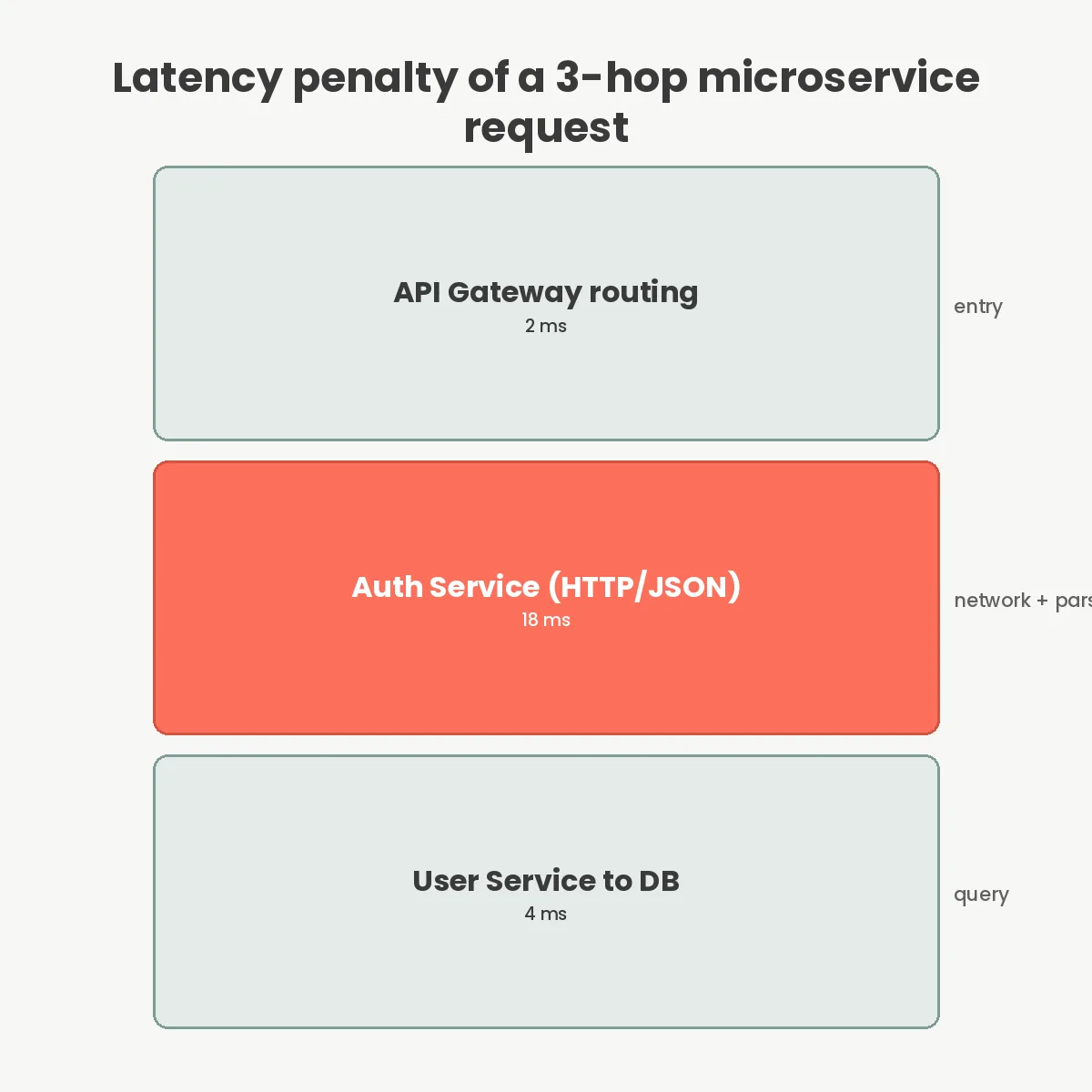
Microservices solve team scaling at the cost of compute efficiency. Every time service A talks to service B, you pay a serialization tax. JSON parsing and network I/O eat CPU cycles. A request that takes 2 milliseconds in memory suddenly takes 15 to 20 milliseconds across a network boundary. This latency penalty is absolute, regardless of your cloud provider or cluster orchestration.
String three or four of these services together for a single user request. You are now spending 60 milliseconds just traversing internal network layers. If you are using Kubernetes, tools like eBPF improve routing efficiency, but they do not eliminate the physics of network traversal. You can read more about reducing cluster network overhead in our eBPF vs iptables networking guide.
Most web apps do not need extreme independent scaling for every component. They need maintainability. The network boundary is an overly aggressive tool for enforcing code isolation. You are forcing data to be marshalled into strings, sent over HTTP or gRPC, and unmarshalled back into objects, purely to prevent junior developers from calling private methods.
A modular monolith is a single application deployment with strictly enforced internal boundaries. Code is organized by domain rather than technical function. The billing module cannot directly read the memory or database tables of the user management module. Every module encapsulates its own business logic and data access layers.
Communication happens through well-defined internal APIs or event buses, not direct method calls to private classes. The difference is execution. These API calls resolve in memory. There is no HTTP overhead. There is no network partition. A failure in one module’s logic might throw an exception, but it will not trigger cascading network timeouts across a distributed mesh.
Shopify scales to over one million requests per minute on a modular Ruby on Rails monolith. They achieve this using Packwerk, an open-source static analysis tool that enforces boundaries at build time. You get microservice-style domain isolation without the runtime penalties, allowing hundreds of developers to contribute to the same repository safely.
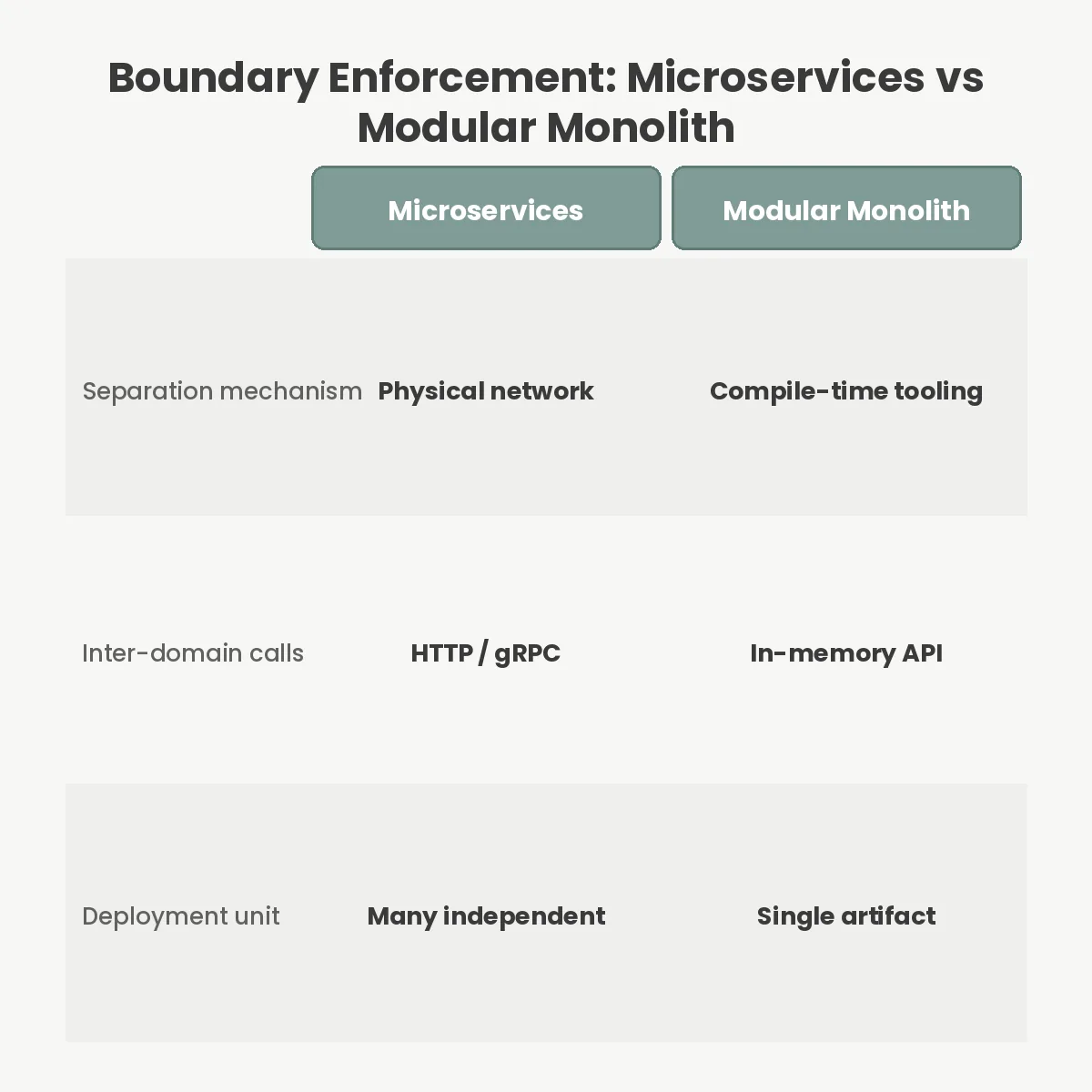
Physical separation is the easiest way to prevent spaghetti code. If the code lives in a different repository and deploys to a different server, developers cannot accidentally couple their internal logic. This physical barrier is why microservices became the default architecture for scaling teams.
Modular monoliths require discipline. You must rely on tooling rather than physical network gaps. Java developers use the Java Platform Module System (JPMS) to enforce compile-time isolation. .NET teams use internal access modifiers and distinct projects within a single solution. In the TypeScript ecosystem, Nx workspaces provide strict dependency graphs that fail CI pipelines if a module imports restricted internal code from another domain.
When you consolidate components, you also reduce the sprawl of third-party monitoring and deployment tools. This mirrors broader trends in enterprise SaaS vendor consolidation, where fewer moving parts lower both licensing and operational costs.
Consider the infrastructure footprint of twenty microservices. Each requires its own base memory allocation, health checks, logging daemons, and sidecar proxies. You are paying for redundancy across the entire fleet. Compute is wasted polling idle containers.
Moving back to a monolith allows the runtime to optimize memory pooling and thread management globally. Segment famously documented their migration from 140+ microservices back to a monolith, citing massive reductions in operational overhead and deployment complexity. They eliminated the cognitive load of tracking hundred-deep dependency chains.
If you are optimizing cloud spend, consolidating compute resources into a single monolith running on highly efficient hardware often yields better results than micro-optimizing fragmented services. Evaluating infrastructure upgrades like AWS Graviton4 vs Intel x86 becomes mathematically simpler when you are sizing a handful of large application servers instead of hundreds of variable container instances.
| Architecture | Internal Request Latency | Developer Cognitive Load | Independent Scaling |
|---|---|---|---|
| Traditional Monolith | < 1ms (In-memory) | High (Spaghetti code) | None |
| Modular Monolith | < 1ms (In-memory API) | Low (Isolated domains) | None |
| Distributed Microservices | 10ms – 50ms (Network/Parse) | Extreme (Tracing/Pipelines) | High |
Monolithic architecture is not a universal fix. Specific constraints mandate physical separation. Mixed runtimes create a hard boundary. If your core web API is written in Go but your data science team requires Python for machine learning inference, you must operate two separate services. You cannot compile them into a single binary.
Extreme scaling disparities also justify microservices. If your web app handles light CRUD operations but one endpoint processes heavy asynchronous video rendering, keep the video worker separate. A monolithic architecture would force you to scale the entire web app tier just to handle the isolated CPU demands of the video load.
Security and compliance boundaries sometimes demand strict network isolation. Payment processing modules handling raw credit card data often reside in isolated VPCs to minimize PCI compliance scope. Merging this logic into a general-purpose monolith exposes the entire application surface area to stricter regulatory audits.
The primary failure mode of a modular monolith architecture is degrading into a “Big Ball of Mud”. Without strict continuous integration pipeline checks, developers facing a tight deadline will bypass internal APIs and directly query other domains. Over time, the modules become tightly coupled, destroying the architectural benefits.
Another critical mistake is sharing database tables across domains. A true modular monolith allocates distinct database schemas or strictly separated tables to specific modules. If the billing module writes directly to the users table via a foreign key, the architecture has failed. Data must only be accessed through the owning module’s public interface, even if that means duplicating non-critical read data.
Finally, teams often struggle with shared caches. Improperly segregating cache keys leads to domain bleed and unintentional data overwrites. Choosing the right caching layer and enforcing logical namespaces is critical, similar to the isolation considerations outlined in our Redis vs Valkey cache comparison.
You scale a modular monolith by running multiple instances of the entire application behind a load balancer. Since all modules are stateless and share the same deployment unit, horizontal scaling is identical to scaling a traditional monolithic application.
Yes. Teams own specific modules and maintain strict public interfaces. Code conflicts are minimized because domains are isolated. Tooling like Codeowners ensures that changes to a module core logic require approval from the team responsible for that specific domain.
A modular monolith deploys as a single unit. This means slower continuous integration build times compared to microservices, as the entire application must be packaged. However, it guarantees that all modules are deployed synchronously, eliminating API version mismatch errors.
The migration requires careful domain mapping. You merge the codebases and replace network calls with internal method calls. The hardest part is often untangling shared databases and ensuring that strict boundaries are enforced by static analysis tools before cutover.
A traditional monolith lacks internal boundaries, allowing any class to call any other class. A modular monolith enforces strict encapsulation. Domains interact only through defined programming interfaces, preventing the tightly coupled spaghetti code that makes traditional monoliths hard to maintain.
Stop paying the network tax for organizational boundaries. Microservices are an infrastructure solution to a people problem. For the vast majority of web applications, a modular monolith architecture provides the necessary isolation for concurrent team development without the crippling latency and operational cost of distributed infrastructure. Evaluate your dependency chains critically. If you are making HTTP calls simply to fetch data from another domain within the exact same system, you are wasting compute. Implement static analysis tools, enforce module boundaries at build time, and consolidate your deployments to reclaim your system performance.
You Can Get More Information!