eBPF vs iptables: Why Netfilter is a Bottleneck in 2026
eBPF replaces the traditional iptables networking stack in Kubernetes by...

Make email marketing simplified

Make email marketing simplified

Make email marketing simplified

Make email marketing simplified

Make email marketing simplified

Make email marketing simplified

Make email marketing simplified

Make email marketing simplified

Make email marketing simplified

Make email marketing simplified

Make email marketing simplified

Make email marketing simplified

Make email marketing simplified

Make email marketing simplified

Make email marketing simplified

We use cookies for our website to give you the most relevant experience by remembering your preferences. By clicking “accept”, you consent to use of ALL the cookies
This website uses cookies to improve your experience while you navigate through the website. Out of these, the cookies that are categorized as necessary are stored on your browser as they are essential for the working of basic functionalities of the website. We also use third-party cookies that help us analyze and understand how you use this website. These cookies will be stored in your browser only with your consent. You also have the option to opt-out of these cookies. But opting out of some of these cookies may affect your browsing experience.
Necessary cookies are absolutely essential for the website to function properly. These cookies ensure basic functionalities and security features of the website, anonymously.
| Cookie | Duration | Description |
|---|---|---|
| cookielawinfo-checkbox-functional | 11 months | This cookie is set by GDPR Cookie Consent plugin. The cookie is used to store the user consent for the cookies in the category “Analytics”. |
| cookielawinfo-checkbox-functional | 11 months | The cookie is set by GDPR cookie consent to record the user consent for the cookies in the category “Functional”. |
| cookielawinfo-checkbox-necessary | 11 months | This cookie is set by GDPR Cookie Consent plugin. The cookies is used to store the user consent for the cookies in the category “Necessary”. |
| cookielawinfo-checkbox-others | 11 months | This cookie is set by GDPR Cookie Consent plugin. The cookie is used to store the user consent for the cookies in the category “Other. |
| cookielawinfo-checkbox-performance | 11 months | This cookie is set by GDPR Cookie Consent plugin. The cookie is used to store the user consent for the cookies in the category “Performance”. |
| viewed_cookie_policy | 11 months | The cookie is set by the GDPR Cookie Consent plugin and is used to store whether or not user has consented to the use of cookies. It does not store any personal data. |
Functional cookies help to perform certain functionalities like sharing the content of the website on social media platforms, collect feedbacks, and other third-party features.
Performance cookies are used to understand and analyze the key performance indexes of the website which helps in delivering a better user experience for the visitors.
Analytical cookies are used to understand how visitors interact with the website. These cookies help provide information on metrics the number of visitors, bounce rate, traffic source, etc.
Advertisement cookies are used to provide visitors with relevant ads and marketing campaigns. These cookies track visitors across websites and collect information to provide customized ads.
Other uncategorized cookies are those that are being analyzed and have not been classified into a category as yet.
Cyberia Tech, Inc. respects your privacy. This Privacy Policy explains how we collect, use, and share your information. By using our services, you agree to this policy. If any other agreements conflict with this Privacy Policy, the terms of those agreements prevail.
Cyberia Tech complies with the EU-US and Swiss-US Privacy Shield Frameworks for handling personal data from the EEA, UK, and Switzerland. In case of any conflict, the Privacy Shield Principles prevail. Learn more at Privacy Shield. Key Definitions
Information linked to an individual, transferred from the EEA, UK, or Switzerland to the U.S.
Data revealing race, religion, health, sexual orientation, and similar categories.
Effective Date: [ 2026 / 10 / 18 ]
Welcome to The Cyberia Tech ! By accessing or using our website or services, you agree to
comply with and be bound by these Terms of Use and our Privacy Policy. If you do not agree with
these terms, please do not use our Services.
Loading
0 %
Your First Piece of the Puzzle in
Business Growth



Enterprise AI coding assistants deliver measurable throughput gains but introduce compounding technical debt if deployed without strict review constraints. A 15 to 30 percent increase in line-level productivity is frequently offset by a 20 percent rise in code churn and elevated vulnerability rates in continuous integration pipelines.
Chief Technology Officers are currently writing large checks for generative developer tooling, convinced by promises of unprecedented engineering speed. Microsoft reported 1.3 million paid GitHub Copilot subscribers by early 2024. But speed creates its own structural stakes. When engineering teams generate thousands of extra lines of code daily, the primary bottleneck shifts rapidly from writing software to reviewing, testing, and maintaining it. The long-term financial cost of this structural shift frequently eclipses the initial licensing fees, forcing technical leaders to re-evaluate their operational models.
Market projections indicate near-total market saturation for developer-focused generative tools. A 2024 Gartner report predicts that 75 percent of enterprise software engineers will use AI coding assistants by 2028, a staggering leap from the estimated 10 percent adoption baseline in early 2023. This rapid uptake is driven by the surface-level economics: at $19 per user per month for GitHub Copilot Enterprise, the tooling appears functionally free compared to six-figure developer salaries.
However, framing these tools as simple productivity multipliers ignores the underlying mechanics of software development. Code is a liability, not an asset. Every line written must be stored, tested, reviewed, and updated when dependencies change. When AI tools accelerate code generation, they concurrently accelerate the accumulation of this liability. The initial licensing fee is merely a down payment on a much larger infrastructure and operational debt.
Organizations integrating these tools often report immediate throughput improvements. Pull requests are opened faster, and boilerplate code is eliminated in seconds. Yet, these gains are asymmetric. Writing code is only a fraction of an engineer’s job, while architectural planning, debugging, and system integration remain stubbornly human-bound. Accelerating only the generation phase often creates cascading traffic jams later in the delivery pipeline.
The most comprehensive data on generative code quality reveals a concerning trend toward software bloat. GitClear’s 2024 analysis of 152 million lines of code written across enterprise environments found a 41 percent increase in overall code volume alongside a 20 percent increase in code churn. Code churn—defined as code that is updated, reverted, or deleted within two weeks of being written—is a direct proxy for wasted engineering effort.
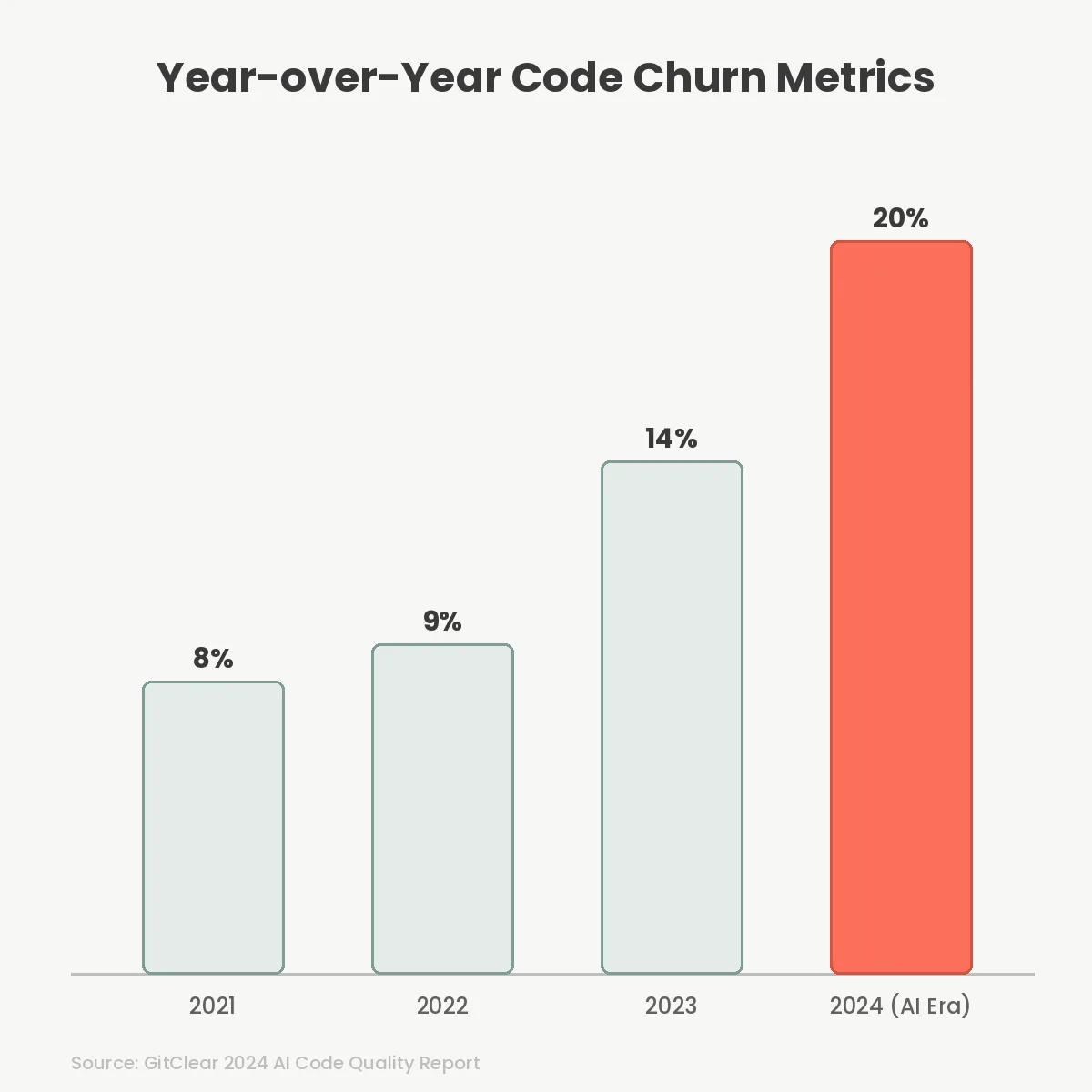
This phenomenon occurs because Large Language Models operate primarily by predicting next-token sequences rather than comprehending global repository architecture. When tasked with modifying a system, an AI assistant exhibits a strong bias toward addition. Instead of refactoring existing logic or properly abstracting a reusable function, the assistant often duplicates slightly modified blocks of code. This localized optimization creates sprawling codebases that are exponentially harder for human maintainers to navigate.
Furthermore, human reviewers suffer from automation complacency. When a developer submits a 500-line pull request generated entirely by an AI assistant in ten minutes, the senior engineer assigned to review it often assumes the machine’s output is fundamentally sound. The superficial readability of AI-generated code masks deeper architectural inefficiencies, allowing brittle patterns to merge into the main branch unexamined.
Understanding the actual financial impact of enterprise AI automation strategies requires looking beyond the monthly user fee. The secondary costs manifest in compute consumption, storage, and, most critically, human resource allocation.
| Cost Category | Visible Expense | Hidden Enterprise Impact |
|---|---|---|
| Licensing | $19–$39 per user/month | Negligible at scale. |
| Compute (CI/CD) | Standard pipeline runs | High. More frequent, larger pull requests exponentially increase automated testing compute costs. |
| Code Review | Senior engineering time | Critical. AI code requires deeper scrutiny, slowing down senior staff and reducing their output. |
| Maintenance | Standard bug fixes | Severe. Increased churn and duplicate logic require extensive future refactoring. |
To accurately gauge return on investment, engineering directors must track cycle times rather than merely counting lines of code or commit frequencies. If an organization sees a 50 percent increase in raw output but cycle times—the duration from code conception to production deployment—remain flat or degrade, the AI assistant is generating busywork, not value. Measuring the ratio of automated testing compute spend against successful production deployments often reveals the true cost of generative bloat.
Security introduces another layer of operational friction. AI models are trained on vast repositories of public code, much of which contains outdated cryptographic standards, unpatched vulnerabilities, or insecure memory management patterns. When these models generate code, they inadvertently replicate these historical flaws.
Snyk’s 2024 AI Code Security Report highlighted the severity of this issue, documenting a 30 percent increase in insecure code snippets introduced to repositories when AI-assisted development bypasses strict automated security checks. Tools like Copilot or Cursor do not intrinsically understand the specific threat model or compliance requirements of the deploying organization. They will happily suggest a SQL query that lacks proper parameterization or suggest importing a library with known Common Vulnerabilities and Exposures (CVEs).
For teams navigating custom versus off-the-shelf software decisions, security liability is paramount. The organization retains full legal and regulatory responsibility for the deployed code, regardless of whether a human or a machine wrote it. Relying on AI assistants necessitates a corresponding investment in robust Static Application Security Testing (SAST) and Dynamic Application Security Testing (DAST) tooling to intercept vulnerabilities before they reach production.
The most frequent failure mode in generative AI adoption is deploying these tools into legacy codebases lacking comprehensive unit test coverage. AI coding assistants assume the surrounding code is functionally correct and stylistically ideal. If a repository is already plagued by tight coupling and poor documentation, the AI will faithfully mimic and amplify those anti-patterns, accelerating architectural decay.
Another significant error is using AI for major structural refactoring. While large language models excel at isolated tasks—such as generating a regular expression or writing boilerplate API endpoints—they fail catastrophically when asked to reorganize complex, multi-file domain logic. They lose context, hallucinate non-existent interfaces, and silently drop edge-case handling.
Engineering teams also err by treating AI assistants as educational tools for junior developers. While asking an AI to explain a concept is useful, allowing a junior engineer to blindly accept code blocks they do not fundamentally understand degrades the team’s overall capability. The junior developer acts merely as a conduit for the AI, failing to build the mental models required for complex debugging later.
Certain engineering domains are actively hostile to the current generation of AI coding tools. Highly regulated environments, such as defense contracting or healthcare infrastructure managing Protected Health Information (PHI), often prohibit the use of cloud-based AI tools outright. The risk of proprietary intellectual property or sensitive schema data being exfiltrated via tool telemetry represents an unacceptable compliance violation.
Similarly, when teams are pioneering novel algorithmic solutions or building bespoke hardware interfaces, AI assistants offer minimal value. Because their intelligence is strictly backward-looking—derived from patterns in existing open-source data—they cannot invent fundamentally new approaches. In these scenarios, the assistant becomes an impediment, stubbornly suggesting conventional, inefficient solutions to novel problems.
Organizations building scalable web application architectures must recognize these boundaries. Delegating repetitive tasks is highly effective, but delegating core architectural design decisions compromises the system’s foundational integrity.
Extracting genuine value from enterprise AI coding assistants requires redesigning the continuous delivery pipeline. The paradigm must shift from optimizing code generation to optimizing code verification. Organizations must treat AI-generated code with the same suspicion as code imported from an untrusted third-party vendor.
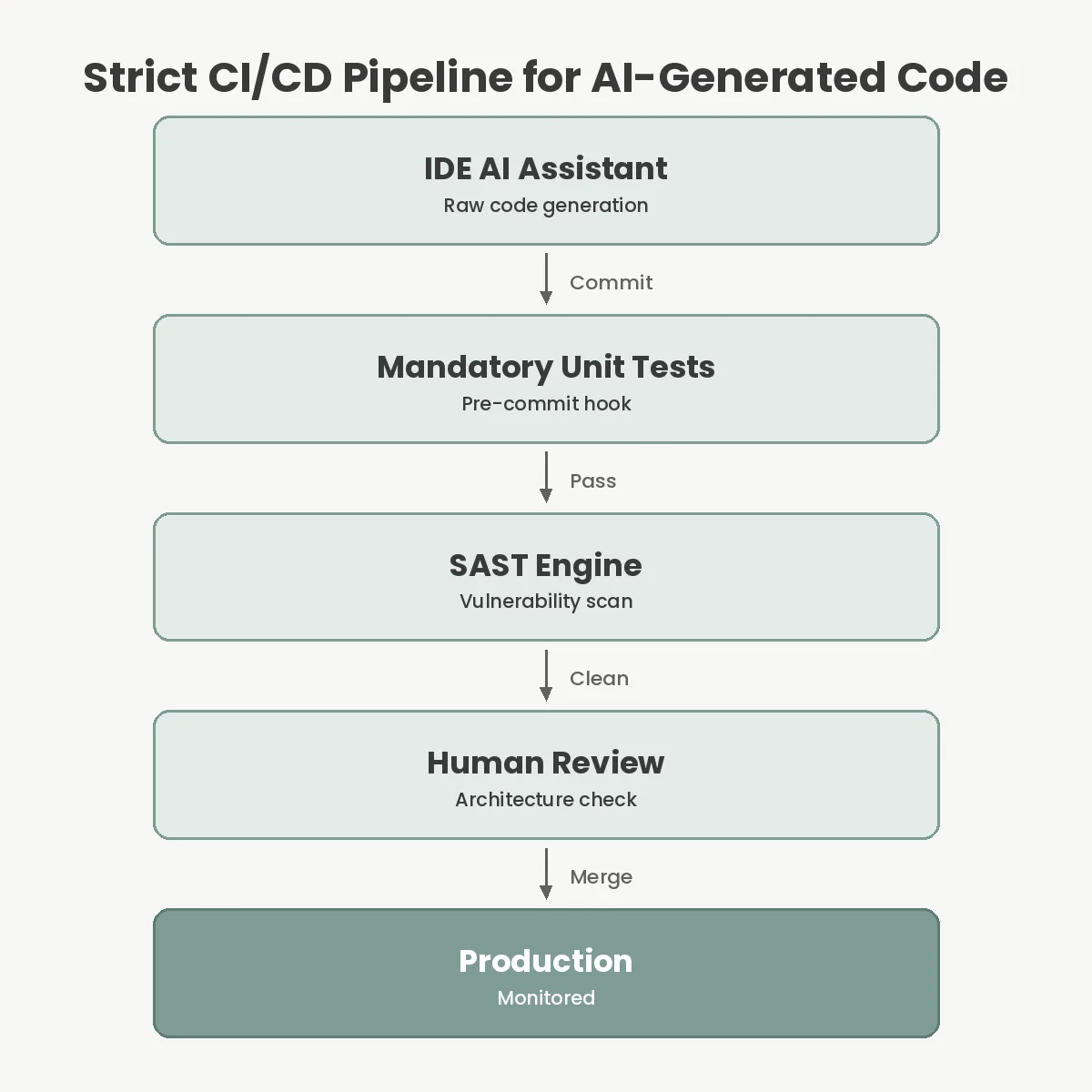
First, mandate comprehensive automated test coverage for any file modified by an AI assistant. The pull request cannot be merged unless the AI has also generated passing, logically sound unit tests that a human has verified. Second, integrate aggressive automated security scanning directly into the developer’s Integrated Development Environment (IDE) to catch hallucinated dependencies and vulnerable patterns before the commit stage.
Finally, engineering leadership must adjust Key Performance Indicators. Stop rewarding developers for commit volume. Instead, incentivize clean, highly cohesive code that reduces system complexity. AI tools are powerful engines, but without upgraded braking systems—in the form of rigorous code review and automated testing—they merely accelerate an organization toward technical bankruptcy.
Code churn refers to code that is written, then modified or deleted shortly after. AI assistants increase churn because they often generate repetitive, localized fixes that fail to address systemic issues, requiring human developers to constantly rewrite or delete the machine-generated output.
It only saves money if the productivity gains outweigh the hidden costs of increased code review times, higher CI/CD compute usage, and future refactoring efforts. Teams must adapt their deployment pipelines to handle higher volume safely to realize true cost savings.
Not inherently. AI models often suggest outdated or vulnerable code patterns based on their training data. Organizations must run aggressive Static Application Security Testing (SAST) on all generated code to prevent vulnerabilities from reaching production environments.
Teams should avoid AI tools when working in highly regulated environments with strict data privacy rules, when building novel proprietary algorithms, or when modifying legacy codebases that lack comprehensive unit test coverage to catch AI hallucinations.
Enterprise AI coding assistants fundamentally alter the physics of software engineering, trading immediate generation speed for delayed maintenance complexity. Before expanding software licenses company-wide, engineering leadership must implement mandatory SAST integration, strict automated testing gates, and metrics that prioritize low code churn over high commit velocity.
You Can Get More Information!