The Hidden Cost of Context Switching in Your Tech Stack
A financial breakdown of how much fragmented productivity apps and constant notification switching cost your enterprise.

Make email marketing simplified

Make email marketing simplified

Make email marketing simplified

Make email marketing simplified

Make email marketing simplified

Make email marketing simplified

Make email marketing simplified

Make email marketing simplified

Make email marketing simplified

Make email marketing simplified

Make email marketing simplified

Make email marketing simplified

Make email marketing simplified

Make email marketing simplified

Make email marketing simplified

We use cookies for our website to give you the most relevant experience by remembering your preferences. By clicking “accept”, you consent to use of ALL the cookies
This website uses cookies to improve your experience while you navigate through the website. Out of these, the cookies that are categorized as necessary are stored on your browser as they are essential for the working of basic functionalities of the website. We also use third-party cookies that help us analyze and understand how you use this website. These cookies will be stored in your browser only with your consent. You also have the option to opt-out of these cookies. But opting out of some of these cookies may affect your browsing experience.
Necessary cookies are absolutely essential for the website to function properly. These cookies ensure basic functionalities and security features of the website, anonymously.
| Cookie | Duration | Description |
|---|---|---|
| cookielawinfo-checkbox-functional | 11 months | This cookie is set by GDPR Cookie Consent plugin. The cookie is used to store the user consent for the cookies in the category “Analytics”. |
| cookielawinfo-checkbox-functional | 11 months | The cookie is set by GDPR cookie consent to record the user consent for the cookies in the category “Functional”. |
| cookielawinfo-checkbox-necessary | 11 months | This cookie is set by GDPR Cookie Consent plugin. The cookies is used to store the user consent for the cookies in the category “Necessary”. |
| cookielawinfo-checkbox-others | 11 months | This cookie is set by GDPR Cookie Consent plugin. The cookie is used to store the user consent for the cookies in the category “Other. |
| cookielawinfo-checkbox-performance | 11 months | This cookie is set by GDPR Cookie Consent plugin. The cookie is used to store the user consent for the cookies in the category “Performance”. |
| viewed_cookie_policy | 11 months | The cookie is set by the GDPR Cookie Consent plugin and is used to store whether or not user has consented to the use of cookies. It does not store any personal data. |
Functional cookies help to perform certain functionalities like sharing the content of the website on social media platforms, collect feedbacks, and other third-party features.
Performance cookies are used to understand and analyze the key performance indexes of the website which helps in delivering a better user experience for the visitors.
Analytical cookies are used to understand how visitors interact with the website. These cookies help provide information on metrics the number of visitors, bounce rate, traffic source, etc.
Advertisement cookies are used to provide visitors with relevant ads and marketing campaigns. These cookies track visitors across websites and collect information to provide customized ads.
Other uncategorized cookies are those that are being analyzed and have not been classified into a category as yet.
Cyberia Tech, Inc. respects your privacy. This Privacy Policy explains how we collect, use, and share your information. By using our services, you agree to this policy. If any other agreements conflict with this Privacy Policy, the terms of those agreements prevail.
Cyberia Tech complies with the EU-US and Swiss-US Privacy Shield Frameworks for handling personal data from the EEA, UK, and Switzerland. In case of any conflict, the Privacy Shield Principles prevail. Learn more at Privacy Shield. Key Definitions
Information linked to an individual, transferred from the EEA, UK, or Switzerland to the U.S.
Data revealing race, religion, health, sexual orientation, and similar categories.
Effective Date: [ 2026 / 11 / 25 ]
Welcome to The Cyberia Tech ! By accessing or using our website or services, you agree to
comply with and be bound by these Terms of Use and our Privacy Policy. If you do not agree with
these terms, please do not use our Services.
Loading
0 %
Your First Piece of the Puzzle in
Business Growth



SaaS procurement mistakes are systematic errors in buying, managing, and renewing software subscriptions that quietly drain corporate budgets. These errors typically involve missing hidden auto-renewal deadlines, decentralizing purchases to departmental credit cards, and failing to audit usage, all of which compound into massive long-term financial waste.
Software subscriptions used to be a predictable line item. By September 2026, SaaS price inflation settled at 14.3% year-over-year, permanently altering how companies forecast their technology budgets. The financial stakes are massive when you consider that between 36% and 46% of paid enterprise SaaS licenses currently go completely unused. You are paying a heavy premium for empty seats. When designing a modern productivity software stack, eliminating these quiet budgetary leaks is the only way to fund the tools your team actually needs.
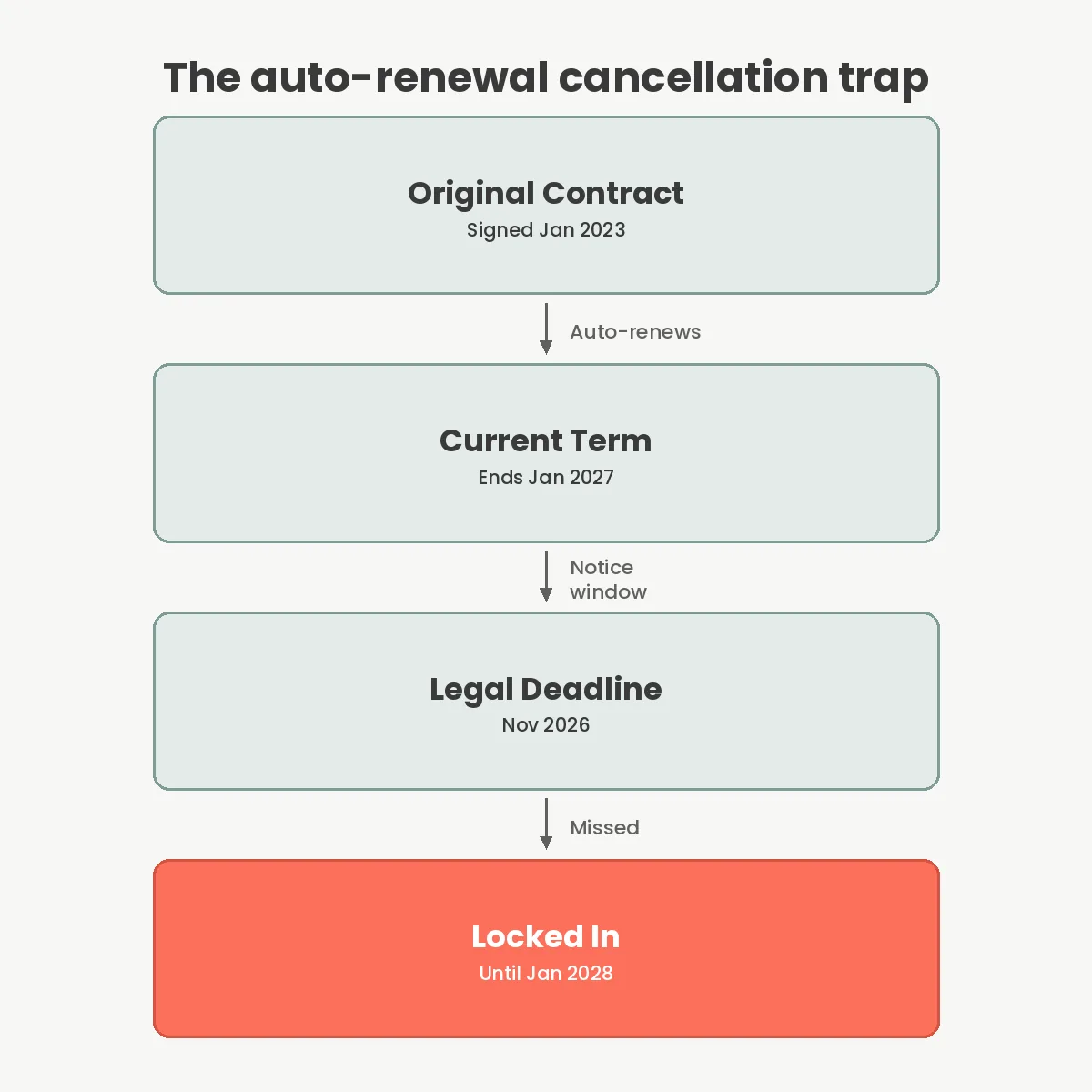
Missing a renewal deadline is a frequent software procurement challenge, but the specific legal mechanism trapping enterprise buyers is wildly misunderstood. Buyers routinely calculate their 30- or 60-day cancellation notice windows based on the original contract start date. This mathematical oversight virtually guarantees a missed deadline.
Standard B2B auto-renewal clauses actually calculate the cancellation deadline based on the end of the “then-current term.” If your multi-year software contract auto-extended once before, your legal cancellation date shifted relative to the new expiration date. Missing this nuanced wording legally binds your organization to another full term, regardless of whether you intend to migrate to a new vendor.
State legislatures are actively responding to this exact contractual trap. As of July 2026, consumer protection laws in states like Virginia classify B2B software as an “access contract,” legally requiring vendors to provide 30 to 60 days’ notice before a cancellation deadline. Colorado enforces a similar 25- to 40-day notification rule. However, relying on state-level mandates is a highly reactive strategy. Proactive procurement requires mapping every contract to its active term rather than its historical signing date.
Software vendors actively manipulate the window of time you have to negotiate. A few years ago, procurement officers could reliably expect a 60-day or 90-day auto-renewal notice period for mid-market software tools. In 2026, that average window has contracted to a punishingly brief 30 days.
This reduced timeframe deliberately limits your procurement team’s ability to evaluate alternatives, run security compliance checks, and migrate data before the existing contract locks in. Evaluating an enterprise knowledge base or project management suite takes far longer than four weeks. When the short notice arrives, you simply do not have the logistical leverage to walk away, forcing you to swallow the vendor’s price increases without a legitimate fight.
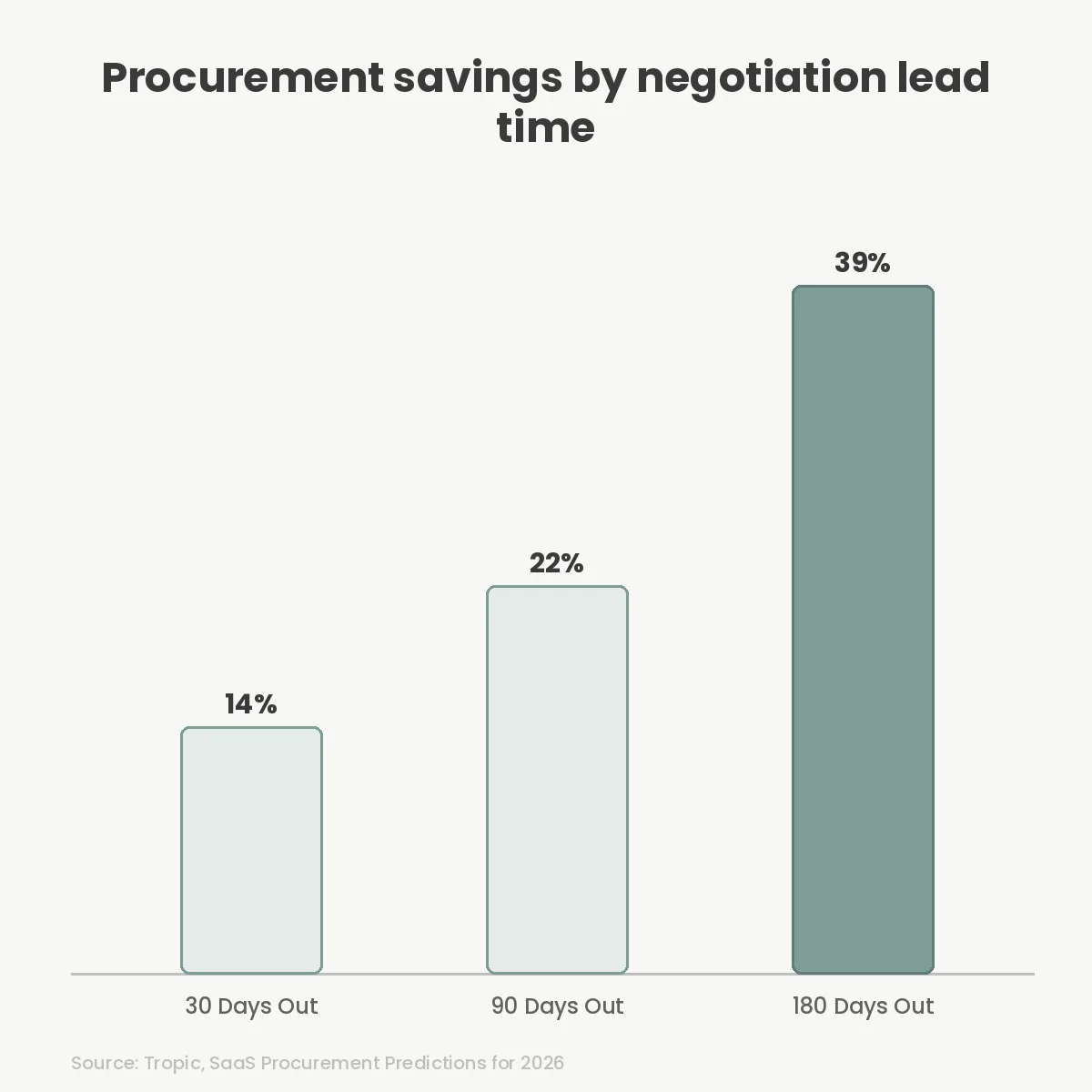
The financial penalty for compressed timelines is severe. Procurement teams that start negotiating six months ahead of a renewal date save up to 39% more on their agreements. Teams that wait until 30 days out average a mere 14% in savings. Regaining that lost 25% margin requires artificially extending your own internal notice periods well beyond what the vendor legally requires.
Handing corporate purchasing cards to department heads sounds like an agile way to bypass IT bottlenecks. In practice, this decentralized purchasing creates a massive categorization failure. CIOs systematically underestimate their shadow IT spend by a factor of 3.2x because they focus entirely on visible network applications while missing the financial paperwork.
When marketing buys a specialized analytics tool and sales buys a competing forecasting dashboard, neither transaction runs through formal procurement oversight. These unmanaged, duplicate subscriptions charge directly to business-unit budgets, completely bypassing security and financial audits. The median annual shadow IT spend for organizations with 5,000 or more employees now sits at $1.8 million. That is nearly two million dollars sitting entirely outside IT governance.
Reining in this specific type of SaaS waste requires more than a simple digital workspace audit. You must intercept the spend at the financial layer by instituting virtual cards tied to specific vendor categories, capping limits at the expected monthly subscription cost, and flagging any transaction categorized as software outside the centralized procurement platform.
Adding artificial intelligence to existing software is the primary driver of the aggressive 2026 price hikes. Organizations are paying a staggering 49% to 63% premium for AI capabilities integrated into enterprise SaaS platforms, according to recent procurement blueprints. Buyers often accept these premiums blindly, assuming the AI features will mathematically justify themselves through a boost in productivity.
The underlying mechanism driving these costs is fundamentally different from traditional software hosting. AI compute incurs variable infrastructure costs for the vendor every time a user generates text or analyzes a massive dataset. To protect their margins from heavy power users, 61% of SaaS companies have adopted hybrid pricing models that combine a base subscription with unpredictable usage-based billing.
This architectural shift makes annual procurement forecasting significantly harder. You can no longer accurately multiply headcounts by a fixed per-user fee. You must now forecast token consumption and complex feature usage. If you are abandoning the per-seat model for outcome-based AI tools, you absolutely need hard usage caps baked into the master service agreement to prevent unexpected billing spikes at the end of a busy quarter.
The average enterprise portfolio currently holds 305 distinct SaaS applications, pushing the average SaaS spend per employee up to a record $9,324 in Q2 2026. Despite this massive capital investment, almost half of that software sits entirely idle. The mechanism behind this waste is rarely a massive, highly visible failed deployment; it is the slow accumulation of minor daily oversights.
Overprovisioning happens when managers confidently request 50 seats for a department of 40 people, just to secure a buffer for future hires. Those 10 buffer seats sit empty, incurring full monthly costs. A more insidious drain occurs during offboarding. When an employee leaves, IT predictably disables their primary email and single sign-on access, but fails to systematically downgrade or reassign their individual specialized software licenses. The vendor continues charging for the seat because the account remains active and provisioned in their backend system.
Addressing the hidden cost of fragmented apps and wasted seats requires automated, continuous telemetry. Your procurement platform must integrate with your identity provider to trigger automated license reclamation workflows after 30 days of inactivity. If a user does not log in for a month, the system should automatically revoke the license and return it to a centralized pool for the next request.
Locking down every single software purchase behind a rigid IT approval process stops rogue spending, but it introduces heavy organizational trade-offs. If developers urgently need a specialized database monitoring tool to hit a Friday deployment deadline and procurement mandates a four-week security review, the developers will simply use a personal credit card and expense it later as generic “cloud hosting.”
Strict centralization fails spectacularly when agility is the primary business requirement. Engineering sandboxes, pilot programs, and rapid prototyping phases require immediate access to novel tools. If you force these exploratory phases through a full, unyielding vendor risk assessment, you stifle innovation and directly incentivize employees to hide their software usage entirely.
Instead of relying on a blanket ban on unapproved purchases, successful organizations implement tiered software governance. Low-risk, low-cost applications intended for pilot programs receive rapid, localized approval. Only tools that cross a specific financial threshold, process sensitive customer data, or require deep integrations with core systems trigger the full, multi-week procurement workflow.
| Governance Model | Approval Speed | Cost Control | Best Used For |
|---|---|---|---|
| Strict Centralization | Slow (3-6 weeks) | High | Core enterprise platforms (ERP, CRM, HRIS) |
| Departmental Agility | Fast (1-2 days) | Low | R&D sandboxes, single-user utility tools |
| Tiered Procurement | Variable | Medium-High | Scaling organizations balancing budget and speed |
One of the most persistent failure modes in enterprise software buying is treating renewals as administrative chores rather than strategic negotiations. Procurement teams frequently wait until the eleventh month of an annual contract before pulling usage data. By that time, the business unit is heavily entrenched in the tool, making migration nearly impossible.
Waiting until the end of the contract term strips away your only real point of leverage: the credible threat of leaving. Vendors actively track your usage telemetry on their end. If they see your team heavily utilizing their application and your procurement officer reaches out just three weeks before renewal, the vendor inherently knows you do not have the time to successfully migrate to a competitor.
Breaking this costly failure mode requires pulling the entire negotiation timeline forward to month six. At the half-year mark, perform a utilization audit to determine exactly how many licenses are actively logging in. You then solicit quotes from two competing vendors. Even if you fully intend to stay with your current provider, securing competitive bids creates the necessary friction to push back against the standard 14.3% annual price inflation. You only secure favorable terms when you operate from a position of documented, actionable alternatives.
The biggest mistake is miscalculating auto-renewal deadlines by basing them on the original contract date rather than the current term. This error traps buyers into unwanted renewals because they miss the legal window to cancel or negotiate better contract terms.
At organizations with over 5,000 employees, the median annual shadow IT spend is $1.8 million. This decentralized purchasing outside IT governance leads to duplicate subscriptions that are categorized incorrectly on departmental credit cards, resulting in massive SaaS waste.
SaaS price inflation hit 14.3% primarily due to vendors integrating artificial intelligence capabilities. Organizations are paying a 49% to 63% premium for these AI features, which carry variable infrastructure costs that force vendors into unpredictable usage-based billing models.
Between 36% and 46% of paid enterprise software licenses are completely unused. This massive waste usually stems from initially overprovisioning buffer seats or failing to properly deactivate licenses in the vendor’s system when employees are offboarded from the company.
Procurement should start negotiating exactly six months before the contract renewal date. Teams that begin this early save up to 39% on their contracts, whereas teams that wait until 30 days before the deadline save only 14% on average.
Fixing your software procurement process requires treating subscriptions as dynamic operational liabilities rather than static purchases. The era of predictable per-seat pricing is ending, rapidly replaced by complex hybrid billing models and aggressive auto-renewal clauses designed to trap buyers. Your immediate next action should be mapping the actual cancellation deadlines for your top ten most expensive software platforms, deliberately calculating backward from the end of their current terms.
Once those specific dates are locked into a centralized calendar, you must audit the past 30 days of platform usage to identify which seats are actively generating value. If a license is not being heavily utilized, kill it before the vendor arbitrarily shrinks your notice window and legally forces you into another costly year of paying for empty space.
You Can Get More Information!