The Hidden Cost of Context Switching in Your Tech Stack
A financial breakdown of how much fragmented productivity apps and constant notification switching cost your enterprise.

Make email marketing simplified

Make email marketing simplified

Make email marketing simplified

Make email marketing simplified

Make email marketing simplified

Make email marketing simplified

Make email marketing simplified

Make email marketing simplified

Make email marketing simplified

Make email marketing simplified

Make email marketing simplified

Make email marketing simplified

Make email marketing simplified

Make email marketing simplified

Make email marketing simplified

We use cookies for our website to give you the most relevant experience by remembering your preferences. By clicking “accept”, you consent to use of ALL the cookies
This website uses cookies to improve your experience while you navigate through the website. Out of these, the cookies that are categorized as necessary are stored on your browser as they are essential for the working of basic functionalities of the website. We also use third-party cookies that help us analyze and understand how you use this website. These cookies will be stored in your browser only with your consent. You also have the option to opt-out of these cookies. But opting out of some of these cookies may affect your browsing experience.
Necessary cookies are absolutely essential for the website to function properly. These cookies ensure basic functionalities and security features of the website, anonymously.
| Cookie | Duration | Description |
|---|---|---|
| cookielawinfo-checkbox-functional | 11 months | This cookie is set by GDPR Cookie Consent plugin. The cookie is used to store the user consent for the cookies in the category “Analytics”. |
| cookielawinfo-checkbox-functional | 11 months | The cookie is set by GDPR cookie consent to record the user consent for the cookies in the category “Functional”. |
| cookielawinfo-checkbox-necessary | 11 months | This cookie is set by GDPR Cookie Consent plugin. The cookies is used to store the user consent for the cookies in the category “Necessary”. |
| cookielawinfo-checkbox-others | 11 months | This cookie is set by GDPR Cookie Consent plugin. The cookie is used to store the user consent for the cookies in the category “Other. |
| cookielawinfo-checkbox-performance | 11 months | This cookie is set by GDPR Cookie Consent plugin. The cookie is used to store the user consent for the cookies in the category “Performance”. |
| viewed_cookie_policy | 11 months | The cookie is set by the GDPR Cookie Consent plugin and is used to store whether or not user has consented to the use of cookies. It does not store any personal data. |
Functional cookies help to perform certain functionalities like sharing the content of the website on social media platforms, collect feedbacks, and other third-party features.
Performance cookies are used to understand and analyze the key performance indexes of the website which helps in delivering a better user experience for the visitors.
Analytical cookies are used to understand how visitors interact with the website. These cookies help provide information on metrics the number of visitors, bounce rate, traffic source, etc.
Advertisement cookies are used to provide visitors with relevant ads and marketing campaigns. These cookies track visitors across websites and collect information to provide customized ads.
Other uncategorized cookies are those that are being analyzed and have not been classified into a category as yet.
Cyberia Tech, Inc. respects your privacy. This Privacy Policy explains how we collect, use, and share your information. By using our services, you agree to this policy. If any other agreements conflict with this Privacy Policy, the terms of those agreements prevail.
Cyberia Tech complies with the EU-US and Swiss-US Privacy Shield Frameworks for handling personal data from the EEA, UK, and Switzerland. In case of any conflict, the Privacy Shield Principles prevail. Learn more at Privacy Shield. Key Definitions
Information linked to an individual, transferred from the EEA, UK, or Switzerland to the U.S.
Data revealing race, religion, health, sexual orientation, and similar categories.
Effective Date: [ 2026 / 11 / 25 ]
Welcome to The Cyberia Tech ! By accessing or using our website or services, you agree to
comply with and be bound by these Terms of Use and our Privacy Policy. If you do not agree with
these terms, please do not use our Services.
Loading
0 %
Your First Piece of the Puzzle in
Business Growth



The cost of context switching is the quantifiable financial loss companies incur when employees constantly toggle between applications, losing focus and momentum. For a software engineer, recovering from just 35 task switches a day consumes enough time to cost an organization between $48,000 and $62,000 annually in wasted salary.
You hire brilliant people. You pay them well. Then you place them in a digital environment where sustained thought is nearly impossible. Modern teams are drowning in notifications, tabs, and fragmented data silos. While it looks like productive activity from a distance, your software stack is quietly bleeding cash through a phenomenon known as the toggle tax. Every time an employee jumps from a ticketing system to a chat app, their brain drops its current cognitive load and scrambles to build a new one. As you design your productivity software stack, recognizing the hard financial penalty of app overload is the first step toward reclaiming your profit margins.
Purchasing software usually involves calculating license fees and implementation expenses. The invisible line item missing from those procurement spreadsheets is the cognitive friction inflicted on the end user. This friction carries a steep, measurable price tag. When a developer shifts their attention from writing a complex function to answering a quick question in a chat channel, their brain effectively clears its short-term memory cache. To return to the code, they have to re-read the previous lines, remember the state of their variables, and recall the architectural constraint they were solving for. This mental rebuilding process takes time.
The financial impact of this recovery period is startling when mapped to actual salaries. The loaded cost of a United States software engineer—factoring in benefits, office space allocations, and payroll taxes—sits at roughly $180,000 to $200,000 per year. This establishes a baseline operational cost of about $90 per working hour. If you understand the baseline hourly rate, you can accurately calculate the bleed caused by a disjointed toolchain.
According to research on engineering focus published in March 2026, if a developer executes 35 task switches a day, and each switch requires a 10-minute recovery period to get back to a state of deep flow, the financial drain is severe. At a $90 loaded hourly rate, context switching costs companies between $48,000 and $62,000 per developer every single year. For a mid-sized engineering department of fifty people, you are looking at millions of dollars evaporating into pure cognitive overhead. Understanding this math completely changes the conversation around the cost of developing a mobile app or launching a new product.
The most dangerous productivity leaks are not caused by long, obvious distractions like hour-long meetings. They are driven by micro-delays. Jumping back and forth between a browser, a terminal, a design file, and an email inbox takes only a moment physically, but the mental disruption compounds heavily throughout the week. Knowledge workers in Fortune 500 companies toggle between applications roughly 1,200 times per day. The cognitive cost per single application switch is just over two seconds.
Two seconds feels negligible in isolation. You alt-tab, you check a status, you alt-tab back. But executing that micro-transition 1,200 times a day aggregates into a massive structural inefficiency. By the end of a typical week, those two-second delays add up to waste approximately 9% of an employee’s total working time. That is nearly four hours a week spent doing nothing but visually and mentally reorienting to a new user interface.
Over the course of a standard working year, this toggle tax equates to roughly five full weeks of lost work per person. The company pays for 52 weeks of salary, but only receives 47 weeks of output, with the remainder lost entirely to the friction of moving between tools. This invisible tax punishes organizations that adopt a new piece of software for every minor operational hiccup, rather than optimizing the core platforms they already own.
Tool sprawl actively punishes employees who are just trying to find the documents they need to do their jobs. The average knowledge worker currently uses 18 different tools every day. This creates a fragmented landscape where critical project data is scattered across wikis, task boards, cloud drives, and localized chat threads. When an employee needs to reference a spec, they often have to search three or four distinct systems before locating the authoritative version.
This hunting and gathering exacts a heavy toll on daily output. According to surveys on digital workspaces from February 2026, 45% of workers report that toggling between too many apps makes them noticeably less productive. Worse, these workers spend nearly one full hour every single day merely searching for information across their fragmented application landscape. That is an hour of completely non-value-additive labor, paid for at premium professional rates.
To visualize the financial scale of this information retrieval penalty, consider the annual cost for different team sizes. Assuming 250 working days a year and an average blended hourly rate of $60 across a mixed team of developers, designers, and managers, the waste scales aggressively.
| Team Size | Hours Lost Searching (Daily) | Hours Lost (Annually) | Estimated Annual Cost Waste |
|---|---|---|---|
| 10 Employees | 10 hours | 2,500 hours | $150,000 |
| 50 Employees | 50 hours | 12,500 hours | $750,000 |
| 100 Employees | 100 hours | 25,000 hours | $1,500,000 |
| 500 Employees | 500 hours | 125,000 hours | $7,500,000 |
These figures highlight why a digital workspace audit is not just an IT housekeeping chore. It is a critical financial exercise aimed at stopping a severe operational bleed.
If you research the cost of distraction, you will inevitably encounter conflicting numbers regarding exactly how long it takes a human brain to refocus after an interruption. The most heavily cited figure across business blogs is “23 minutes and 15 seconds.” This number originates from a conversational interview that researcher Gloria Mark gave to Gallup back in 2006. Because it is highly specific, it is frequently repeated as gospel truth without further verification.
However, the actual peer-reviewed data tells a slightly different, more rigorous story. In the foundational 2005 ACM CHI paper published by Mark, González, and Harris—which covered a massive 700-hour shadowing study of office workers—the recorded average time to resume interrupted work on the same day was exactly 25 minutes and 26 seconds. The peer-reviewed paper’s figure is the credible metric you should base your operational models on, as it represents documented telemetry from a controlled field study rather than an off-the-cuff interview quote.
The mechanics of this 25-minute recovery phase are brutal for deep work. In a massive study analyzing 10,000 recorded programming sessions by 85 different programmers, developers were able to resume coding within one minute of returning to their workstations in only 10% of sessions. The vast majority of the time, the developer sat in front of the screen, scrolling through files, trying to painstakingly reconstruct the mental scaffolding that collapsed the moment they were interrupted.
A common assumption among managers is that context switching damages productivity because it makes people work slower once they finally return to their original task. The logic seems sound: if you are distracted, you lose your rhythm, and your typing speed or decision-making velocity drops. Field data, however, proves this assumption entirely backward. The real danger of interruptions is not that they slow workers down.
Field experiments show that workers who are interrupted often finish their tasks as fast, or even faster, than their uninterrupted peers. When an employee realizes they have lost 25 minutes to an unplanned chat, they instinctively accelerate their workflow to compensate for the lost time. They type faster, skip double-checking their logic, and push through tickets aggressively to meet their daily quotas.
This artificial speed comes at a terrible human and technical cost. The acceleration introduces measurably higher stress, immense frustration, and severe time pressure. The mental effort required to sprint through complex technical tasks ultimately leads to a spike in deployment errors, sloppy architecture, and QA failures. Over time, operating in this state of continuous panicked compensation chips away at mental health, leading directly to burnout and turnover.
Resource allocation is a standard challenge for any product owner or engineering manager. When multiple initiatives are behind schedule, the temptation is to spread your best senior engineers across several teams. You might assign your lead architect to Project A on Mondays, Project B on Tuesdays, and Project C for the rest of the week. This looks efficient on a Gantt chart, but it ignores the fundamental architecture of human cognition.
Lab studies on task switching demonstrate that the cognitive tax of moving between different objectives can consume up to 40% of a worker’s total productive time. Crucially, this tax scales up dramatically as the tasks become more complex. Writing an email takes very little cognitive loading; architecting a database schema takes immense preparation. When you force a developer to juggle multiple complex codebases, the penalty is severe.
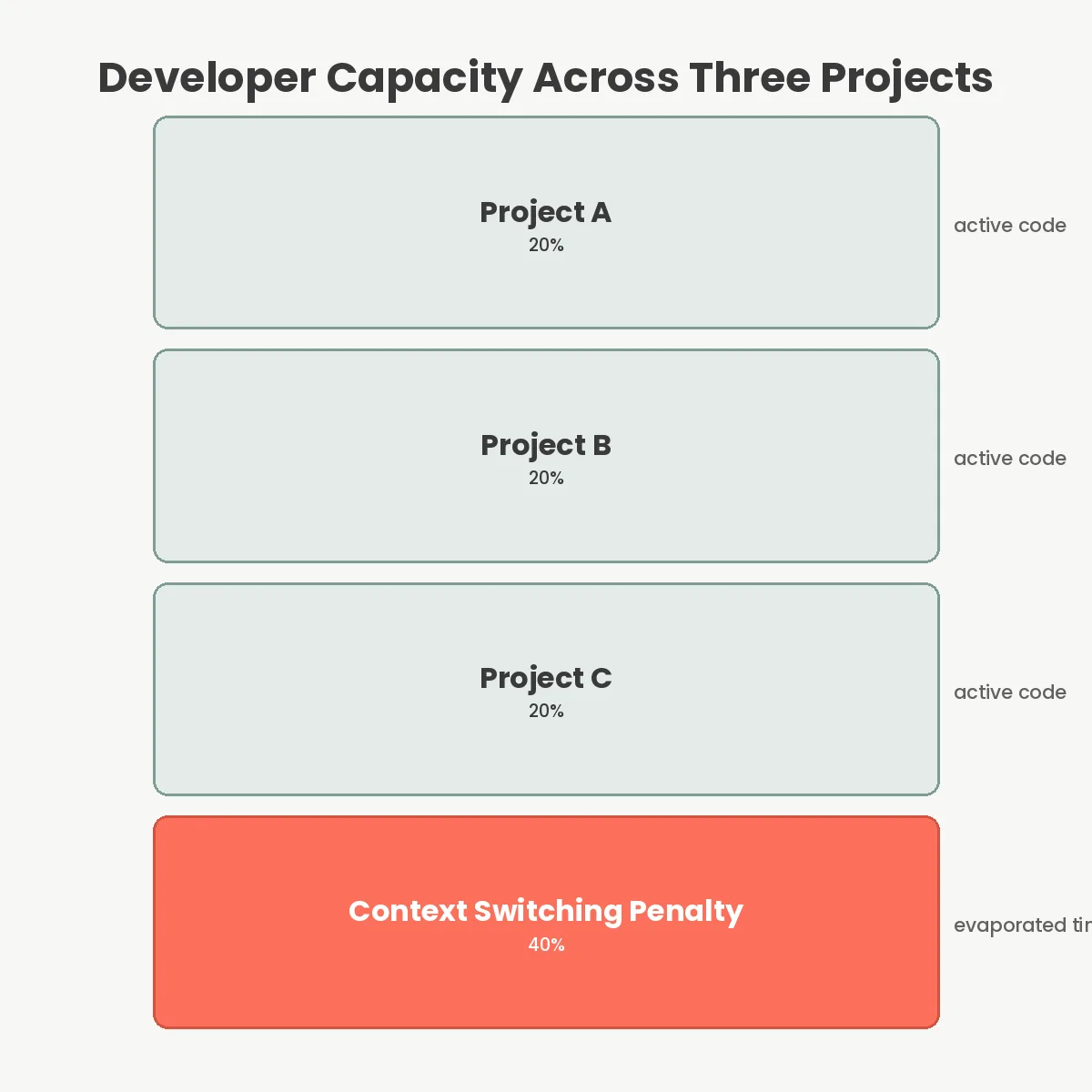
Assigning a developer to three concurrent projects does not mean each project gets 33% of their time. According to Gerald Weinberg’s historical analysis of engineering capacity, each of the three projects gets only 20% of the developer’s focus. The remaining 40% of their total weekly capacity evaporates entirely into context switching overhead. They spend that 40% tearing down local environments, checking out different Git branches, re-reading different product requirements, and trying to remember which client requested which feature.
Not all context switches are created equal. Jumping between two similar coding tasks is disruptive, but jumping across departmental lines carries a much heavier penalty. Cross-departmental context switching is mathematically more expensive than switching between tasks within your own discipline. The friction here is not just about changing software applications; it is about changing languages.
When a product owner moves from a developer standup to a marketing strategy sync, they are forced into a mental translation exercise. They have to unload technical vocabularies—API endpoints, JSON payloads, latency metrics—and load entirely different domain-specific vocabularies, like impression shares, cost-per-click, and sales accruals. This cognitive translation substantially increases the mental load required to participate effectively.
The recovery time required before real work can begin is extended because the brain has to re-calibrate its entire frame of reference. This is why a mid-day meeting with a completely different department can destroy an engineer’s momentum for the entire afternoon. To mitigate this, many successful organizations strictly separate their communication methods, relying on synchronous vs asynchronous communication tools to ensure that cross-departmental queries do not interrupt core engineering hours.
Artificial intelligence is frequently pitched as the ultimate antidote to workflow friction. Vendors promise that adding an AI layer to your stack will summarize threads, draft emails, and eliminate busywork. However, when these tools are purchased haphazardly and deployed without deep technical integration, they actually increase the cost of context switching rather than reducing it.
According to an August 2026 survey on digital behavior, 30% of AI users report spending more than half of their working hours manually re-entering information between different tools just to maintain context. If your AI meeting assistant lives in a browser tab, but your project management suite lives in a separate desktop app, employees are forced to copy transcripts, paste them into prompt windows, refine the output, and paste the results back into a Jira ticket.
This lack of integration creates a massive data entry trap. The employee is technically using advanced AI, but their physical workflow is identical to that of a 1990s data entry clerk. To prevent this, technology leaders must prioritize native integrations or reliable API connectivity when evaluating new tools. An AI tool that cannot automatically push its outputs to your system of record is a liability, not an asset.
The obvious reaction to the crippling cost of context switching is to mandate aggressive software consolidation. The theory is simple: if toggling between ten apps is expensive, force the company to use just one monolithic platform that does everything. While consolidation is generally positive, blindly eliminating specialized tools introduces its own set of dangerous trade-offs and operational limitations.
Monolithic software suites often suffer from the “jack of all trades, master of none” problem. An all-in-one platform might include a built-in code repository, a ticketing system, and a chat interface, but if those individual modules are clunky and slow, you have simply replaced the friction of switching apps with the friction of using bad software. High-performing engineering teams require best-of-breed specialized tools to do complex work efficiently.
You should not force a team to abandon a highly optimized, specialized application just to reduce your vendor count by one. The goal is to eliminate redundant overlapping tools (like having both Slack and Microsoft Teams active for the same department) without stripping away the precise instruments your specialists rely on. A balanced approach focuses on integrating the specialized tools deeply via APIs, allowing data to flow directly between them so the user does not have to switch windows.
When leadership finally decides to rein in tool sprawl and reduce the context switching tax, they often execute the initiative poorly. The most common failure mode is conducting a top-down audit based solely on procurement data. An IT director looks at a spreadsheet of software licenses, notices that the company pays for three different whiteboard applications, and arbitrarily cancels two of them to save money.
This approach ignores the reality of user workflows. If you cancel a tool without understanding why a specific team adopted it in the first place, you will break their processes. Perhaps the design team uses one specific whiteboard app because it natively handles large vector files without lagging, a feature the “approved” corporate whiteboard lacks. Forcing them onto the inferior tool will slow them down, creating a hidden productivity loss that far outweighs the saved licensing fee.
Another major mistake is ignoring the need for behavioral change. You can configure the perfect, streamlined software stack, but if you do not train the team on how to route information correctly, they will fall back into old habits. They will continue to direct-message files instead of linking to the central repository. A successful reduction in context switching requires thorough onboarding, which is why utilizing a comprehensive software implementation checklist is critical to ensure actual adoption.
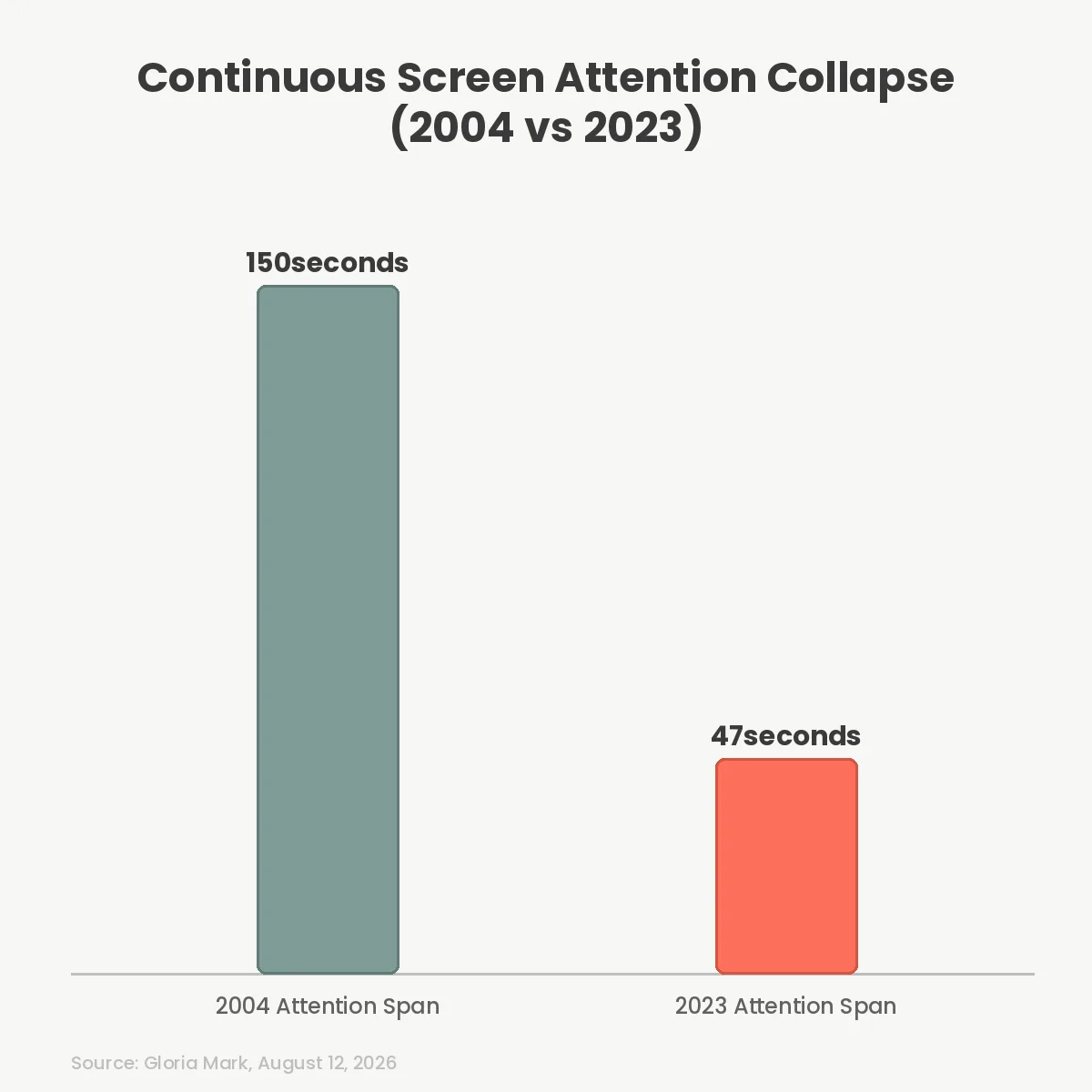
The cost of context switching is not a vague psychological concept; it is a brutal mathematical reality that destroys engineering capacity. When you pay a premium for top-tier talent, forcing them to spend five weeks a year visually reorienting to different application interfaces is operational malpractice. Telemetry proves that continuous screen attention has collapsed over two decades, falling from 2.5 minutes in 2004 to just 47 seconds in 2023. You cannot afford to let your software stack accelerate that decline.
The decision rule moving forward is strict constraint. Before approving any new application, you must demand proof that it integrates natively with your existing systems of record. If a tool requires employees to manually copy data, toggle windows, or translate glossaries, the hidden cognitive tax will completely erase the tool’s intended value. Audit your workspace, sever the redundant subscriptions, and protect your team’s ability to maintain deep focus.
Context switching costs companies between $48,000 and $62,000 per developer annually. This calculation is based on a loaded hourly rate of $90, assuming the developer is forced to switch tasks 35 times a day and requires 10 minutes of mental recovery per switch.
The toggle tax is the accumulated time lost from constantly switching between digital applications. While a single switch takes just over two seconds, doing it 1,200 times a day wastes roughly four hours a week, compounding into five weeks of lost productivity per year.
Peer-reviewed field data shows it takes an average of 25 minutes and 26 seconds to fully resume interrupted work on the same day. During this lengthy recovery phase, workers must painstakingly reconstruct the mental scaffolding and context required to perform complex tasks.
No, distracted employees often work as fast or faster once they return to a task to compensate for lost time. However, this rushed compensation drastically increases stress, frustration, and error rates, ultimately damaging both the product quality and the employee’s mental health.
You Can Get More Information!