Why SaaS Vendor Consolidation is the Top Enterprise Priority in 2025
SaaS vendor consolidation is the strategic process of reducing an...

Make email marketing simplified

Make email marketing simplified

Make email marketing simplified

Make email marketing simplified

Make email marketing simplified

Make email marketing simplified

Make email marketing simplified

Make email marketing simplified

Make email marketing simplified

Make email marketing simplified

Make email marketing simplified

Make email marketing simplified

Make email marketing simplified

Make email marketing simplified

Make email marketing simplified

We use cookies for our website to give you the most relevant experience by remembering your preferences. By clicking “accept”, you consent to use of ALL the cookies
This website uses cookies to improve your experience while you navigate through the website. Out of these, the cookies that are categorized as necessary are stored on your browser as they are essential for the working of basic functionalities of the website. We also use third-party cookies that help us analyze and understand how you use this website. These cookies will be stored in your browser only with your consent. You also have the option to opt-out of these cookies. But opting out of some of these cookies may affect your browsing experience.
Necessary cookies are absolutely essential for the website to function properly. These cookies ensure basic functionalities and security features of the website, anonymously.
| Cookie | Duration | Description |
|---|---|---|
| cookielawinfo-checkbox-functional | 11 months | This cookie is set by GDPR Cookie Consent plugin. The cookie is used to store the user consent for the cookies in the category “Analytics”. |
| cookielawinfo-checkbox-functional | 11 months | The cookie is set by GDPR cookie consent to record the user consent for the cookies in the category “Functional”. |
| cookielawinfo-checkbox-necessary | 11 months | This cookie is set by GDPR Cookie Consent plugin. The cookies is used to store the user consent for the cookies in the category “Necessary”. |
| cookielawinfo-checkbox-others | 11 months | This cookie is set by GDPR Cookie Consent plugin. The cookie is used to store the user consent for the cookies in the category “Other. |
| cookielawinfo-checkbox-performance | 11 months | This cookie is set by GDPR Cookie Consent plugin. The cookie is used to store the user consent for the cookies in the category “Performance”. |
| viewed_cookie_policy | 11 months | The cookie is set by the GDPR Cookie Consent plugin and is used to store whether or not user has consented to the use of cookies. It does not store any personal data. |
Functional cookies help to perform certain functionalities like sharing the content of the website on social media platforms, collect feedbacks, and other third-party features.
Performance cookies are used to understand and analyze the key performance indexes of the website which helps in delivering a better user experience for the visitors.
Analytical cookies are used to understand how visitors interact with the website. These cookies help provide information on metrics the number of visitors, bounce rate, traffic source, etc.
Advertisement cookies are used to provide visitors with relevant ads and marketing campaigns. These cookies track visitors across websites and collect information to provide customized ads.
Other uncategorized cookies are those that are being analyzed and have not been classified into a category as yet.
Cyberia Tech, Inc. respects your privacy. This Privacy Policy explains how we collect, use, and share your information. By using our services, you agree to this policy. If any other agreements conflict with this Privacy Policy, the terms of those agreements prevail.
Cyberia Tech complies with the EU-US and Swiss-US Privacy Shield Frameworks for handling personal data from the EEA, UK, and Switzerland. In case of any conflict, the Privacy Shield Principles prevail. Learn more at Privacy Shield. Key Definitions
Information linked to an individual, transferred from the EEA, UK, or Switzerland to the U.S.
Data revealing race, religion, health, sexual orientation, and similar categories.
Effective Date: [ 2026 / 10 / 22 ]
Welcome to The Cyberia Tech ! By accessing or using our website or services, you agree to
comply with and be bound by these Terms of Use and our Privacy Policy. If you do not agree with
these terms, please do not use our Services.
Loading
0 %
Your First Piece of the Puzzle in
Business Growth



SaaS vendor consolidation is the strategic process of reducing an organization’s software footprint by eliminating redundant applications, terminating unused licenses, and centralizing procurement. For enterprises, it recovers up to 32% of wasted cloud budgets while immediately reducing the compliance risks associated with unmanaged shadow IT.
The average enterprise is currently paying for 371 different SaaS applications, yet employee engagement with these tools hovers at a dismal 47%. This bloat is no longer just a minor administrative inefficiency; it is a direct drain on corporate profitability. When business units independently procure software, the resulting fragmentation creates overlapping capabilities and fractured data silos. More critically, unvetted vendors introduce severe third-party vulnerabilities into the corporate network. Resolving this sprawl requires systematic governance, not merely asking departments to cancel forgotten subscriptions.
Decentralized purchasing models initially promised agility. Departments could deploy specialized tools without waiting for IT procurement cycles. However, this autonomy generated unmanageable financial overhead. According to the 2024 State of the Cloud Report by Flexera, organizations consistently waste approximately 32% of their cloud and software budgets on redundant or idle licenses. The waste compounds annually as vendors enforce automatic renewals and escalate per-seat pricing models.
Financial leakage occurs primarily through duplicate functionality. A marketing department might utilize Asana for campaign tracking, while engineering standardizes on Jira, and operations relies on Monday.com. Each isolated instance requires separate single sign-on integrations, distinct data backup protocols, and independent compliance audits. The administrative burden of maintaining these parallel ecosystems frequently exceeds the base license costs themselves. Rationalizing this portfolio forces leaders to evaluate whether minor feature differences justify the compounding operational overhead.
Organizations must also account for tiered pricing inefficiencies. Purchasing 50 seats across four different project management tools prevents the enterprise from negotiating volume discounts with a single provider. Consolidating contracts transforms fragmented spending into leverage, allowing procurement teams to demand better service level agreements and enterprise-grade security features at lower unit economics.
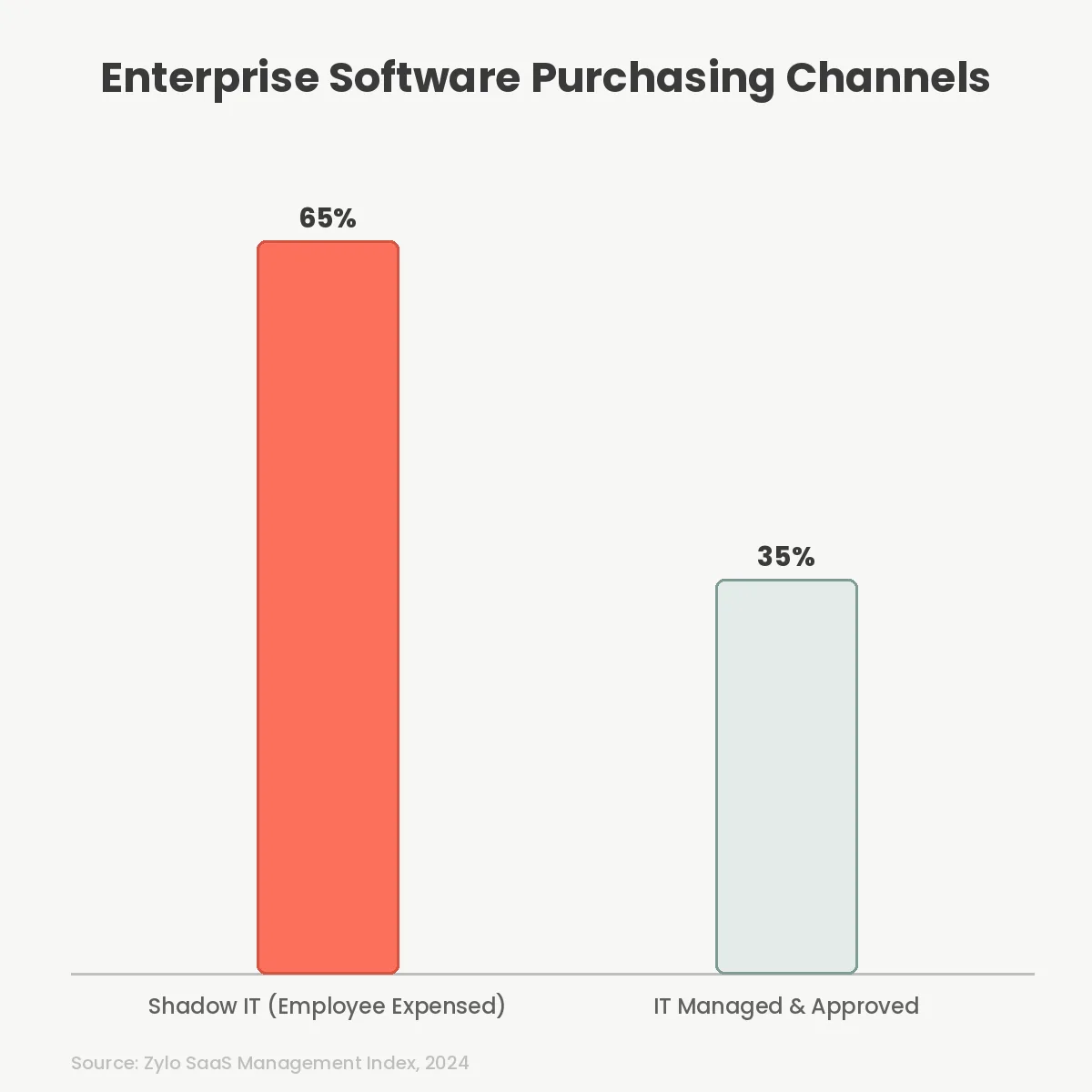
Financial waste represents only half the liability. The Zylo 2024 SaaS Management Index reveals that shadow IT—software purchased outside of central IT oversight—now accounts for 65% of enterprise SaaS adoption. Employees routinely use corporate credit cards to bypass procurement protocols, granting untested third-party applications access to sensitive corporate data.
Unmanaged applications operate outside the corporate security perimeter. They lack mandatory multi-factor authentication enforcement, bypass regular penetration testing, and evade standard off-boarding procedures. When an employee departs, their access to corporate assets within shadow IT applications often remains active indefinitely, creating persistent backdoor access. Transitioning from legacy perimeters to modern architectures requires strict control over application access, making zero trust network access frameworks nearly impossible to implement when IT lacks visibility into the applications employees actually use.
Regulatory frameworks such as GDPR and CCPA assign liability to the data controller regardless of which unvetted sub-processor leaked the information. Auditing decentralized SaaS applications for compliance is practically impossible when the inventory is unknown. Consolidation mitigates this risk by fundamentally reducing the attack surface. Fewer vendors equate to fewer third-party risk assessments, tighter control over data residency, and simplified incident response protocols.
Effective consolidation requires mapping application capabilities against actual business workflows. Organizations must move beyond vendor labels and categorize software by its functional output. A communications audit frequently reveals that an enterprise is paying for Slack, Microsoft Teams, and Zoom simultaneously, despite all three platforms offering overlapping chat and video conferencing capabilities.
A rigorous functional mapping exercise typically exposes overlaps across operational domains such as work management, digital whiteboarding, and cloud storage. By forcing departments to justify why the enterprise standard cannot meet their needs, IT can begin deprecating redundant instances.
| Functional Category | Common Sprawl Examples | Consolidation Strategy |
|---|---|---|
| Work Management | Jira, Asana, Trello, Monday.com, Wrike | Standardize on one agile tracking tool and one general workflow tool. |
| Digital Whiteboarding | Miro, Mural, Lucidchart, FigJam | Select a platform bundled with existing suites to avoid separate licenses. |
| Cloud Storage | Box, Dropbox, Google Drive, OneDrive | Mandate usage of the primary identity provider’s native storage. |
| Data Visualization | Tableau, Looker, PowerBI, Domo | Align visualization tools with the core data warehouse provider. |
Usage telemetry provides the empirical evidence required to enforce these mandates. Analyzing single sign-on logs rather than employee surveys reveals true engagement metrics. If a specialized design tool shows only 12 active users despite a 100-seat enterprise license, procurement can confidently downgrade the tier during the next renewal cycle. Similar to evaluating the economics of cloud repatriation, rationalizing SaaS requires hard data on actual utilization rather than hypothetical provisioning allocations.
Executing a vendor reduction strategy requires specialized tooling. Relying on spreadsheets to track hundreds of renewal dates and compliance certificates guarantees failure. Gartner analysis indicates that 50% of organizations will centralize their application oversight using dedicated SaaS Management Platforms by 2026, shifting away from manual inventory methods.
The audit process begins with financial discovery. Ingesting expense reports and accounts payable data into an oversight platform instantly surfaces the hidden software purchases employees make via credit card. Once the true inventory is established, the platform monitors SSO authentications to calculate actual cost-per-active-user. This metric dictates the consolidation roadmap, highlighting high-cost, low-engagement applications for immediate termination.
Negotiation represents the final mechanical phase. Armed with usage data, procurement leaders can approach the chosen core vendors to expand license volume in exchange for significant discounts. Centralizing the budget prevents departments from renewing specialized applications independently, forcing them into the unified platforms the enterprise has prioritized.
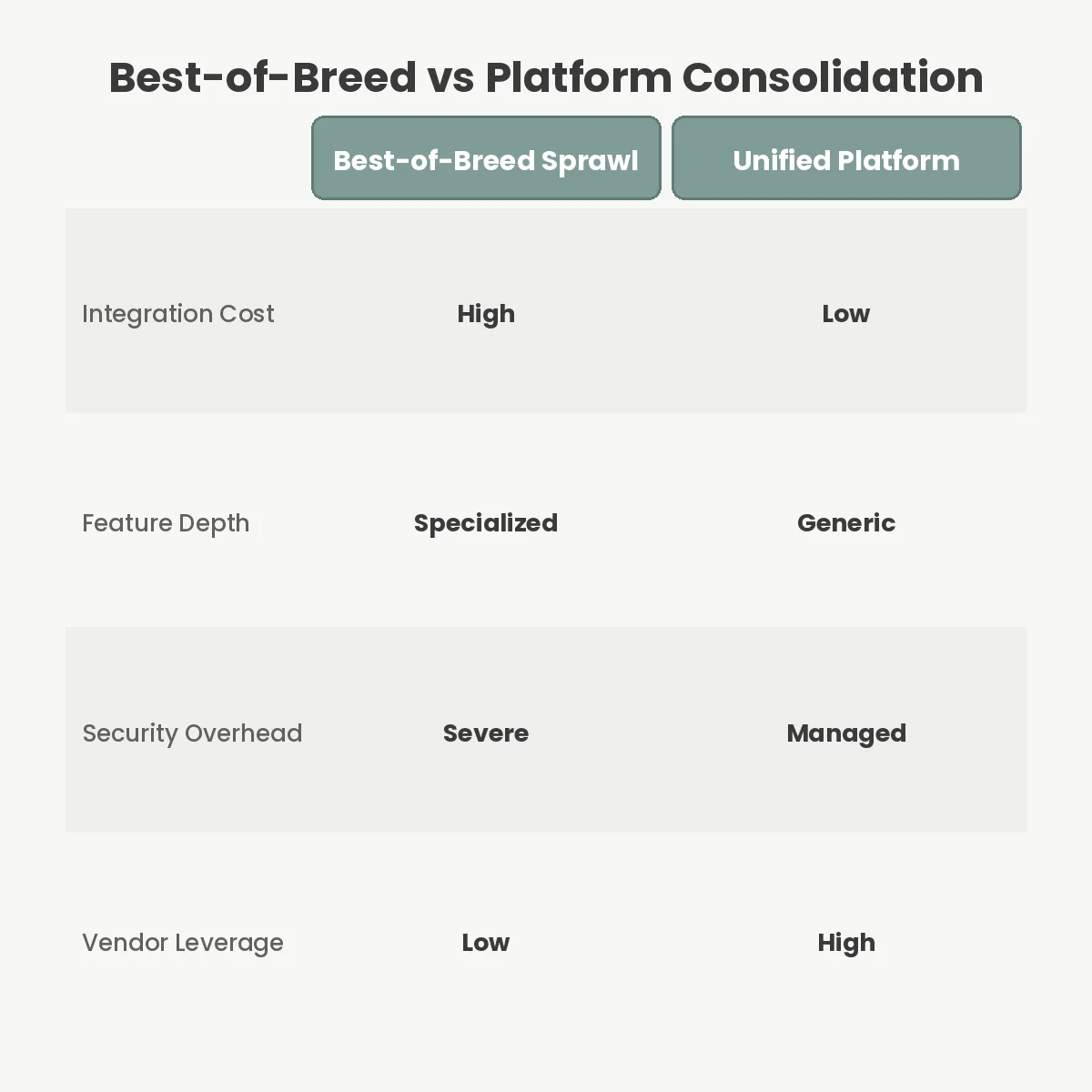
Reducing vendor count is not a universal positive. Aggressive consolidation inherently favors horizontal platforms over best-of-breed specialized tools. A unified platform might handle 80% of a department’s requirements efficiently, but the missing 20% can severely impact the productivity of specialized teams. Forcing a sophisticated engineering team off a dedicated issue tracker onto a generic project management tool risks slowing down deployment cycles.
Vendor lock-in represents another significant trade-off. By consolidating infrastructure, communication, and productivity suites into a single ecosystem, the enterprise loses negotiation leverage. If the monolithic provider increases prices dramatically, the organization has no viable alternative but to accept the cost, as migrating the entire company is prohibitively disruptive.
Furthermore, relying on a single platform creates centralized points of failure. If an enterprise uses a single vendor for identity management, email, and cloud infrastructure, a severe outage at that provider halts all business operations globally. Organizations must weigh the financial savings of consolidation against the operational resilience provided by a diversified, multi-vendor architecture.
The most frequent failure mode in SaaS consolidation occurs when IT disables applications without understanding the underlying business processes. Terminating a seemingly redundant file-sharing tool without migrating the historical data and active client links severs external workflows and damages customer relationships. Users will predictably subvert the mandate by expensing a new tool under a disguised billing category.
Another common mistake is ignoring the cost of data migration. Extracting terabytes of historical project data from a deprecated system, formatting it, and ingesting it into the surviving platform often requires costly custom software migration services. If the migration engineering costs exceed the annual savings from canceling the redundant license, the consolidation exercise actively destroys value.
Finally, treating consolidation as a one-time project rather than a continuous governance protocol ensures that sprawl will return. Without implementing strict approval workflows and automated license reclamation for inactive users, the enterprise will simply accumulate a new portfolio of unmanaged software within the next fiscal year.
Shadow IT encompasses any software, application, or cloud service purchased and used by employees without explicit approval and oversight from the central IT department. It typically enters the organization via corporate credit card expenses and bypasses formal security reviews.
Organizations identify dormant licenses by integrating a SaaS management platform with their single sign-on provider. This integration tracks active authentications rather than assigned seats, providing empirical data on which applications are genuinely utilized and which are abandoned.
Yes. Consolidating vendors eliminates duplicate subscription costs and allows procurement to negotiate higher volume discounts with fewer providers. Systematic consolidation typically recovers approximately thirty percent of wasted enterprise software expenditure.
The primary risk is degrading employee productivity by forcing specialized teams onto generic platforms. Additionally, over-consolidation creates severe vendor lock-in, eliminating pricing leverage and exposing the business to centralized points of failure during provider outages.
Vendor consolidation succeeds when it operates as an ongoing governance framework rather than a reactionary cost-cutting event. The mandate is clear: businesses cannot secure perimeters they cannot see, nor can they optimize budgets obscured by decentralized spending. The transition requires a firm commitment to data-driven procurement, utilizing single sign-on telemetry to separate essential tools from dormant subscriptions.
Leaders must balance the undeniable financial and security benefits of centralizing software with the operational realities of their specialized teams. The most effective approach defines core enterprise platforms for communication, infrastructure, and identity, while establishing a strict, formalized intake process for evaluating specialized additions. Moving forward, IT must shift from being the department that blindly blocks purchases to the architect of a curated, secure, and highly leveraged software portfolio.
You Can Get More Information!