Why SaaS Vendor Consolidation is the Top Enterprise Priority in 2025
SaaS vendor consolidation is the strategic process of reducing an...

Make email marketing simplified

Make email marketing simplified

Make email marketing simplified

Make email marketing simplified

Make email marketing simplified

Make email marketing simplified

Make email marketing simplified

Make email marketing simplified

Make email marketing simplified

Make email marketing simplified

Make email marketing simplified

Make email marketing simplified

Make email marketing simplified

Make email marketing simplified

Make email marketing simplified

We use cookies for our website to give you the most relevant experience by remembering your preferences. By clicking “accept”, you consent to use of ALL the cookies
This website uses cookies to improve your experience while you navigate through the website. Out of these, the cookies that are categorized as necessary are stored on your browser as they are essential for the working of basic functionalities of the website. We also use third-party cookies that help us analyze and understand how you use this website. These cookies will be stored in your browser only with your consent. You also have the option to opt-out of these cookies. But opting out of some of these cookies may affect your browsing experience.
Necessary cookies are absolutely essential for the website to function properly. These cookies ensure basic functionalities and security features of the website, anonymously.
| Cookie | Duration | Description |
|---|---|---|
| cookielawinfo-checkbox-functional | 11 months | This cookie is set by GDPR Cookie Consent plugin. The cookie is used to store the user consent for the cookies in the category “Analytics”. |
| cookielawinfo-checkbox-functional | 11 months | The cookie is set by GDPR cookie consent to record the user consent for the cookies in the category “Functional”. |
| cookielawinfo-checkbox-necessary | 11 months | This cookie is set by GDPR Cookie Consent plugin. The cookies is used to store the user consent for the cookies in the category “Necessary”. |
| cookielawinfo-checkbox-others | 11 months | This cookie is set by GDPR Cookie Consent plugin. The cookie is used to store the user consent for the cookies in the category “Other. |
| cookielawinfo-checkbox-performance | 11 months | This cookie is set by GDPR Cookie Consent plugin. The cookie is used to store the user consent for the cookies in the category “Performance”. |
| viewed_cookie_policy | 11 months | The cookie is set by the GDPR Cookie Consent plugin and is used to store whether or not user has consented to the use of cookies. It does not store any personal data. |
Functional cookies help to perform certain functionalities like sharing the content of the website on social media platforms, collect feedbacks, and other third-party features.
Performance cookies are used to understand and analyze the key performance indexes of the website which helps in delivering a better user experience for the visitors.
Analytical cookies are used to understand how visitors interact with the website. These cookies help provide information on metrics the number of visitors, bounce rate, traffic source, etc.
Advertisement cookies are used to provide visitors with relevant ads and marketing campaigns. These cookies track visitors across websites and collect information to provide customized ads.
Other uncategorized cookies are those that are being analyzed and have not been classified into a category as yet.
Cyberia Tech, Inc. respects your privacy. This Privacy Policy explains how we collect, use, and share your information. By using our services, you agree to this policy. If any other agreements conflict with this Privacy Policy, the terms of those agreements prevail.
Cyberia Tech complies with the EU-US and Swiss-US Privacy Shield Frameworks for handling personal data from the EEA, UK, and Switzerland. In case of any conflict, the Privacy Shield Principles prevail. Learn more at Privacy Shield. Key Definitions
Information linked to an individual, transferred from the EEA, UK, or Switzerland to the U.S.
Data revealing race, religion, health, sexual orientation, and similar categories.
Effective Date: [ 2026 / 10 / 22 ]
Welcome to The Cyberia Tech ! By accessing or using our website or services, you agree to
comply with and be bound by these Terms of Use and our Privacy Policy. If you do not agree with
these terms, please do not use our Services.
Loading
0 %
Your First Piece of the Puzzle in
Business Growth



WebAssembly (Wasm) is not a universal replacement for JavaScript. While Wasm executes heavy computational workloads at near-native speeds, passing data across the JS-to-Wasm boundary introduces strict latency penalties. Use JavaScript for DOM manipulation and lightweight logic. Reserve WebAssembly for intensive tasks like video encoding, cryptography, or running desktop-class engines in the browser.
Developers often assume compiling existing application logic to Rust and shipping it as WebAssembly will instantly fix computational bottlenecks. This assumption breaks applications. Moving lightweight operations into a Wasm module often degrades performance because data serialization outpaces the execution gains. You face a rigid architectural decision: is your computation heavy enough to pay the toll of crossing the memory boundary? The answer dictates your entire deployment strategy.
JavaScript engines like V8 are heavily optimized. Just-In-Time (JIT) compilers parse, compile, and execute JavaScript rapidly. WebAssembly skips the parsing phase, arriving as an already-compiled binary format. This predictable parsing behavior is WebAssembly’s primary initialization advantage.
However, Wasm still requires compilation to machine code upon arrival. The V8 engine compiles WebAssembly at roughly 4 to 5 milliseconds per megabyte of code on standard hardware. If you ship a massive binary, the browser blocks execution until compilation finishes. You trade parsing overhead for binary download and compilation time. This is why optimizing web performance bottlenecks requires measuring the total time-to-interactive, not just the execution speed of a single loop.
Streaming compilation mitigates this. Browsers compile Wasm modules asynchronously while they download. Yet, initialization remains a fixed cost. Bootstrapping a Wasm instance is overkill for basic form validation or state management. The upfront cost only pays dividends when the subsequent computation runs for hundreds of milliseconds.
WebAssembly and JavaScript operate in isolated memory spaces. WebAssembly cannot read a JavaScript string directly. It operates entirely on a linear array of bytes (its memory buffer). Passing a string from JavaScript to Wasm requires encoding it into bytes, writing it to Wasm’s memory, and passing the memory pointer. Wasm then decodes it, processes it, and reverses the sequence to return a value.
Crossing this JS-to-Wasm boundary costs roughly 15 to 25 nanoseconds per call. This sounds microscopic. It becomes catastrophic inside a tight loop. If a JavaScript animation frame calls a Wasm function 10,000 times to calculate particle coordinates, the serialization overhead destroys any performance gained from the Wasm execution speed.
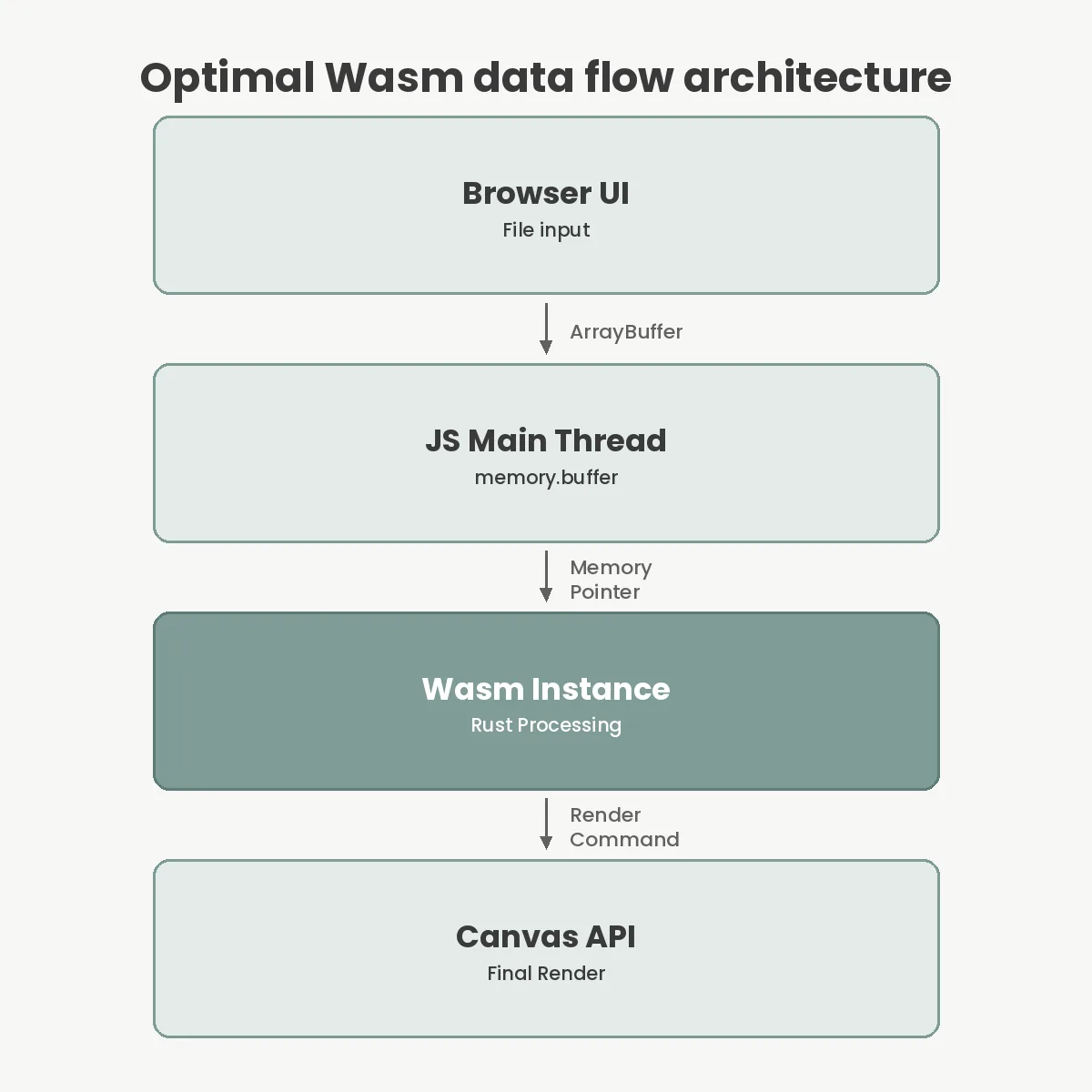
Heavy data transfer kills Wasm adoption. You must structure applications to pass pointers, not values, keeping the bulk of the data resident inside the WebAssembly memory space. Chatty architectures fail here.

JavaScript wins for anything interacting heavily with the Document Object Model (DOM). WebAssembly has zero direct DOM access. Every UI update routed through Wasm must call out to JavaScript. This indirect routing guarantees UI lag if heavily utilized.
To evaluate the architectural fit, consider the specific constraints of the two runtimes.
| Criteria | JavaScript | WebAssembly |
|---|---|---|
| DOM Access | Direct and highly optimized | Requires JS bridge calls |
| Execution Predictability | Variable due to JIT compilation | Near-native and consistent |
| Payload Size (Simple Logic) | Minimal (kilobytes) | Heavy (hundreds of kilobytes) |
| Best Use Case | UI routing, events, lightweight state | Video encoding, physics, parsers |
JavaScript’s tooling ecosystem is also unmatched. Hot-module reloading, step-through debugging, and memory profiling are native. WebAssembly debugging relies on source maps that often obscure underlying memory management issues. Stick with JavaScript until profiling proves computational execution is the bottleneck.
Historically, languages with their own memory management (like Go, Java, or Kotlin) suffered massive payload bloat when compiled to WebAssembly. Because Wasm lacked a garbage collector, these languages had to bundle their entire runtime environments into the final binary. This pushed minimum payload sizes well over 2MB, making them unusable for fast-loading consumer apps.
Chrome 119 introduced native WebAssembly Garbage Collection (WasmGC) in October 2023. This update fundamentally shifted the payload economics. Compilers for Dart and Kotlin now target the browser’s built-in garbage collector instead of shipping their own.
This reduces the baseline bundle sizes dramatically, saving around 2MB of runtime overhead per module. It opens the door for enterprise teams to deploy complex frontend logic written in traditional backend languages without crippling network overhead. However, Rust and C++ remain the optimal choices for pure performance, as they manage memory manually without any GC pauses.
Figma provides the definitive case study for WebAssembly migration. Their browser-based design tool demands intense graphical computation. In 2017, Figma migrated their 2D rendering engine from asm.js to WebAssembly. The result was a 3x reduction in load times.
Figma succeeded because their architecture treats WebAssembly as a heavy engine, not a utility library. The application loads the design file directly into WebAssembly memory. The Wasm core handles the heavy lifting of layout, vector math, and scene-graph calculation, returning only final render commands to the JavaScript UI layer.
For operations like audio mixing, local SQLite databases, or machine learning model inference, this chunked data approach is mandatory. Load the asset into Wasm memory once, process it entirely within the Wasm sandbox, and emit a single result back to the main thread.
The most common failure mode is the “lift and shift” rewrite. A team decides their React application is slow, rewrites fifty small utility functions in Rust, compiles to Wasm, and binds them to JavaScript. The application inevitably slows down.
Another frequent mistake is ignoring payload optimization. A basic “Hello World” Rust program compiled to Wasm can easily exceed 1.5MB if compiled blindly. Using standard tooling like wasm-opt strips dead code and optimizes the binary. A properly optimized base Rust module shrinks down to around 400KB.
Furthermore, developers building scalable web apps must remember Wasm runs on the main browser thread by default. Heavy Wasm execution will freeze the UI just as quickly as a blocking JavaScript loop. You must initialize WebAssembly modules inside Web Workers to achieve true parallel execution without jank.
Adopting WebAssembly introduces severe observability blind spots. While browser developer tools have improved, inspecting a Wasm memory leak remains tedious compared to JavaScript heap snapshots. You are debugging compiled assembly in the browser.
Error tracking tools struggle to map Wasm panics back to source code accurately. If an out-of-bounds memory access crashes the Wasm module, the resulting JavaScript stack trace is often useless. Teams adopting Wasm must heavily instrument their Rust or C++ code with internal logging before compilation.
Measure the serialization cost before writing a single line of code. Rely on actual performance profiling over theoretical speed claims. WebAssembly is a specialized industrial tool. Use it to build heavy machinery, but don’t use a bulldozer to plant a garden.
No. WebAssembly cannot access the Document Object Model directly. It must call JavaScript functions to manipulate user interface elements. This indirect access introduces minor latency, which makes WebAssembly poorly suited for standard layout rendering and lightweight DOM event handling.
WebAssembly executes at near-native speed but is still constrained by the browser engine. The browser must compile the Wasm binary into machine code specific to the host device. Security sandboxing and runtime checks also introduce a slight execution overhead compared to raw native desktop applications.
Rewriting a standard React application in Rust and WebAssembly is strongly discouraged. The serialization costs between the Wasm logic and the UI layer will likely degrade performance. Reserve WebAssembly for isolated, highly computational tasks while keeping your primary application structure in JavaScript.
An unoptimized binary can easily exceed 2MB. However, by using optimization tools like wasm-opt and stripping dead code, a base Rust-compiled module can be reduced to around 400KB. Using languages that rely on WasmGC also prevents bundling large garbage collection environments.
If your computational operation completes in under 10 milliseconds in standard JavaScript, keep it in JavaScript. If you are processing real-time video frames, manipulating massive image buffers, or porting an existing C++ physics engine, WebAssembly is mandatory. Stop viewing Wasm as a JavaScript killer. Treat it as a high-performance co-processor inside the browser environment.
You Can Get More Information!