SSE vs WebSockets for LLM Streaming: Why SSE Wins
Server-Sent Events (SSE) beat WebSockets for LLM streaming because AI...

Make email marketing simplified

Make email marketing simplified

Make email marketing simplified

Make email marketing simplified

Make email marketing simplified

Make email marketing simplified

Make email marketing simplified

Make email marketing simplified

Make email marketing simplified

Make email marketing simplified

Make email marketing simplified

Make email marketing simplified

Make email marketing simplified

Make email marketing simplified

Make email marketing simplified

We use cookies for our website to give you the most relevant experience by remembering your preferences. By clicking “accept”, you consent to use of ALL the cookies
This website uses cookies to improve your experience while you navigate through the website. Out of these, the cookies that are categorized as necessary are stored on your browser as they are essential for the working of basic functionalities of the website. We also use third-party cookies that help us analyze and understand how you use this website. These cookies will be stored in your browser only with your consent. You also have the option to opt-out of these cookies. But opting out of some of these cookies may affect your browsing experience.
Necessary cookies are absolutely essential for the website to function properly. These cookies ensure basic functionalities and security features of the website, anonymously.
| Cookie | Duration | Description |
|---|---|---|
| cookielawinfo-checkbox-functional | 11 months | This cookie is set by GDPR Cookie Consent plugin. The cookie is used to store the user consent for the cookies in the category “Analytics”. |
| cookielawinfo-checkbox-functional | 11 months | The cookie is set by GDPR cookie consent to record the user consent for the cookies in the category “Functional”. |
| cookielawinfo-checkbox-necessary | 11 months | This cookie is set by GDPR Cookie Consent plugin. The cookies is used to store the user consent for the cookies in the category “Necessary”. |
| cookielawinfo-checkbox-others | 11 months | This cookie is set by GDPR Cookie Consent plugin. The cookie is used to store the user consent for the cookies in the category “Other. |
| cookielawinfo-checkbox-performance | 11 months | This cookie is set by GDPR Cookie Consent plugin. The cookie is used to store the user consent for the cookies in the category “Performance”. |
| viewed_cookie_policy | 11 months | The cookie is set by the GDPR Cookie Consent plugin and is used to store whether or not user has consented to the use of cookies. It does not store any personal data. |
Functional cookies help to perform certain functionalities like sharing the content of the website on social media platforms, collect feedbacks, and other third-party features.
Performance cookies are used to understand and analyze the key performance indexes of the website which helps in delivering a better user experience for the visitors.
Analytical cookies are used to understand how visitors interact with the website. These cookies help provide information on metrics the number of visitors, bounce rate, traffic source, etc.
Advertisement cookies are used to provide visitors with relevant ads and marketing campaigns. These cookies track visitors across websites and collect information to provide customized ads.
Other uncategorized cookies are those that are being analyzed and have not been classified into a category as yet.
Cyberia Tech, Inc. respects your privacy. This Privacy Policy explains how we collect, use, and share your information. By using our services, you agree to this policy. If any other agreements conflict with this Privacy Policy, the terms of those agreements prevail.
Cyberia Tech complies with the EU-US and Swiss-US Privacy Shield Frameworks for handling personal data from the EEA, UK, and Switzerland. In case of any conflict, the Privacy Shield Principles prevail. Learn more at Privacy Shield. Key Definitions
Information linked to an individual, transferred from the EEA, UK, or Switzerland to the U.S.
Data revealing race, religion, health, sexual orientation, and similar categories.
Effective Date: [ 2026 / 10 / 13 ]
Welcome to The Cyberia Tech ! By accessing or using our website or services, you agree to
comply with and be bound by these Terms of Use and our Privacy Policy. If you do not agree with
these terms, please do not use our Services.
Loading
0 %
Your First Piece of the Puzzle in
Business Growth



Server-Sent Events (SSE) beat WebSockets for LLM streaming because AI responses are fundamentally unidirectional server-to-client pushes. SSE operates over standard HTTP, natively leverages HTTP/2 multiplexing, and works seamlessly with standard edge caching. WebSockets require complex stateful connection management and full-duplex overhead that most AI applications never actually use.
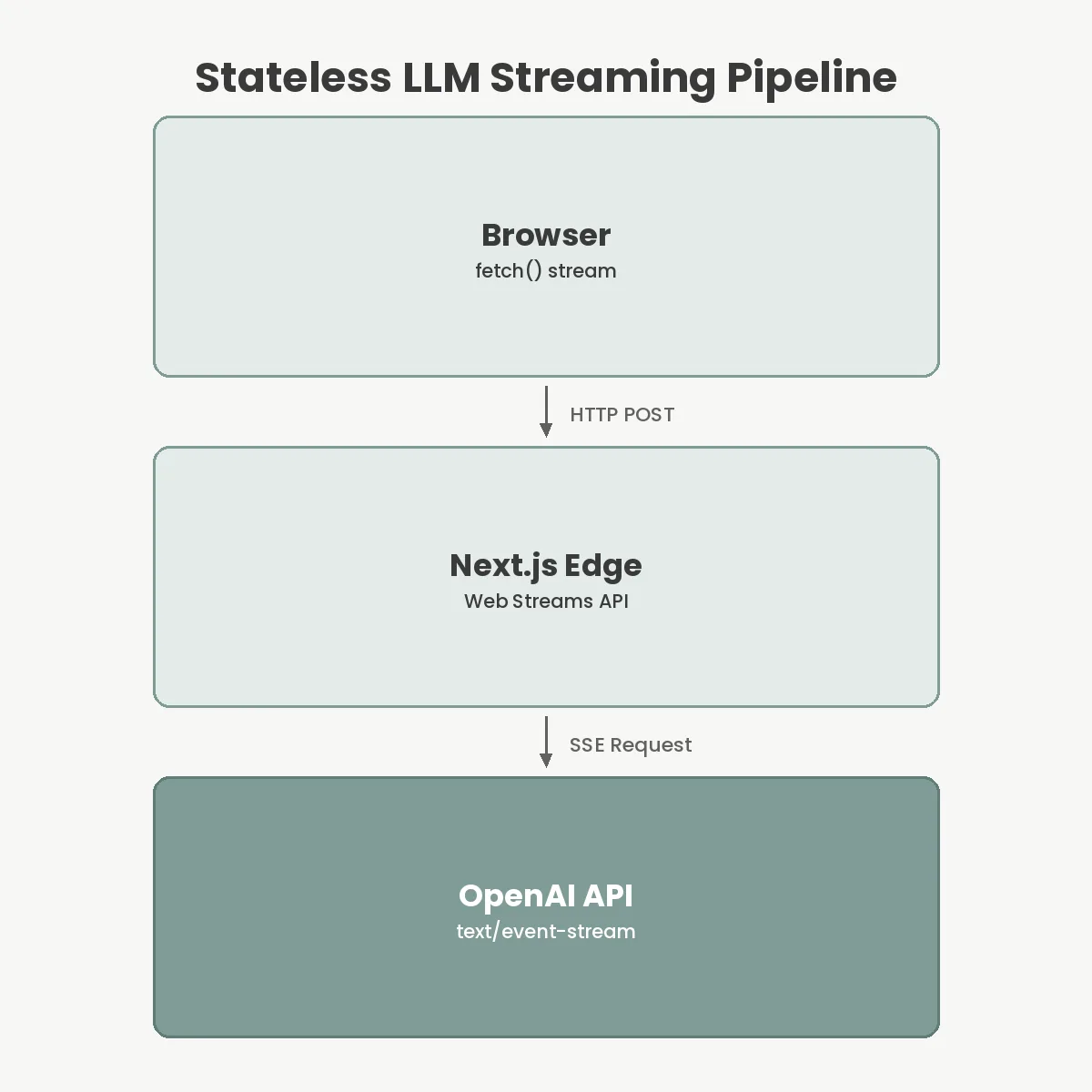
Building an AI chat interface feels like a real-time problem. Developers immediately reach for the tools they know. Usually, that means WebSockets. But keeping thousands of stateful TCP connections alive just to trickle text tokens to a client destroys server memory limits. It breaks standard load balancing. You spend days configuring Redis pub-sub architectures just to scale your application horizontally. There is a much simpler approach. The official OpenAI API does not use WebSockets to stream tokens. They rely entirely on Server-Sent Events. To build scalable AI applications, you should too.
WebSockets are defined by RFC 6455 as a protocol providing full-duplex communication channels over a single TCP connection. They are designed for scenarios where the client and server exchange high-frequency messages simultaneously. Think multiplayer gaming, financial trading dashboards, or collaborative drawing canvases. In these use cases, the bidirectional nature of the protocol is an absolute requirement.
LLM interfaces do not work this way. When a user interacts with a chatbot, they submit a prompt. That prompt is a single payload. The server processes it, queries the model, and then streams back a response consisting of hundreds or thousands of tokens. This is not a bidirectional conversation. It is a standard request followed by a long, unidirectional response.
Using a full-duplex protocol for a unidirectional data flow wastes infrastructure. The client does not need an open socket to send continuous updates while the model is generating. It just needs to listen. By forcing WebSockets into this architecture, engineers inherit the operational complexity of stateful connections without utilizing the protocol’s primary benefit. If your architecture relies on modern web protocols, adapting to standard data flows is crucial, much like adapting to HTTP/3 performance standards to reduce overhead.
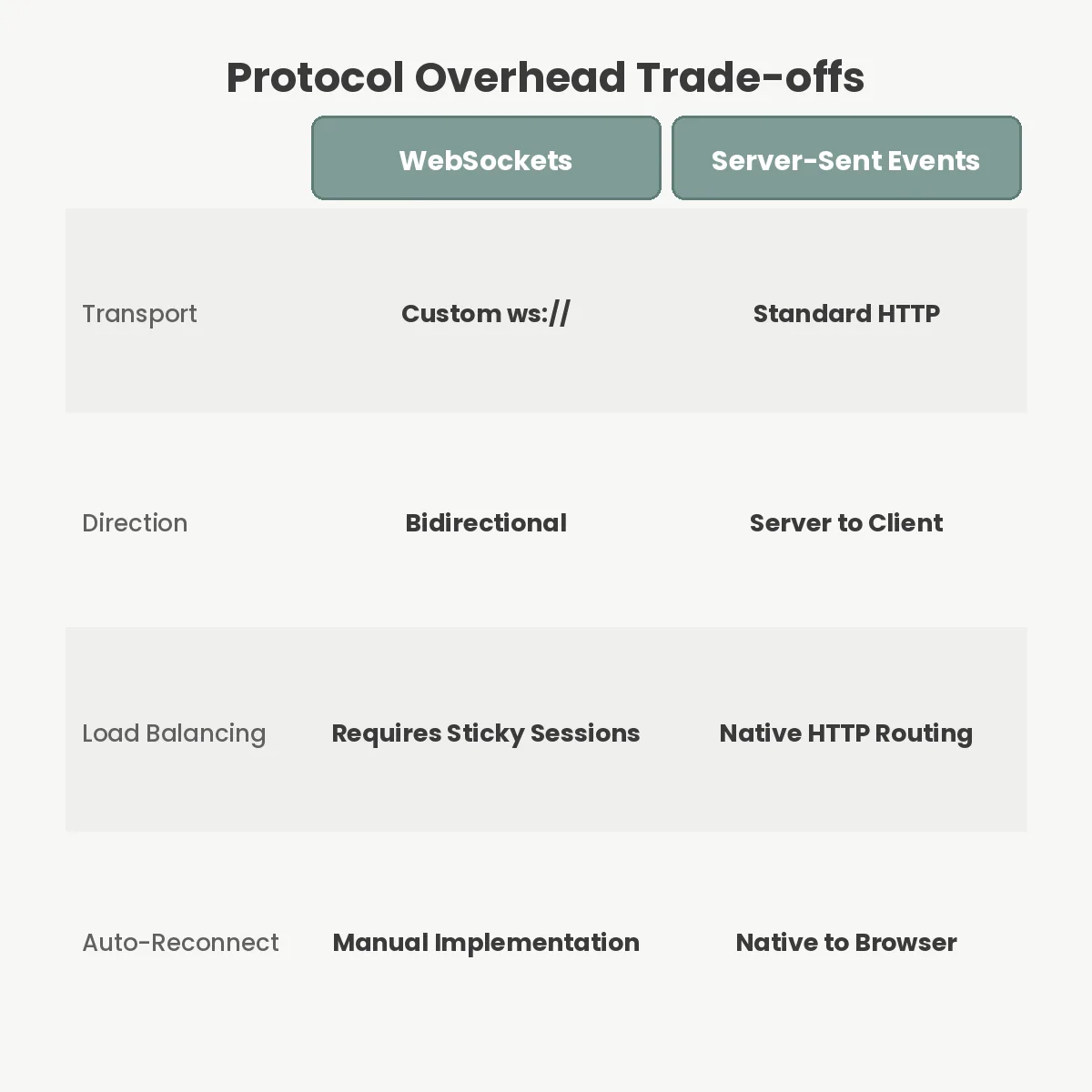
Server-Sent Events represent a web standard that allows a browser to receive automatic updates from a server via an HTTP connection. Unlike WebSockets, which require a protocol upgrade mechanism and a custom `ws://` transport layer, SSE uses standard HTTP. The server responds with a specific `text/event-stream` content type, keeps the connection alive, and pushes data payloads prefixed with `data: ` as they become available.
Because SSE operates entirely within the HTTP layer, your existing infrastructure understands it natively. Your Web Application Firewall (WAF) can inspect the initial request. Your load balancers can route the traffic using standard rules. Your existing authentication middleware functions exactly as it does for standard REST endpoints.
Modern frameworks have embraced this simplicity. In Next.js 15, the App Router natively supports streaming responses using the standard Web Streams API. You do not need external libraries or custom connection handlers. You simply instantiate a `ReadableStream`, yield chunks of text as the LLM generates them, and return a standard HTTP response. The browser handles the rest automatically.
Scaling a stateless HTTP application is trivial. You place instances behind a load balancer, and traffic distributes based on capacity. Scaling WebSockets requires entirely different infrastructure patterns. Because WebSockets maintain a persistent connection to a specific server instance, they introduce stateful routing requirements.
Imagine a scenario where a client establishes a WebSocket connection to Instance A. The application backend finishes processing an AI task on a background worker and needs to send the result to the client. That worker cannot just send data to Instance B; it must route the message specifically to Instance A. This requires a message broker. Developers typically introduce Redis pub/sub simply to coordinate which server holds which socket connection.
Platform limits compound this issue. Managed API gateways restrict WebSocket concurrency far more aggressively than standard HTTP connections. AWS API Gateway enforces strict quotas on WebSocket connection duration and idle timeouts. Migrating this logic to scalable front-end architectures becomes significantly harder when the transport layer demands rigid state management. Server-Sent Events eliminate this completely. Any instance can handle the initial POST request, and the stream remains isolated to that specific HTTP transaction.
If SSE is technically superior for unidirectional streams, why did WebSockets dominate real-time development for the last decade? The answer lies in legacy browser limitations. Historically, under the HTTP/1.1 specification, browsers strictly capped concurrent connections to a single domain at six. If a user opened multiple tabs or if a dashboard required multiple concurrent streams, SSE would easily consume the entire connection pool. The browser would stall, unable to load images or execute secondary API calls.
HTTP/2 completely resolved this bottleneck by introducing multiplexing. Multiple data streams now share a single underlying TCP connection. Most modern web servers and browsers negotiate a limit of 100 concurrent streams per HTTP/2 connection. This means an application can maintain dozens of active SSE streams without exhausting the browser’s connection limits.
Because practically all edge networks, CDNs, and load balancers now default to HTTP/2 or HTTP/3, the primary historical objection to Server-Sent Events no longer exists. Developers referencing old stack-overflow answers often cite the six-connection limit without realizing the protocol underlying the modern web has already solved it.
Evaluating the raw differences between the protocols highlights why HTTP-based streaming requires significantly less engineering overhead. Building custom solutions for native features represents a massive waste of development cycles.
| Specification | WebSockets | Server-Sent Events (SSE) |
|---|---|---|
| Transport Layer | Custom ws:// Protocol | Standard HTTP/1.1 or HTTP/2 |
| Data Flow | Full-Duplex (Bidirectional) | Unidirectional (Server to Client) |
| Connection State | Stateful (Requires Sticky Sessions) | Stateless HTTP transaction |
| Reconnection Logic | Requires Custom Implementation | Native Browser Support |
| Data Format | Binary and Text | UTF-8 Text Only |
The native reconnection logic of SSE stands out as a critical advantage. When an SSE connection drops, the browser automatically attempts to reconnect. The server can even issue an `id` field with events, allowing the client to send a `Last-Event-ID` header upon reconnection to resume exactly where the stream failed. Replicating this behavior in WebSockets requires manually writing heartbeat loops, backoff algorithms, and state synchronization code.
Advocating for SSE in LLM text streaming does not mean WebSockets are obsolete. They remain the correct choice for specific, highly interactive engineering requirements. If you are building a voice-to-voice AI agent, WebSockets are mandatory. The user must be able to interrupt the agent mid-sentence, requiring simultaneous upstream audio packets and downstream response packets with sub-millisecond latency.
Similarly, multiplayer architectures, real-time collaboration tools like Figma, and high-frequency financial tickers necessitate bidirectional channels. If your application pushes state changes from the client to the server at a high frequency without waiting for request-response cycles, you need an open socket. Before choosing your protocol, map your data flow. You can explore how these interactive patterns map to business needs in our guide to real-world AI agents.
While SSE is simpler structurally, it introduces specific configuration traps at the infrastructure level. The most common failure mode involves proxy buffering. By default, reverse proxies like Nginx are designed to buffer HTTP responses. They wait until they accumulate a significant chunk of data before sending it to the client. This improves throughput for static files but completely breaks streaming.
If you implement SSE and notice the client receives nothing for ten seconds, followed by the entire text block appearing instantly, your proxy is buffering the stream. To fix this, you must explicitly configure your reverse proxy to bypass buffering for the event stream route. In Nginx, this requires setting `proxy_buffering off;` and ensuring your application server returns the `X-Accel-Buffering: no` header.
Another common trap involves enterprise firewalls. Some strict corporate networks proactively terminate long-running HTTP connections that appear idle. If your LLM takes 15 seconds to generate its first token, the firewall might sever the connection before data arrives. To mitigate this, developers should implement a server-side heartbeat. Pushing an empty comment line (`: keepalive\n\n`) every ten seconds prevents aggressive middleboxes from dropping the stream while the AI model processes complex prompts.
Server-Sent Events are strictly text-based, utilizing UTF-8 encoding. If you need to send binary data, you must encode it to base64 first. For heavy binary streaming like raw audio packets, WebSockets or WebRTC represent far better protocol choices.
Yes, modern browsers support reading SSE streams using the fetch API combined with a ReadableStream. This modern approach gives developers significantly more control over request headers and POST bodies compared to the older, restrictive EventSource interface.
You pass standard HTTP headers, such as Authorization bearer tokens, during the initial request. Because SSE runs entirely over standard HTTP, your existing API gateway middleware and session management validate the connection natively before the stream opens.
Yes, Server-Sent Events enjoy universal support across all modern mobile browsers on both iOS and Android. They run reliably over mobile networks, though maintaining connection stability during cellular handoffs still requires implementing appropriate server-side heartbeat mechanisms.
Do not build stateful infrastructure for stateless workflows. If your client only needs to receive continuous data payloads from an external provider, implement Server-Sent Events. If you are building an LLM wrapper, text generator, or automated summarization tool, use the Web Streams API over HTTP. Reserve WebSockets strictly for genuine bidirectional, high-frequency exchanges where latency in both directions matters. Evaluating your transport layer correctly at the start prevents massive architectural rewrites when your user base grows. Your operations team will thank you.
You Can Get More Information!