HTTP/3 Web App Performance: Why QUIC Isn't Always Faster
HTTP/3 improves web app performance by replacing TCP with the...

Make email marketing simplified

Make email marketing simplified

Make email marketing simplified

Make email marketing simplified

Make email marketing simplified

Make email marketing simplified

Make email marketing simplified

Make email marketing simplified

Make email marketing simplified

Make email marketing simplified

Make email marketing simplified

Make email marketing simplified

Make email marketing simplified

Make email marketing simplified

Make email marketing simplified

We use cookies for our website to give you the most relevant experience by remembering your preferences. By clicking “accept”, you consent to use of ALL the cookies
This website uses cookies to improve your experience while you navigate through the website. Out of these, the cookies that are categorized as necessary are stored on your browser as they are essential for the working of basic functionalities of the website. We also use third-party cookies that help us analyze and understand how you use this website. These cookies will be stored in your browser only with your consent. You also have the option to opt-out of these cookies. But opting out of some of these cookies may affect your browsing experience.
Necessary cookies are absolutely essential for the website to function properly. These cookies ensure basic functionalities and security features of the website, anonymously.
| Cookie | Duration | Description |
|---|---|---|
| cookielawinfo-checkbox-functional | 11 months | This cookie is set by GDPR Cookie Consent plugin. The cookie is used to store the user consent for the cookies in the category “Analytics”. |
| cookielawinfo-checkbox-functional | 11 months | The cookie is set by GDPR cookie consent to record the user consent for the cookies in the category “Functional”. |
| cookielawinfo-checkbox-necessary | 11 months | This cookie is set by GDPR Cookie Consent plugin. The cookies is used to store the user consent for the cookies in the category “Necessary”. |
| cookielawinfo-checkbox-others | 11 months | This cookie is set by GDPR Cookie Consent plugin. The cookie is used to store the user consent for the cookies in the category “Other. |
| cookielawinfo-checkbox-performance | 11 months | This cookie is set by GDPR Cookie Consent plugin. The cookie is used to store the user consent for the cookies in the category “Performance”. |
| viewed_cookie_policy | 11 months | The cookie is set by the GDPR Cookie Consent plugin and is used to store whether or not user has consented to the use of cookies. It does not store any personal data. |
Functional cookies help to perform certain functionalities like sharing the content of the website on social media platforms, collect feedbacks, and other third-party features.
Performance cookies are used to understand and analyze the key performance indexes of the website which helps in delivering a better user experience for the visitors.
Analytical cookies are used to understand how visitors interact with the website. These cookies help provide information on metrics the number of visitors, bounce rate, traffic source, etc.
Advertisement cookies are used to provide visitors with relevant ads and marketing campaigns. These cookies track visitors across websites and collect information to provide customized ads.
Other uncategorized cookies are those that are being analyzed and have not been classified into a category as yet.
Cyberia Tech, Inc. respects your privacy. This Privacy Policy explains how we collect, use, and share your information. By using our services, you agree to this policy. If any other agreements conflict with this Privacy Policy, the terms of those agreements prevail.
Cyberia Tech complies with the EU-US and Swiss-US Privacy Shield Frameworks for handling personal data from the EEA, UK, and Switzerland. In case of any conflict, the Privacy Shield Principles prevail. Learn more at Privacy Shield. Key Definitions
Information linked to an individual, transferred from the EEA, UK, or Switzerland to the U.S.
Data revealing race, religion, health, sexual orientation, and similar categories.
Effective Date: [ 2026 / 10 / 10 ]
Welcome to The Cyberia Tech ! By accessing or using our website or services, you agree to
comply with and be bound by these Terms of Use and our Privacy Policy. If you do not agree with
these terms, please do not use our Services.
Loading
0 %
Your First Piece of the Puzzle in
Business Growth



As the modern workforce becomes increasingly decentralized, mobile applications have transitioned from convenience tools to mission-critical infrastructure. This shift brings significant challenges: how do organizations securely manage and update applications across a diverse, globally distributed fleet of corporate and personal devices? The answer lies in establishing a robust enterprise mobile deployment ecosystem fortified by advanced Mobile Device Management (MDM) solutions and rigorous cross-platform security protocols.
Mobile Device Management (MDM) is the cornerstone of any secure enterprise mobile deployment strategy. It provides IT administrators with the centralized authority needed to enforce corporate policies, provision devices, and secure sensitive data across smartphones and tablets, regardless of their physical location or operating system.

A comprehensive MDM strategy goes beyond simple device tracking. It encompasses full lifecycle management, from zero-touch provisioning and automated application deployment to remote wiping capabilities for lost or compromised devices. By isolating corporate data within secure, containerized environments on the device, MDM allows organizations to safely manage their internal data flow without sacrificing control over proprietary information.
As organizations scale their enterprise mobile deployment strategies, the Bring Your Own Device (BYOD) trend presents a unique set of hurdles. Employees increasingly prefer using their personal smartphones for work tasks, which blurs the line between corporate and personal data. Effective BYOD policies require a delicate balance between rigorous security measures and respecting user privacy. By leveraging containerization technologies within MDM solutions, IT departments can establish encrypted workspaces on personal devices. This ensures that corporate data remains fully isolated and manageable. For a deeper dive into securing your internal networks, check out our guide to comprehensive network security.
Developing native applications separately for iOS and Android is often cost-prohibitive and difficult to maintain at scale. Cross-platform frameworks have matured significantly, offering a unified approach to mobile app creation within the enterprise mobile deployment lifecycle.
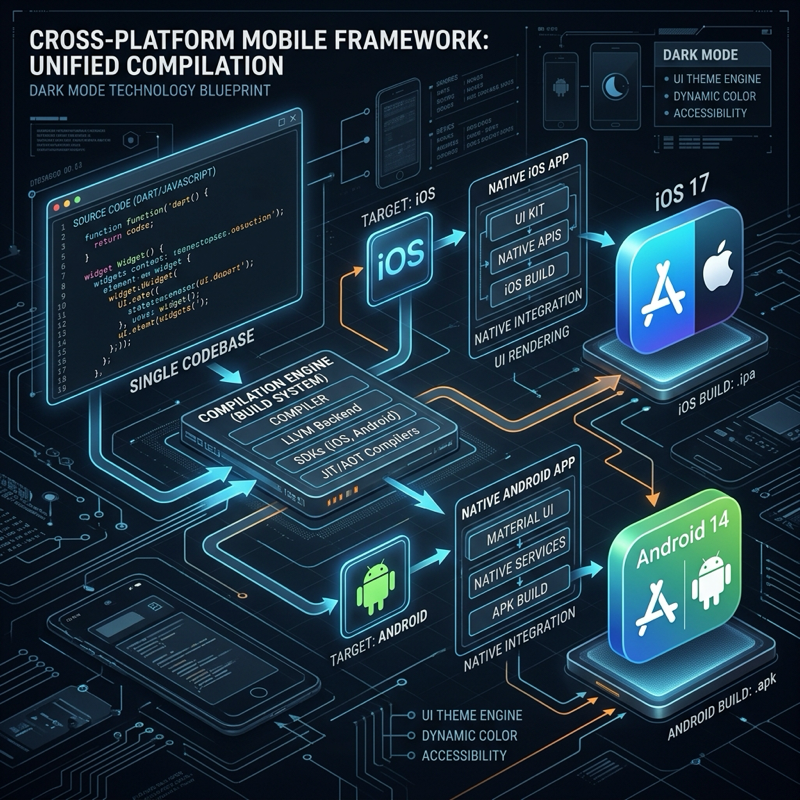
Frameworks such as React Native and Flutter enable development teams to write a single codebase that compiles into native binaries for multiple platforms. This drastically reduces time-to-market, ensures feature parity across devices, and simplifies the deployment of crucial security patches. However, leveraging cross-platform tools requires a deep understanding of underlying native APIs to ensure that performance-intensive tasks and hardware integrations function seamlessly.
A secure enterprise mobile deployment strategy requires a “defense-in-depth” approach, assuming that the device itself operates in a hostile environment. Applications must be engineered to protect data both at rest and in transit, following best practices outlined by organizations like the OWASP Mobile Security Project.

Key security protocols include:
Agile enterprise mobile deployment requires a specialized CI/CD pipeline tailored for mobile applications. Unlike web deployment, mobile updates must navigate platform-specific provisioning profiles, signing certificates, and app store review processes.
Automated mobile pipelines utilize tools like Fastlane to handle certificate management, automate the generation of screenshots, and orchestrate the deployment of beta builds to testing platforms (like TestFlight or Firebase App Distribution). This automation ensures that security patches and feature updates reach users rapidly and reliably, minimizing the window of exposure to known vulnerabilities.
Deployment is not the final step; it is the beginning of the operational lifecycle. Enterprises must implement continuous monitoring to detect anomalies, track application performance, and identify emerging threats in real-time.
Integrating mobile applications with centralized Security Information and Event Management (SIEM) systems allows IT teams to correlate mobile threat data with broader network intelligence. This proactive approach to threat detection ensures that the enterprise can respond rapidly to compromised devices, revoked certificates, or suspicious access patterns before they escalate into significant breaches, ensuring a safe and reliable enterprise mobile deployment.
You Can Get More Information!