eBPF vs iptables: Why Netfilter is a Bottleneck in 2026
eBPF replaces the traditional iptables networking stack in Kubernetes by...

Make email marketing simplified

Make email marketing simplified

Make email marketing simplified

Make email marketing simplified

Make email marketing simplified

Make email marketing simplified

Make email marketing simplified

Make email marketing simplified

Make email marketing simplified

Make email marketing simplified

Make email marketing simplified

Make email marketing simplified

Make email marketing simplified

Make email marketing simplified

Make email marketing simplified

We use cookies for our website to give you the most relevant experience by remembering your preferences. By clicking “accept”, you consent to use of ALL the cookies
This website uses cookies to improve your experience while you navigate through the website. Out of these, the cookies that are categorized as necessary are stored on your browser as they are essential for the working of basic functionalities of the website. We also use third-party cookies that help us analyze and understand how you use this website. These cookies will be stored in your browser only with your consent. You also have the option to opt-out of these cookies. But opting out of some of these cookies may affect your browsing experience.
Necessary cookies are absolutely essential for the website to function properly. These cookies ensure basic functionalities and security features of the website, anonymously.
| Cookie | Duration | Description |
|---|---|---|
| cookielawinfo-checkbox-functional | 11 months | This cookie is set by GDPR Cookie Consent plugin. The cookie is used to store the user consent for the cookies in the category “Analytics”. |
| cookielawinfo-checkbox-functional | 11 months | The cookie is set by GDPR cookie consent to record the user consent for the cookies in the category “Functional”. |
| cookielawinfo-checkbox-necessary | 11 months | This cookie is set by GDPR Cookie Consent plugin. The cookies is used to store the user consent for the cookies in the category “Necessary”. |
| cookielawinfo-checkbox-others | 11 months | This cookie is set by GDPR Cookie Consent plugin. The cookie is used to store the user consent for the cookies in the category “Other. |
| cookielawinfo-checkbox-performance | 11 months | This cookie is set by GDPR Cookie Consent plugin. The cookie is used to store the user consent for the cookies in the category “Performance”. |
| viewed_cookie_policy | 11 months | The cookie is set by the GDPR Cookie Consent plugin and is used to store whether or not user has consented to the use of cookies. It does not store any personal data. |
Functional cookies help to perform certain functionalities like sharing the content of the website on social media platforms, collect feedbacks, and other third-party features.
Performance cookies are used to understand and analyze the key performance indexes of the website which helps in delivering a better user experience for the visitors.
Analytical cookies are used to understand how visitors interact with the website. These cookies help provide information on metrics the number of visitors, bounce rate, traffic source, etc.
Advertisement cookies are used to provide visitors with relevant ads and marketing campaigns. These cookies track visitors across websites and collect information to provide customized ads.
Other uncategorized cookies are those that are being analyzed and have not been classified into a category as yet.
Cyberia Tech, Inc. respects your privacy. This Privacy Policy explains how we collect, use, and share your information. By using our services, you agree to this policy. If any other agreements conflict with this Privacy Policy, the terms of those agreements prevail.
Cyberia Tech complies with the EU-US and Swiss-US Privacy Shield Frameworks for handling personal data from the EEA, UK, and Switzerland. In case of any conflict, the Privacy Shield Principles prevail. Learn more at Privacy Shield. Key Definitions
Information linked to an individual, transferred from the EEA, UK, or Switzerland to the U.S.
Data revealing race, religion, health, sexual orientation, and similar categories.
Effective Date: [ 2026 / 10 / 20 ]
Welcome to The Cyberia Tech ! By accessing or using our website or services, you agree to
comply with and be bound by these Terms of Use and our Privacy Policy. If you do not agree with
these terms, please do not use our Services.
Loading
0 %
Your First Piece of the Puzzle in
Business Growth



The modern technology startup ecosystem is a high-stakes arena where rapid innovation collides with relentless market competition. Entering this startup ecosystem is an exciting, yet daunting endeavor. Startups must be agile, leveraging every resource available to outpace competitors. The failure rate is high, but with a calculated approach to growth, founders can transform their visionary ideas into reality. While a disruptive concept is the necessary spark, successfully scaling a startup from an initial idea to a market-leading enterprise demands rigorous execution. This journey requires founders to master product development lifecycles, strategically secure venture capital, and build technical architectures capable of supporting hypergrowth without buckling under pressure.
The journey begins with the Minimum Viable Product (MVP). In the startup ecosystem, an MVP is not a half-baked or low-quality release; rather, it is the most streamlined version of a product that can be deployed to validate core assumptions and capture early adopter feedback.

Developing a successful MVP requires strict discipline. Founders must ruthlessly prioritize features, focusing solely on the core value proposition. The objective is to achieve a continuous feedback loop: build, measure, learn. By deploying a functional prototype early, startups minimize the risk of spending months engineering features that the market ultimately rejects. The data gathered during this phase is critical for iterating the product and demonstrating early traction to potential investors.
Before aggressively scaling in the startup ecosystem, achieving product-market fit is paramount. This means your product effectively solves a significant problem for a specific target audience. Founders must conduct continuous user interviews, A/B testing, and market research. If the initial MVP doesn’t resonate, the team must be willing to pivot. A pivot isn’t a failure; it’s a necessary strategic shift based on real-world data. Understanding your target market’s pain points allows you to refine your offering until demand naturally accelerates. You can read more about this in our complete guide to finding product-market fit.
Once the MVP has demonstrated market validation, securing capital becomes the primary focus for scaling operations. The venture capital landscape is complex, requiring startups to align their funding strategies with their growth milestones.

Understanding the nuances between Seed, Series A, and subsequent funding rounds is essential. Seed funding typically finances the transition from MVP to a mature product, while Series A investors look for established business models and clear paths to significant revenue. Successful fundraising depends on presenting a compelling narrative backed by hard data: low customer acquisition costs (CAC), high lifetime value (LTV), and a scalable go-to-market strategy. Furthermore, selecting the right investors goes beyond capital; strategic investors provide crucial mentorship, industry connections, and operational expertise.
A brilliant product and ample funding will falter if the underlying technical infrastructure cannot support rapid expansion. Hypergrowth—where user bases and transaction volumes increase exponentially—stresses systems in unpredictable ways.
Startups must design their architecture with scalability as a foundational principle rather than an afterthought. This often involves transitioning from monolithic applications that served the MVP well, to microservices architectures that allow discrete components of the application to scale independently.
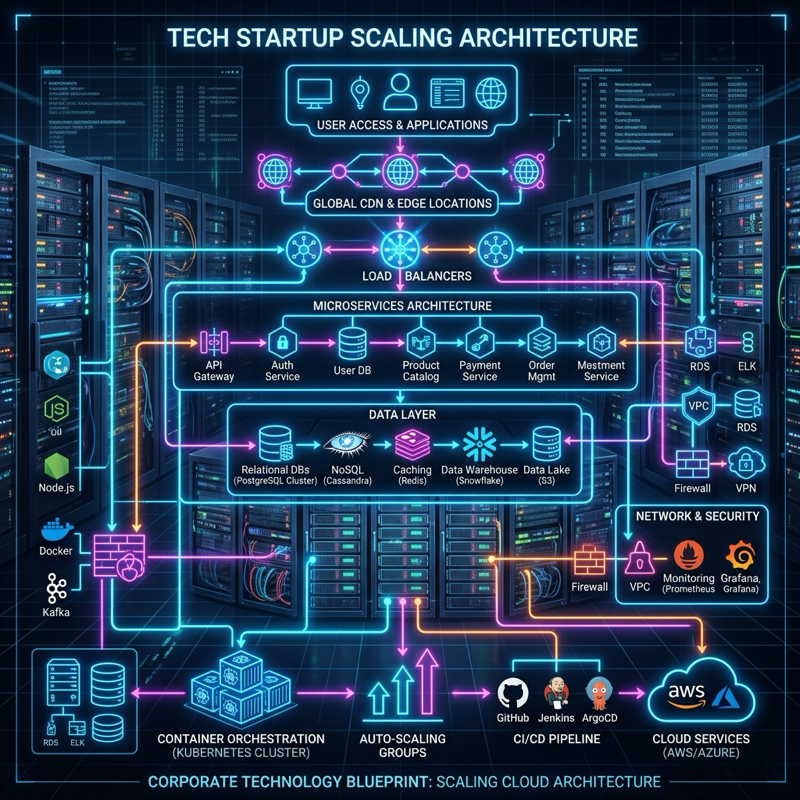
Leveraging cloud-native infrastructure is non-negotiable. Technologies such as containerization (Docker, Kubernetes) and serverless computing provide the elasticity required to handle sudden traffic spikes dynamically. Furthermore, implementing robust observability and monitoring tools from day one ensures that engineering teams can detect and resolve performance bottlenecks before they impact the user experience.
While technology and capital are critical, the ultimate differentiator in the startup ecosystem is human capital. As a startup scales, maintaining the agility and innovative spirit of the early days becomes increasingly difficult.
Founders must actively cultivate a culture that embraces calculated risk, encourages cross-functional collaboration, and normalizes learning from failure. Establishing clear engineering standards, adopting agile methodologies, and fostering open communication are vital steps in ensuring that the team remains cohesive and aligned with the company’s long-term vision as headcount expands.
Surviving the startup ecosystem is an exercise in balancing immediate tactical execution with long-term strategic vision. By focusing on rapid MVP iteration, securing strategic capital, and engineering scalable infrastructure, founders can navigate the transition from a fragile early-stage venture to a resilient, market-leading enterprise. Embracing these core principles, maintaining technical excellence, and prioritizing user feedback will significantly increase your chances of long-term success and sustainability in a highly competitive market.
You Can Get More Information!