Postgres Connection Pooling Architectures: PgBouncer, PgCat, and RDS Proxy Analyzed
Postgres connection pooling reduces database memory exhaustion by multiplexing thousands...

Make email marketing simplified

Make email marketing simplified

Make email marketing simplified

Make email marketing simplified

Make email marketing simplified

Make email marketing simplified

Make email marketing simplified

Make email marketing simplified

Make email marketing simplified

Make email marketing simplified

Make email marketing simplified

Make email marketing simplified

Make email marketing simplified

Make email marketing simplified

Make email marketing simplified

We use cookies for our website to give you the most relevant experience by remembering your preferences. By clicking “accept”, you consent to use of ALL the cookies
This website uses cookies to improve your experience while you navigate through the website. Out of these, the cookies that are categorized as necessary are stored on your browser as they are essential for the working of basic functionalities of the website. We also use third-party cookies that help us analyze and understand how you use this website. These cookies will be stored in your browser only with your consent. You also have the option to opt-out of these cookies. But opting out of some of these cookies may affect your browsing experience.
Necessary cookies are absolutely essential for the website to function properly. These cookies ensure basic functionalities and security features of the website, anonymously.
| Cookie | Duration | Description |
|---|---|---|
| cookielawinfo-checkbox-functional | 11 months | This cookie is set by GDPR Cookie Consent plugin. The cookie is used to store the user consent for the cookies in the category “Analytics”. |
| cookielawinfo-checkbox-functional | 11 months | The cookie is set by GDPR cookie consent to record the user consent for the cookies in the category “Functional”. |
| cookielawinfo-checkbox-necessary | 11 months | This cookie is set by GDPR Cookie Consent plugin. The cookies is used to store the user consent for the cookies in the category “Necessary”. |
| cookielawinfo-checkbox-others | 11 months | This cookie is set by GDPR Cookie Consent plugin. The cookie is used to store the user consent for the cookies in the category “Other. |
| cookielawinfo-checkbox-performance | 11 months | This cookie is set by GDPR Cookie Consent plugin. The cookie is used to store the user consent for the cookies in the category “Performance”. |
| viewed_cookie_policy | 11 months | The cookie is set by the GDPR Cookie Consent plugin and is used to store whether or not user has consented to the use of cookies. It does not store any personal data. |
Functional cookies help to perform certain functionalities like sharing the content of the website on social media platforms, collect feedbacks, and other third-party features.
Performance cookies are used to understand and analyze the key performance indexes of the website which helps in delivering a better user experience for the visitors.
Analytical cookies are used to understand how visitors interact with the website. These cookies help provide information on metrics the number of visitors, bounce rate, traffic source, etc.
Advertisement cookies are used to provide visitors with relevant ads and marketing campaigns. These cookies track visitors across websites and collect information to provide customized ads.
Other uncategorized cookies are those that are being analyzed and have not been classified into a category as yet.
Cyberia Tech, Inc. respects your privacy. This Privacy Policy explains how we collect, use, and share your information. By using our services, you agree to this policy. If any other agreements conflict with this Privacy Policy, the terms of those agreements prevail.
Cyberia Tech complies with the EU-US and Swiss-US Privacy Shield Frameworks for handling personal data from the EEA, UK, and Switzerland. In case of any conflict, the Privacy Shield Principles prevail. Learn more at Privacy Shield. Key Definitions
Information linked to an individual, transferred from the EEA, UK, or Switzerland to the U.S.
Data revealing race, religion, health, sexual orientation, and similar categories.
Effective Date: [ 2026 / 11 / 15 ]
Welcome to The Cyberia Tech ! By accessing or using our website or services, you agree to
comply with and be bound by these Terms of Use and our Privacy Policy. If you do not agree with
these terms, please do not use our Services.
Loading
0 %
Your First Piece of the Puzzle in
Business Growth



Postgres connection pooling reduces database memory exhaustion by multiplexing thousands of client requests onto a small pool of persistent database connections. For high-throughput web applications, PgBouncer remains the standard for single-core efficiency, PgCat offers multithreaded scaling for modern workloads, and RDS Proxy provides automated AWS failover at the cost of 2ms baseline latency.
Connecting a web application directly to a PostgreSQL database works until traffic spikes. Because PostgreSQL uses a process-per-connection architecture, each new connection requires the operating system to allocate a new process. In PostgreSQL 17, allocating 2,000 direct connections strips approximately 6 GB of RAM away from the database’s shared_buffers, throttling cache performance and forcing the system into swap. When application servers scale horizontally, they inadvertently execute a denial-of-service attack on their own database cluster.
PostgreSQL manages concurrency by forking a separate OS process for every connected client. This isolation prevents a fatal error in one session from crashing the entire database engine, but it carries a severe resource penalty. Each idle connection consumes between 2 MB and 3 MB of RAM purely for state management, before a single byte of work_mem is allocated for sorting or hashing.
In a typical microservices environment operating a modular monolith architecture, 50 application instances configured with a modest maximum pool size of 50 connections will attempt to establish 2,500 simultaneous connections to the primary database. The database server spends more CPU cycles context-switching between these processes than it does executing SQL statements. Connection pooling intercepts these requests, allowing 2,500 application-side connections to funnel through just 100 actual database-side connections.
Implementing a pooler requires choosing how state is managed across connections. Session pooling maps an application connection to a database connection for the lifetime of the client session. This approach supports session-level features like temporary tables and LISTEN/NOTIFY, but limits scalability because an idle application process holds a database process hostage.
Transaction pooling maps the connection only for the duration of a single SQL transaction. Once the COMMIT or ROLLBACK is issued, the database connection is immediately returned to the pool for another client to use. This achieves massive multiplexing, allowing 100 backend connections to serve tens of thousands of clients. The trade-off is the loss of session state. Prepared statements—previously incompatible with transaction pooling—now have experimental support in PgBouncer 1.22, provided the application framework and proxy are configured specifically to utilize `max_prepared_statements`.
PgBouncer has been the default PostgreSQL pooler for over a decade. It is written in C, utilizes the libevent library for asynchronous I/O, and operates strictly on a single thread. This architectural choice makes it incredibly lightweight, typically consuming less than 50 MB of RAM while managing thousands of client connections.
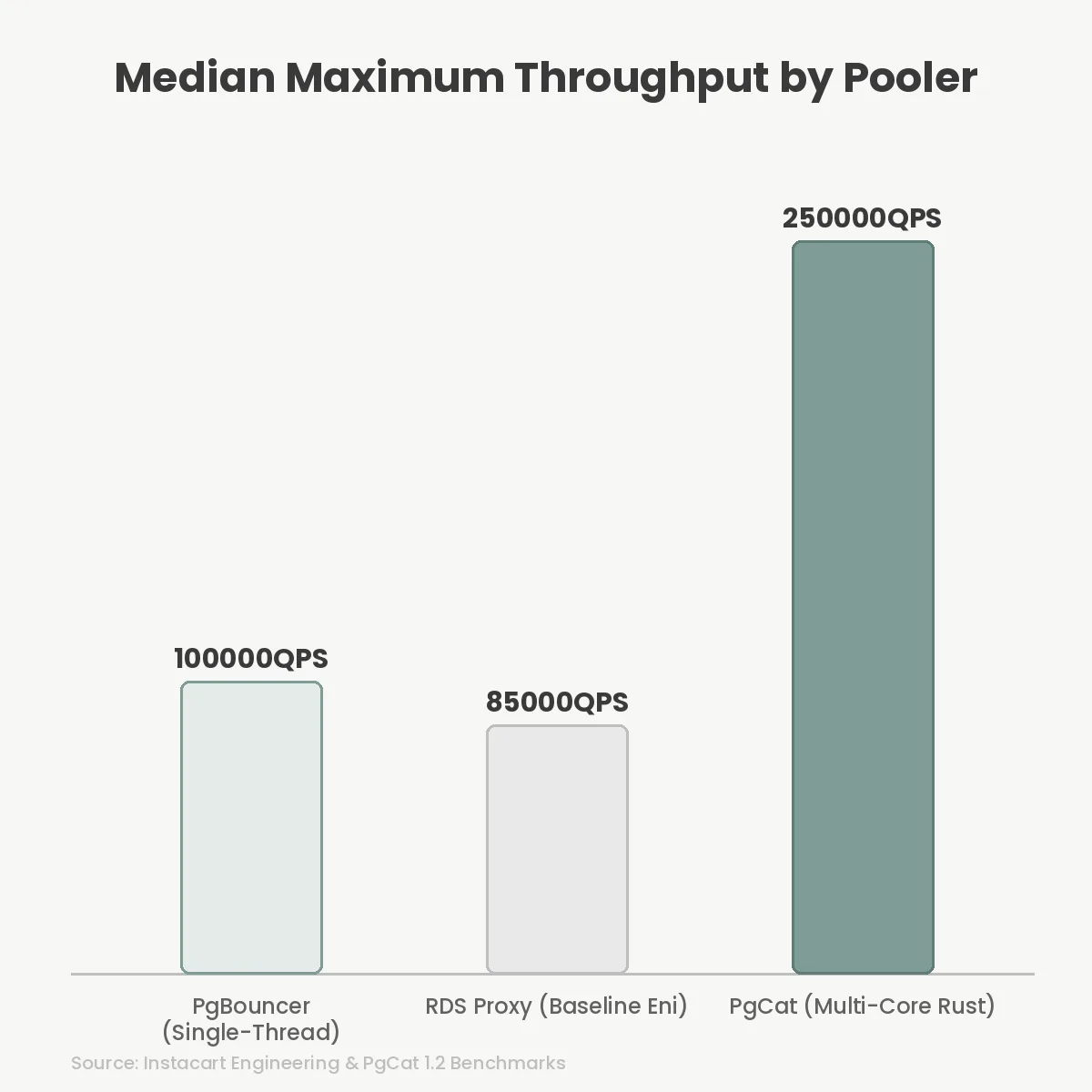
However, the single-threaded design creates a hard ceiling on throughput. According to official PgBouncer 1.22 documentation, a single PgBouncer instance maxes out around 100,000 queries per second (QPS) before it fully saturates one CPU core. If your application pushes beyond this limit, deploying a single PgBouncer instance introduces a bottleneck. Engineering teams bypass this by running multiple PgBouncer processes and balancing traffic across them via SO_REUSEPORT, or by running PgBouncer as a sidecar container on every application node rather than as a centralized gateway.
To address the single-core limitation of PgBouncer, engineering teams at Instacart developed PgCat, an open-source pooler written in Rust. PgCat 1.2 relies on the Tokio asynchronous runtime to distribute connection handling across multiple CPU cores. By utilizing multithreading, a single PgCat instance scales linearly with available hardware.
Benchmarks from the PgCat 1.2 release data demonstrate the pooler comfortably handling over 250,000 QPS on a multi-core virtual machine. Beyond raw throughput, PgCat natively supports advanced routing capabilities like reading from replicas and automatic sharding, features that previously required deploying custom application logic or heavier proxies like HAProxy. While still newer than PgBouncer, its memory safety guarantees and native multi-threading make it the preferred choice for massive-scale caching workloads offloaded from engines like Valkey.
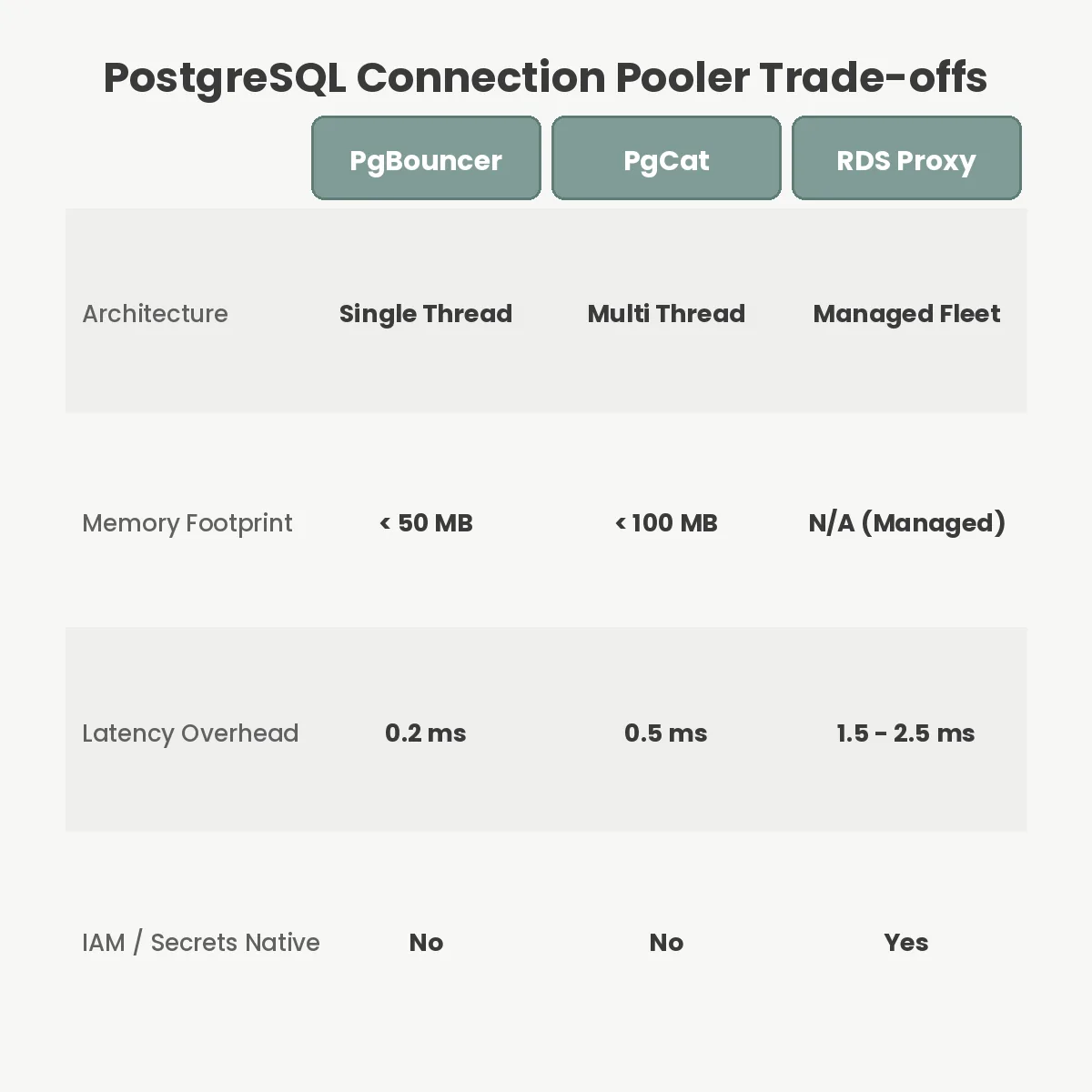
For organizations running managed databases on AWS, RDS Proxy offers a zero-maintenance alternative. RDS Proxy sits outside the database instance, multiplexing connections while providing deep integration with AWS Secrets Manager and IAM authentication. Its most significant advantage is failover speed; during an RDS Multi-AZ failover, RDS Proxy holds application connections open while the backend DNS propagates, preventing connection drops and application crashes.
The cost of this managed service is measured in latency and capital. Because RDS Proxy is deployed as a highly available fleet of Elastic Network Interfaces (ENIs) across your VPC endpoint infrastructure, it forces an additional network hop. Benchmarks indicate RDS Proxy adds an average latency penalty of 1.5 to 2.5 milliseconds per transaction compared to a local PgBouncer sidecar. For latency-sensitive workloads, such as real-time pgvector search queries, this overhead is unacceptable.
Deploying a connection pooler introduces new failure domains. The most common configuration mistake is misaligning the pooler’s default_pool_size with the PostgreSQL max_connections parameter. If PgBouncer allows 200 backend connections but PostgreSQL is configured for 100, the database will aggressively reject the proxy during peak load, causing cascading connection timeouts across the web application.
Another frequent failure mode is TCP port exhaustion. When application nodes rapidly open and close connections to the proxy, the operating system accumulates sockets in the TIME_WAIT state. If the rate of connection churn exceeds the kernel’s ability to recycle these sockets, the server runs out of ephemeral ports. Connection pooling requires persistent application-to-proxy connections just as much as proxy-to-database connections. Frameworks like Node.js and Django must be configured to keep their proxy connections alive to avoid this exhaustion.
Below is a comparative breakdown of architectural capabilities:
| Capability | PgBouncer 1.22 | PgCat 1.2 | AWS RDS Proxy |
|---|---|---|---|
| Architecture | Single-threaded C | Multithreaded Rust | Managed AWS Service |
| Max QPS (Single Instance) | ~100,000 | 250,000+ | Scales automatically |
| Latency Overhead | < 0.2 ms | < 0.5 ms | 1.5 – 2.5 ms |
| IAM Authentication | No | No | Native |
PostgreSQL utilizes a process-per-connection model for crash resilience. Forking a new operating system process for every client guarantees isolation but forces the system to allocate 2 to 3 MB of RAM per idle connection, exhausting memory under high client concurrency.
Yes, but with limitations. PgBouncer 1.22 introduced experimental support for prepared statements in transaction pooling mode. You must explicitly configure the max_prepared_statements parameter and ensure your application framework correctly tracks protocol-level statement IDs.
No. RDS Proxy introduces an additional network hop within AWS infrastructure, adding 1.5 to 2.5 milliseconds of latency per request. It trades raw query speed for managed high availability, automated failovers, and native IAM credential integration.
You should migrate to PgCat when your database throughput exceeds 100,000 queries per second, causing a single PgBouncer core to bottleneck. PgCat leverages multithreading to scale across multiple CPU cores, preventing single-thread CPU starvation on heavy workloads.
Selecting a connection pooler determines your application’s ceiling. If your infrastructure processes fewer than 50,000 queries per second and runs on standard virtual machines, PgBouncer deployed as a sidecar remains the most efficient choice. Its microscopic memory footprint is unmatched.
For hyperscale workloads where single-threaded bottlenecks appear, PgCat provides a necessary modernization path. Its multithreaded architecture scales horizontally across cores, preventing proxy starvation. Conversely, teams prioritizing operational simplicity on AWS over sub-millisecond query latency should adopt RDS Proxy. The decision rule is strict: evaluate your tolerance for latency and operational overhead. If you cannot afford a 2-millisecond penalty on every SQL transaction, you must self-host your proxy layer.
You Can Get More Information!