Startup FinOps Strategy: How to Tame Cloud Sprawl Before Series B
A startup FinOps strategy is a cross-functional financial management practice...

Make email marketing simplified

Make email marketing simplified

Make email marketing simplified

Make email marketing simplified

Make email marketing simplified

Make email marketing simplified

Make email marketing simplified

Make email marketing simplified

Make email marketing simplified

Make email marketing simplified

Make email marketing simplified

Make email marketing simplified

Make email marketing simplified

Make email marketing simplified

Make email marketing simplified

We use cookies for our website to give you the most relevant experience by remembering your preferences. By clicking “accept”, you consent to use of ALL the cookies
This website uses cookies to improve your experience while you navigate through the website. Out of these, the cookies that are categorized as necessary are stored on your browser as they are essential for the working of basic functionalities of the website. We also use third-party cookies that help us analyze and understand how you use this website. These cookies will be stored in your browser only with your consent. You also have the option to opt-out of these cookies. But opting out of some of these cookies may affect your browsing experience.
Necessary cookies are absolutely essential for the website to function properly. These cookies ensure basic functionalities and security features of the website, anonymously.
| Cookie | Duration | Description |
|---|---|---|
| cookielawinfo-checkbox-functional | 11 months | This cookie is set by GDPR Cookie Consent plugin. The cookie is used to store the user consent for the cookies in the category “Analytics”. |
| cookielawinfo-checkbox-functional | 11 months | The cookie is set by GDPR cookie consent to record the user consent for the cookies in the category “Functional”. |
| cookielawinfo-checkbox-necessary | 11 months | This cookie is set by GDPR Cookie Consent plugin. The cookies is used to store the user consent for the cookies in the category “Necessary”. |
| cookielawinfo-checkbox-others | 11 months | This cookie is set by GDPR Cookie Consent plugin. The cookie is used to store the user consent for the cookies in the category “Other. |
| cookielawinfo-checkbox-performance | 11 months | This cookie is set by GDPR Cookie Consent plugin. The cookie is used to store the user consent for the cookies in the category “Performance”. |
| viewed_cookie_policy | 11 months | The cookie is set by the GDPR Cookie Consent plugin and is used to store whether or not user has consented to the use of cookies. It does not store any personal data. |
Functional cookies help to perform certain functionalities like sharing the content of the website on social media platforms, collect feedbacks, and other third-party features.
Performance cookies are used to understand and analyze the key performance indexes of the website which helps in delivering a better user experience for the visitors.
Analytical cookies are used to understand how visitors interact with the website. These cookies help provide information on metrics the number of visitors, bounce rate, traffic source, etc.
Advertisement cookies are used to provide visitors with relevant ads and marketing campaigns. These cookies track visitors across websites and collect information to provide customized ads.
Other uncategorized cookies are those that are being analyzed and have not been classified into a category as yet.
Cyberia Tech, Inc. respects your privacy. This Privacy Policy explains how we collect, use, and share your information. By using our services, you agree to this policy. If any other agreements conflict with this Privacy Policy, the terms of those agreements prevail.
Cyberia Tech complies with the EU-US and Swiss-US Privacy Shield Frameworks for handling personal data from the EEA, UK, and Switzerland. In case of any conflict, the Privacy Shield Principles prevail. Learn more at Privacy Shield. Key Definitions
Information linked to an individual, transferred from the EEA, UK, or Switzerland to the U.S.
Data revealing race, religion, health, sexual orientation, and similar categories.
Effective Date: [ 2026 / 10 / 28 ]
Welcome to The Cyberia Tech ! By accessing or using our website or services, you agree to
comply with and be bound by these Terms of Use and our Privacy Policy. If you do not agree with
these terms, please do not use our Services.
Loading
0 %
Your First Piece of the Puzzle in
Business Growth



A startup FinOps strategy is a cross-functional financial management practice that aligns engineering, finance, and product teams to maximize the business value of cloud infrastructure. By replacing unpredictable cloud sprawl with unit-based cost tracking, startups can accurately project infrastructure margins, negotiate enterprise volume discounts, and extend their operational runway without sacrificing technical feature velocity.
Cloud infrastructure functions as a utility, but billing behaves like an unrestricted corporate card handed to every engineer. When a software business scales its user base, compute costs naturally rise. However, the Flexera 2025 State of the Cloud Report reveals that organizations consistently waste 27% of their cloud spend on idle resources and over-provisioned infrastructure. For a Series A startup burning $150,000 monthly on Amazon Web Services (AWS) or Google Cloud Platform (GCP), that waste directly consumes venture capital. The stakes are binary: either establish cost governance early, or watch gross margins erode until future fundraising becomes mathematically unviable.
Infrastructure debt accumulates differently than code debt. It materializes silently through orphaned Elastic Block Store (EBS) volumes, forgotten development environments, and over-provisioned databases. Engineers typically provision resources based on peak load estimates rather than average utilization, prioritizing uptime over capital efficiency. Because cloud providers abstract away hardware constraints, the physical feedback loop of purchasing servers no longer exists to check excessive scaling.
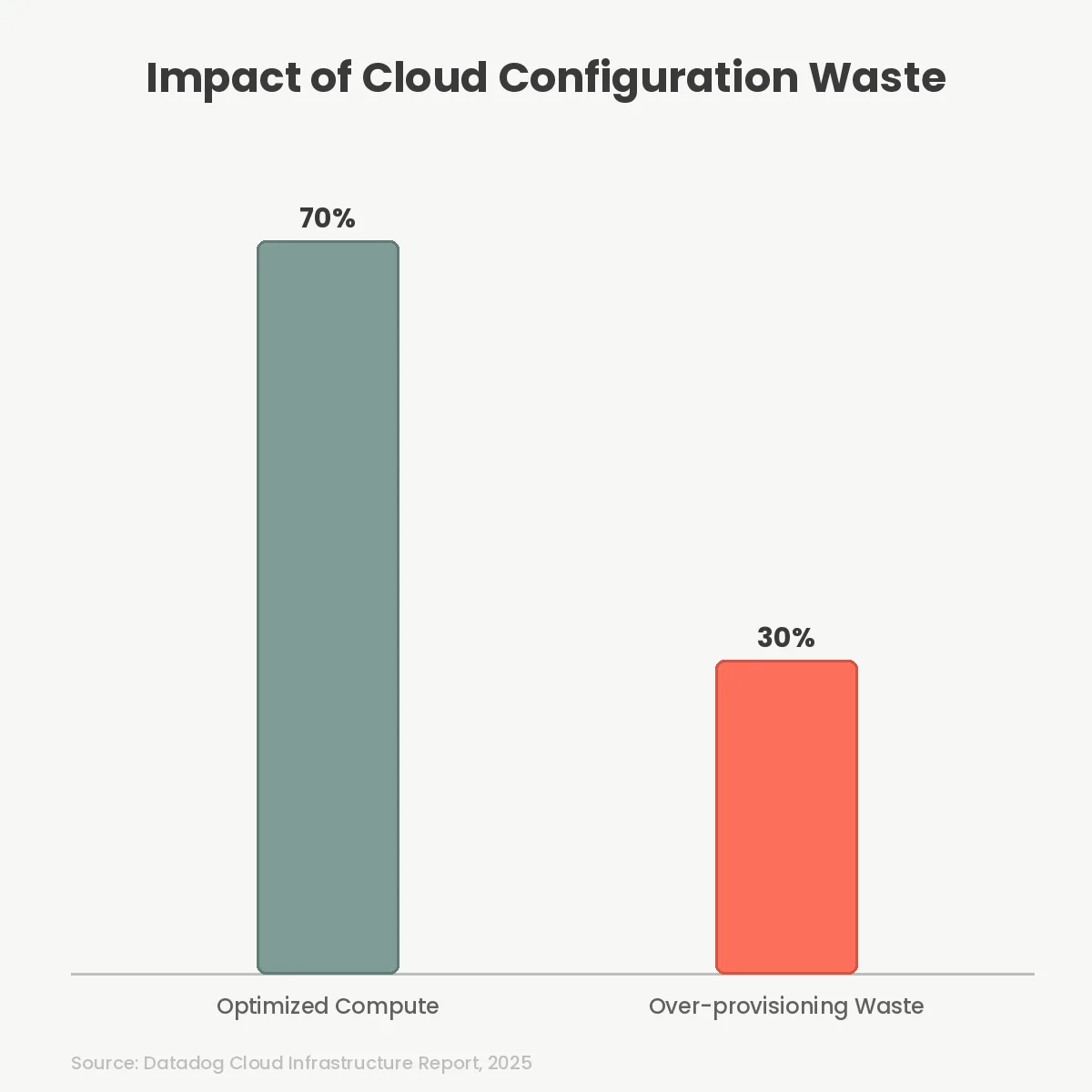
The transition to microservices exacerbates this cost blindness. Datadog’s 2025 Cloud Infrastructure report notes that while median serverless function execution times have dropped to 80ms, poor architectural configurations routinely lead to 30% over-provisioning in serverless environments. Every unoptimized database query and oversized container adds a micro-fraction of a cent to the infrastructure bill, which aggregates into massive monthly liabilities as transaction volume grows.
Establishing control requires shifting organizational perspective. Startups must stop viewing the cloud invoice as a fixed operational tax and start treating it as an engineering variable. Just as development teams optimize for latency or availability, they must optimize for unit cost. The goal is not merely reducing the total bill, but maximizing the feature output and user capacity delivered per dollar spent.
The FinOps Foundation outlines a prescriptive, iterative lifecycle for managing cloud consumption: Inform, Optimize, and Operate. Startups rarely implement this linearly; instead, they cycle through these phases as their architecture matures and traffic patterns shift.
The ‘Inform’ phase focuses entirely on visibility. Finance teams cannot optimize what they cannot see. Engineering must implement strict resource tagging policies, categorizing infrastructure by product feature, environment, or customer tier. Without granular tagging, a sudden $10,000 spike in compute spend is impossible to diagnose, forcing teams to guess whether the cost stems from organic user growth or a runaway background job.
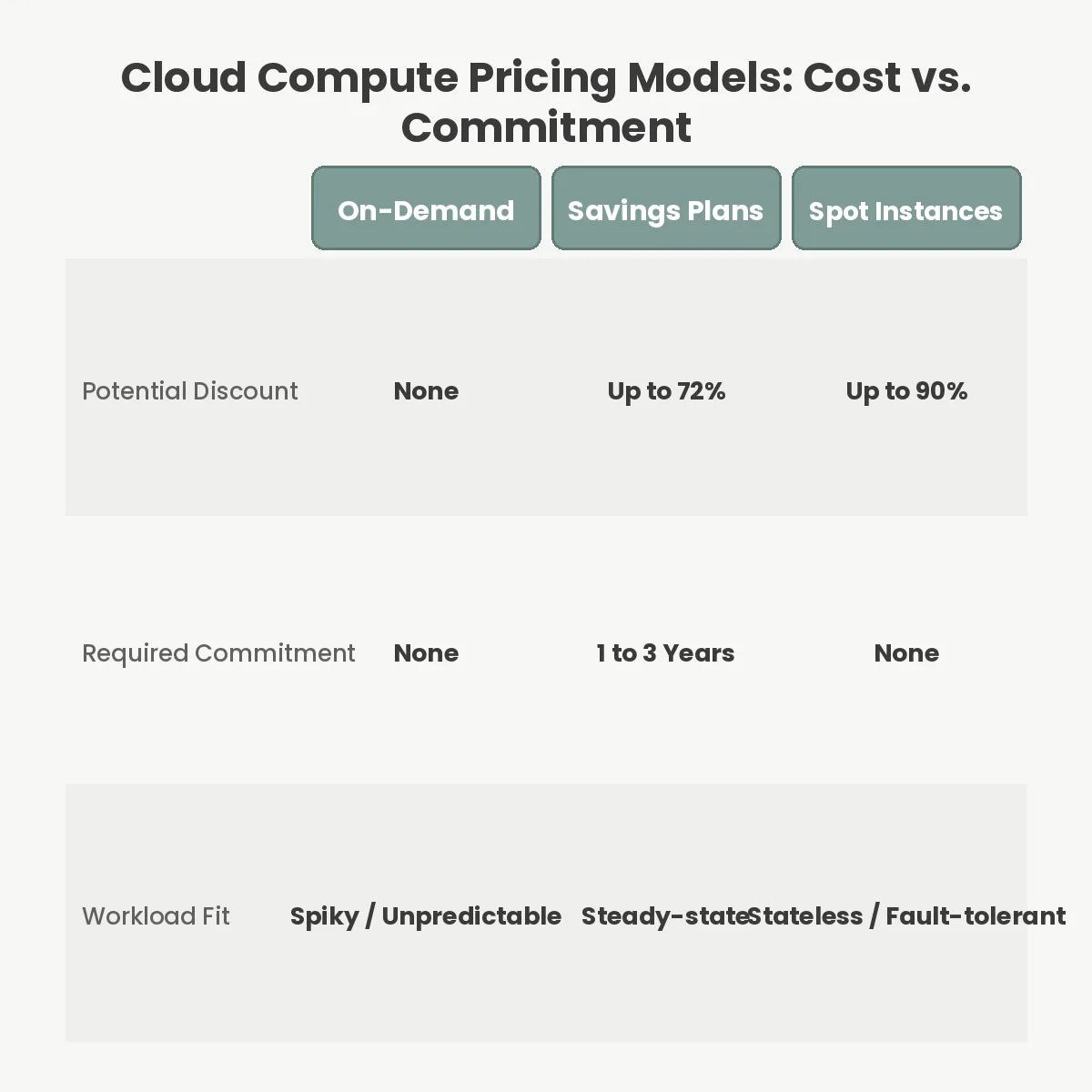
During the ‘Optimize’ phase, organizations align their resource consumption with pricing reality. This involves right-sizing underutilized instances and transitioning steady-state workloads away from expensive On-Demand pricing to committed use models. Finally, the ‘Operate’ phase automates these optimizations, integrating cost checks directly into continuous integration and deployment (CI/CD) pipelines to prevent expensive configurations from ever reaching production.
Aggregate monthly billing is a useless metric for strategic planning. If a startup’s AWS bill increases by 40% quarter-over-quarter, executives cannot determine if the business is thriving or bleeding capital without context. FinOps solves this by establishing unit economics: the exact infrastructure cost required to serve a single customer, process one transaction, or support one active session.
Calculating unit cost bridges the gap between engineering reality and commercial viability. If an application charges users $50 monthly but requires $60 in compute resources to process their specific data volume, the business model is inherently flawed. Understanding these margins is critical before attempting scaling their infrastructure or entering new enterprise markets.
| Metric Type | Example Measurement | Business Value | Actionable Outcome |
|---|---|---|---|
| Aggregate Cost | $120,000 total AWS monthly spend | Low (Accounting only) | Pay the invoice |
| Service Cost | $45,000 spent on RDS databases | Medium (Resource targeting) | Investigate query efficiency |
| Unit Economics | $0.14 compute cost per active user | High (Strategic planning) | Forecast margins for next funding round |
Tracking unit economics also simplifies pricing strategy. When product managers understand the precise floor price of delivering a feature, they can construct subscription tiers that guarantee profitability. This financial clarity is a distinct advantage when bootstrapping SaaS startups, where cash flow management dictates survival.
While cost discipline is necessary, misapplied FinOps actively damages startup growth. The most valuable asset an early-stage company possesses is engineering velocity. Forcing developers to spend a week optimizing a database cluster to save $300 a month destroys value, as the engineering hours spent far exceed the realized cloud savings. Optimization must always be weighed against the opportunity cost of building new product features.
Strict FinOps implementations often introduce bureaucratic friction. Mandating approval workflows for spinning up testing environments slows down deployment cycles and frustrates engineering talent. The objective is establishing guardrails, not roadblocks. High-performing organizations use automated budget alerts rather than pre-approval processes, allowing developers to move quickly while maintaining financial accountability.
Furthermore, committing to long-term discount programs too early restricts architectural flexibility. Startups frequently pivot their technology stack during their first two years. Locking into a three-year compute contract based on a legacy architecture creates sunk costs that discourage necessary technical evolution. Financial flexibility often outweighs minor discount percentages in early-stage environments.
The most frequent failure mode in startup cloud management is treating FinOps exclusively as a finance function. When accountants attempt to cut infrastructure budgets without understanding the technical architecture, they mandate impossible reductions. Conversely, when engineers operate without financial visibility, they build brilliant systems that bankrupt the company. According to Gartner, by 2026, 80% of enterprises will establish a dedicated FinOps practice specifically to bridge this gap, as the FinOps Foundation certified practitioner count grew 45% year-over-year in 2025.
Another critical mistake is misapplying compute pricing models. AWS Spot Instances offer up to 90% discounts by utilizing excess cloud capacity, but AWS can terminate them with a two-minute warning. Startups frequently attempt to run stateful applications or primary databases on Spot Instances to save money, resulting in catastrophic data loss and downtime. Spot capacity is strictly for stateless, fault-tolerant workloads like batch processing or containerized background workers.
Finally, teams often attempt massive architectural refactors—such as cloud repatriation or full serverless migrations—under the guise of cost savings, without modeling the transition costs. Migration efforts consume months of engineering time and require running parallel infrastructure during the cutover, temporarily doubling the cloud bill. Minor rightsizing and commitment discounts almost always yield a higher immediate return on investment than wholesale architectural rewrites.
Sustainable cloud cost management relies on cultural alignment rather than tooling alone. Engineering teams must adopt cost as a first-class operational metric, tracked on the same dashboards as error rates and response times. When developers can instantly see the financial impact of their code deployments, they naturally architect more efficient solutions.
This visibility requires democratizing cloud billing data. Instead of keeping the AWS invoice hidden in the finance department, startups should distribute cost anomaly reports directly to the Slack channels of the engineers responsible for those services. Accountability requires transparency. When teams are measured against unit cost targets, they prioritize infrastructure efficiency alongside feature delivery.
Ultimately, FinOps is an ongoing operational practice, not a one-time auditing project. As user behavior shifts and cloud providers release new instance types, the optimal infrastructure configuration will constantly change. By embedding cost awareness into the daily engineering workflow, startups ensure that revenue growth consistently outpaces infrastructure expenditure.
FinOps is a collaborative framework combining engineering, finance, and business teams to manage cloud costs efficiently. For startups, it focuses on replacing unpredictable billing variables with measurable unit economics to ensure infrastructure scales profitably alongside user growth.
AWS Savings Plans provide up to a 72% discount compared to On-Demand pricing in exchange for a one- or three-year compute commitment. They offer flexibility across instance families and regions, making them ideal for covering a startup’s baseline infrastructure usage.
Total monthly spend obscures business health. If an infrastructure bill rises, it could mean catastrophic resource leaks or simply rapid user acquisition. Unit economics track the exact compute cost per user, proving whether the company’s underlying business model remains profitable as it scales.
Premature optimization occurs when engineers spend days chasing negligible server savings at the expense of shipping core product features. In early stages, technical velocity and achieving product-market fit take priority over minor infrastructure discounts, provided major architectural flaws are avoided.
Implementing a rigorous FinOps practice transitions cloud infrastructure from an opaque financial liability into a highly controlled business lever. Startups that master their unit economics gain a definitive structural advantage over their competitors. They can price subscriptions more aggressively, endure longer fundraising droughts, and prove their fundamental operational competence to late-stage investors. Before executing complex architectural overhauls, establish strict visibility, right-size your existing footprint, and embed cost awareness natively into the engineering culture.
You Can Get More Information!